 The Standard Group Plc is a multi-media organization with investments in media
platforms spanning newspaper print
operations, television, radio broadcasting, digital and online services. The
Standard Group is recognized as a
leading multi-media house in Kenya with a key influence in matters of national and
international interest.
The Standard Group Plc is a multi-media organization with investments in media
platforms spanning newspaper print
operations, television, radio broadcasting, digital and online services. The
Standard Group is recognized as a
leading multi-media house in Kenya with a key influence in matters of national and
international interest.

Before water levels started rising, Longicharo island enjoyed the serenity of a mythical animal kingdom, towering above the vast mass of water in Lake Baringo. Longicharo’s magnificence has almost been magical - popping out in unsullied splendour at the backdrop of the endless lake. Within it, towering giraffes ruled, hundreds of birds lulled it to sleep and Longicharo always woke up to the grunts from hungry warthogs ravaging for the day’s meal.
Initially, the island was part of the 44,000-hectare Ruko Community Conservancy in Baringo before rising water levels cut it off from the mainland.
The giraffes, who were moved to the conservancy in 2011, coexisted alongside impalas, a few ostriches and pythons. Several species of birds also enjoyed the serenity of ‘Zootopia’.
Over the years, Longicharo stood out from the other six islands strapped within Lake Baringo. While it remained an entirely animal kingdom, the neighbouring Devil’s Island remained uninhabited because of its inaccessibility even by boat.
Ol-Kokwe remains the largest of the islands, hosting almost 1,000 residents while Samatian and Island Camp hosts exclusive hotels and lodges. Lekorosi and Lempakany have been shrinking as a result of increasing water levels. Longcharo’s serenity was however cut short - it shrunk by day and pythons posed a threat to giraffe calves as they got strangled.
However as time went by, a crisis was brewing on Longicharo, the animals were running out of food. And the island was also shrinking and splitting further, living trapped animals with no room to move. The solution, move the animals from the island. A delicate effort that took months of planning and even more months of implementation.
“As rising water levels cut off their peninsula home from the mainland, Ruko rangers had to supplement the giraffe’s food as natural browse became scarce. Not only was this financially unsustainable for Ruko, there were also fears that nutritional deficiencies were affecting the breeding potential and overall health of the animals,” said Aloise Naitira, Baringo County Conservancies Director for the Northern Rangelands Trust (NRT), which Ruko Conservancy falls in.

Shrinking island
Initially, the island was estimated to be 188 acres but by 2020 the rising water levels according to the Kenya Wildlife Service (KWS), had eaten up almost 90 per cent of the entire island. It also split it further into two. This further limited the area available to trapped warthogs, impalas and ostriches as well as one of the giraffes to barely an acre and a half.
One of the eight giraffes was also trapped in the lower part while the other seven were trapped on the raised part.
“The situation necessitated a translocation because the animals were scrambled in one area. The competition for food was high and the water levels are still rising,” KWS Central Rift Assistant Director Dickson Ritan said during the first translocation.
Rothschild giraffes, are also known as Baringo giraffes. They are only found in Kenya and Uganda and although they originally roamed in Baringo, they became locally extinct, a move that necessitated their translocation from Soysambu Conservancy in 2011 to Ruko Conservancy.
The aim, according to KWS, was to reintroduce them to their endemic range. Then this new hiccup.
Before the giraffes were translocated to the main land in Ruko, 1,770 hectares of the Community Conservancy was set aside for the new giraffe sanctuary.
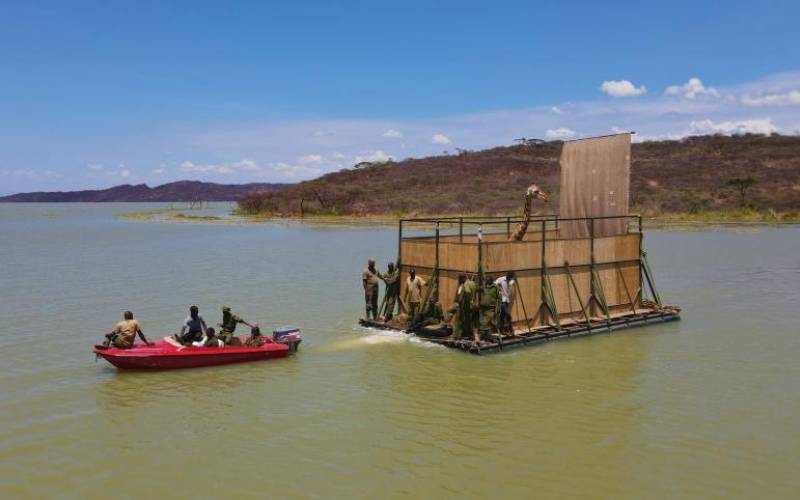
Then came the slow walk to freedom. To move the animals over the lake, special badges (a long flat-bottomed boat) had to be made and the giraffes carefully made accustomed to them. Who wants a buckling five-meter tall animal mid-crossing?
In 2019, the custom-made barge was placed on the shores of Longicharo where the giraffes were being fed their supplements. This was to get accustomed to the barge before the final journey across the lake.
And despite the news coverage focusing on giraffes, other animals were in the plan as well. Smaller animals, however, had the option of speed boats with rangers keeping them calm, often by holding them down. Giraffes, on the other hand, was where the real test was.
“The plans to translocate them were in place initially but Covid-19 put that to a halt. The rising water levels and lack of grass on the remaining area made it an emergency to translocate the animals. We had to first start with the smaller animals then giraffes later,” Ritan said.
Finally, on September 2020, the first batch of animals were rescued. An ostrich elegantly walked into the badge following a ranger luring it with a twig. The grand disembarking of the ostrich onto the mainland after an almost two-hour journey across the mass of water was a sign of hope for an operation years in the making.
Interestingly, tranquilisers were not used to sedate warthogs, ostriches, impalas and the giraffes - hide, seek games, panting chases, wrestling matches pitting rangers against warthogs and traps came into play.
Intricate operation
For a successful expedition across the vast lake with an animal on board, the team ensured that the lake was clear of waves to avoid shock and the badge closed from all sides to prevent the animal from taking to flight.
To trap impalas and warthogs within the shrinking island, the area was partitioned in sections with traps similar to volleyball nets.
The drill, was to have an impala or a warthog run and get trapped by the net as they scramble for safety.
The drill entailed making loud noises so that scared animals darts out, gets trapped and the rangers then jump over and bundle the animal up.
Blood samples for purposes of disease surveillance are then taken and animals ferried on a speed boat, a journey that takes less than 15 minutes across.
On board, were rangers holding on to the animals bundled up in sacks to avoid movements until they were released on the other side.
In December, Asiwa, made a historic entry as the first giraffe to cross over to the mainland using a barge, setting the tone for the rest of the movement.
An excited giraffe would make its way in to the barge to get the supplements, upon which the barge was closed all around, signalling the journey to kick off. A speed board tied to the barge pulled it across to the final destination on the shores of Ruko Conservancy. The team stayed with the animals close by, monitoring. Hoping for the best.
“Ruko rangers worked hard to get each animal accustomed to the barge beforehand, leaving their favourite treats (mangos) on board every day to get them used to the idea of getting on and off the vessel voluntarily,” NRT said.
By the time Asiwa was making the grand entry on to Ruko Conservancy, Nkarikoni, one of the females still on the island gave birth to a calf who rangers named Noelle.
Four months later, Nkarikoni and Noella became two of the final animals to be rescued, due to the sensitive nature of moving such a young giraffe. Nasieku and Susan had been ferried a day earlier before the last two.
“The giraffes in the mainland sanctuary are thriving, with rangers reporting that they have never seen their giraffes look so healthy and happy. There is no need for food supplementation, which is set to save the conservancy a lot of money and ensure healthier animals,” NRT said.
KWS Senior Veterinary Officer Dr Isaac Lekolool said KWS was keen to grow the Rothschild giraffe population and that the rescue effort was commendable.
Except for the pythons that can swim across, all other animals that roamed Longicharo were moved.





