 The Standard Group Plc is a multi-media organization with investments in media
platforms spanning newspaper print
operations, television, radio broadcasting, digital and online services. The
Standard Group is recognized as a
leading multi-media house in Kenya with a key influence in matters of national and
international interest.
The Standard Group Plc is a multi-media organization with investments in media
platforms spanning newspaper print
operations, television, radio broadcasting, digital and online services. The
Standard Group is recognized as a
leading multi-media house in Kenya with a key influence in matters of national and
international interest.

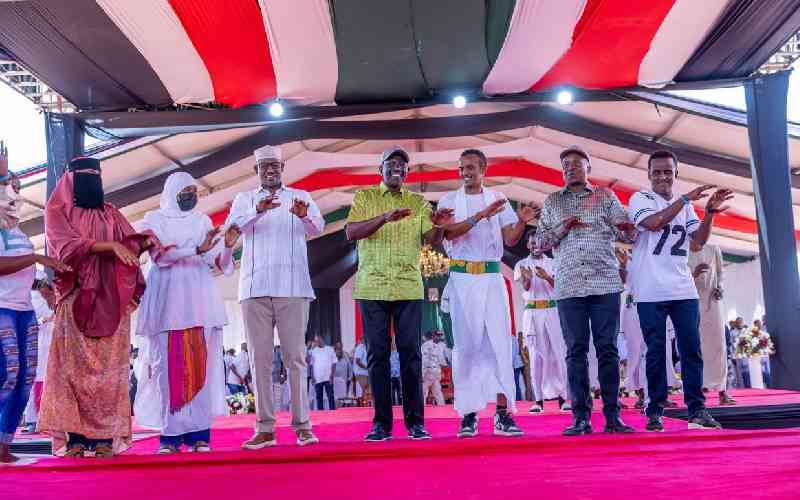
There is a grumble that is simmering among Kenyans, and like a worried individual entering a dark alley, we are suddenly looking over our shoulders and anxious of the path ahead. The ongoing debate on the rising Kenyan debt has got Kenyans talking over the Sh12 trillion debt burden and the tough choices ahead. What triggered the latest gripe for the cavil is the pomposity of The National Youth Opportunities Towards Advancement (Nyota) project launched by President William Ruto at Mumias Sports Complex in Kakamega last year.
On paper, the World Bank-funded Nyota programme is pitched as a bold five-year intervention targeting 820,000 vulnerable youth through skills training, job placements and business grants starting at Sh50,000. Marketed as a response to persistent youth unemployment, it promises enterprise over despair.
However, the programme has quickly become entangled in a wider debate about debt, transparency and who ultimately pays for development. Public perception remains sceptical. An Infotrak survey found that 64 per cent of respondents had neither participated in Nyota nor knew anyone who had, while 11 per cent applied and were rejected; amounting to a 75 per cent exclusion rate.
Recently, a Catholic priest accused President Ruto of using the Nyota start-up capital programme to deceive Kenyan youth for political gain. Speaking during Sunday mass at St. Teresa Catholic Church, Father Joseph declared that the Nyota fund is not a government grant but a World Bank loan that citizens will ultimately repay.
“Hiyo NYOTA Fund mnapewa ni sisi tutalipa kwa sababu ni mkopo kutoka kwa World Bank,” he told congregants, warning that the initiative is being misrepresented as free support.
The sermon ignited a digital firestorm. Answering him on X, Dennis Itumbi, who works as head of Presidential Special Projects and Creative Economy, issued a pointed rebuttal, which, more or else, confirmed the cleric’s assertion.
“A Catholic priest standing at the pulpit should speak the truth and nothing but the truth. Criticise the government all you want, Father, but please get your facts right. Yes, it is a World Bank facility. However, for Kenyan youth, it is structured as a grant, not a loan. That “fictional youth” you referred to is, in fact, correct: no young person will be required to repay a single cent. There was a training before the funds and they were taught that the businesses they open will eventually be a source of taxes. For your information, Father, those businesses will also be part of the Loan repayment,” Itumbi shared.
The online exchange encapsulates the central paradox: the grants are non-refundable to beneficiaries, yet the nation collectively shoulders the repayment obligation.
The broader debt landscape
Nyota is unfolding against the backdrop of Kenya’s ballooning external debt, which continues to fuel debates over sustainability and fiscal management. Estimates show the country owes Sh1.9 trillion to the World Bank’s International Development Association (IDA), Sh1.3 trillion to commercial banks, Sh654 billion to China, Sh551 billion to the African Development Bank, Sh480 billion to the IMF, Sh169 billion to Japan, Sh101 billion to France, and Sh255 billion to other lenders.
According to the National Treasury’s Annual Public Debt Report for the fiscal year ending June 2025, the largest external creditor was indeed the IDA, accounting for 30.3 per cent of total external debt, while International Sovereign Bond (ISB) holders; including private investors and Eurobond holders, were the second largest at 18.6 per cent. China was the largest bilateral creditor at 11.9 per cent, with the African Development Bank (ADB) and the International Monetary Fund (IMF) accounting for about 10 per cent and 8.7 per cent respectively. The remaining debt is owed to the World Bank’s International Bank for Reconstruction and Development (IBRD) arm, Japan, France, and other bilateral and commercial creditors.
Critics warn that this dependence could crowd out domestic investment, while supporters argue that strategic borrowing is necessary to fund infrastructure and economic growth. The debate continues over whether Kenya’s debt trajectory is a calculated investment or a looming fiscal disaster.
Yet Kenya’s debt story is not just about trillions borrowed! It is also about the institutions meant to guard how that borrowing happens, where the money goes, and whether the country can afford it.

On paper, Kenya has one of the region’s most robust debt oversight frameworks, anchored in the Constitution, Parliament, the National Treasury, the Central Bank and independent watchdogs. However, recent audits and fiscal trends point to gaps that critics say are allowing borrowing to outpace the safeguards meant to control it.
The National Treasury sits at the centre of the process, negotiating loans and justifying borrowing within limits approved by Parliament under the Public Finance Management Act. While Parliament is legally mandated to oversee public debt, enforcement is weak, giving the Executive wide latitude. Analysts note that loopholes allow borrowing to proceed faster than oversight, with lawmakers often reviewing loans after contracts are signed, undermining effective scrutiny.
The Central Bank of Kenya (CBK) acts as the government’s fiscal agent, managing public debt instruments and influencing interest rate conditions. In 2025, the benchmark Central Bank Rate hovered around 9.75 per cent, but commercial lending spreads pushed effective borrowing costs significantly higher. While CBK manages the mechanics, it cannot stop the Treasury from borrowing heavily in a high-interest environment.
Meanwhile, oversight bodies; the Controller of Budget, the Auditor General, and the Kenya Revenue Authority, operate largely in a post-facto capacity. They authorise withdrawals, audit spending legality, and collect revenue, respectively. Their reports have repeatedly flagged irregularities, yet enforcement delays often blunt the corrective impact.
Recent audit findings paint a sobering picture. The Auditor General reported Sh6.6 billion paid in commitment fees on foreign loans that remained unused between 2019 and 2024, including Sh59 billion sitting idle in the 2023/24 fiscal year. Other findings highlighted Sh43 billion in unapproved borrowing linked to State corporations and cases where grants were diverted from intended infrastructure uses to recurrent expenses.
Legal framework
Legal analyst Kenneth Essendi says these patterns reveal a deeper disconnect between constitutional safeguards and day-to-day borrowing practice.
“Kenya’s legal framework is clear that borrowing must be transparent, purpose-driven and sustainable,” Essendi explains. “But when oversight happens after commitments are made, instead of before, it weakens Parliament’s ability to prevent risky or misaligned borrowing. The issue is not the absence of law, but enforcement and procedural clarity.”
Essendi argues that gaps in ratification processes allow Executive borrowing decisions to outpace legislative scrutiny, creating room for diversion or inefficiencies.
“If loans and grants are not tightly tied to their approved purposes, you risk turning development financing into a revolving debt cycle,” he adds. “That ultimately shifts the burden to taxpayers, because debt servicing crowds out essential public spending.”
The fiscal consequences are becoming harder to ignore. Domestic debt servicing alone reached about Sh1.05 trillion in the 2024/25 financial year; a nearly 26 per cent jump from the previous year. By late 2025, total debt servicing absorbed over 80 per cent of tax revenues, leaving a shrinking share for development spending. In practical terms, money that could build hospitals, roads, or classrooms increasingly goes toward paying interest.
Economists warn that this imbalance mirrors stress patterns seen in other heavily indebted economies, where rising interest obligations crowd out social investment. Globally, many low-income nations now spend more on debt servicing than on health and education combined, a warning Kenya is edging closer to.
A study by Bujeti Hub, Unpacking the Social Costs of Public Debt in Kenya — A 30-Year Analysis of Public Debt, Governance, and Social Spending in Kenya, shows that Kenya’s rising public debt is increasingly influencing how social sectors are financed, with health relying far more on loans than education.

National Treasury data shows that the share of the health sector’s approved budget funded through borrowing rose from 7.4 per cent in 2020/21 to 9.4 per cent in 2023/24, after peaking at 12.5 per cent in 2021/22. Key loan-funded projects include a US$50 million (about Sh6.5 billion) World Bank loan for the COVID-19 Emergency Response and a US$150 million (about Sh19.4 billion) International Development Association loan to improve primary health care services. Borrowing has also supported major health infrastructure projects, including a cancer centre at Kisii Level 5 Hospital and the Burns and Paediatrics Centre at Kenyatta National Hospital.
In contrast, education financing has remained largely dependent on tax revenue and grants, with only 1.7 to 3 per cent of the sector’s approved budget funded by external loans between 2020/21 and 2023/24. The largest education loan during this period was the Kenya Secondary Education Quality Improvement Project, worth US$200 million (about Sh25.8 billion), which ran from 2018 to 2024 to improve learning outcomes and transitions to secondary school. Its successor, the Kenya Secondary Education Equity and Quality Improvement Programme (SEEQIP), has a further US$250 million (about Sh32.3 billion) allocated for 2024–2029.
Experts argue that the problem lies not in the framework itself but in weak implementation. While the Constitution envisions borrowing as a transparent and sustainable development tool, poor coordination, delayed enforcement and rising financing costs have undermined this goal.
To address this, policy thinkers are calling for deeper reforms beyond budget adjustments, including debt restructuring under international frameworks, debt-for-climate swaps, stronger parliamentary oversight, and better integration of debt strategies into medium-term fiscal planning.
Controller of Budget Margaret Nyakang’o recently framed the dilemma in blunt terms:
“When did the rain start beating us? We have overspending on our budgets and the revenues that do not perform”
IMF pressure and fiscal crossroads
International scrutiny is intensifying as the IMF makes governance reforms a key condition for resuming bailout talks with Kenya this month following the release of its long-awaited audit of corruption vulnerabilities.
These talks come at a critical moment, with public debt surpassing Sh12.8 trillion and debt servicing projected to absorb Sh1.66 trillion in the next financial year.
For ordinary Kenyans, the debate is less about spreadsheets and more about lived experience.




