 The Standard Group Plc is a multi-media organization with investments in media
platforms spanning newspaper print
operations, television, radio broadcasting, digital and online services. The
Standard Group is recognized as a
leading multi-media house in Kenya with a key influence in matters of national and
international interest.
The Standard Group Plc is a multi-media organization with investments in media
platforms spanning newspaper print
operations, television, radio broadcasting, digital and online services. The
Standard Group is recognized as a
leading multi-media house in Kenya with a key influence in matters of national and
international interest.

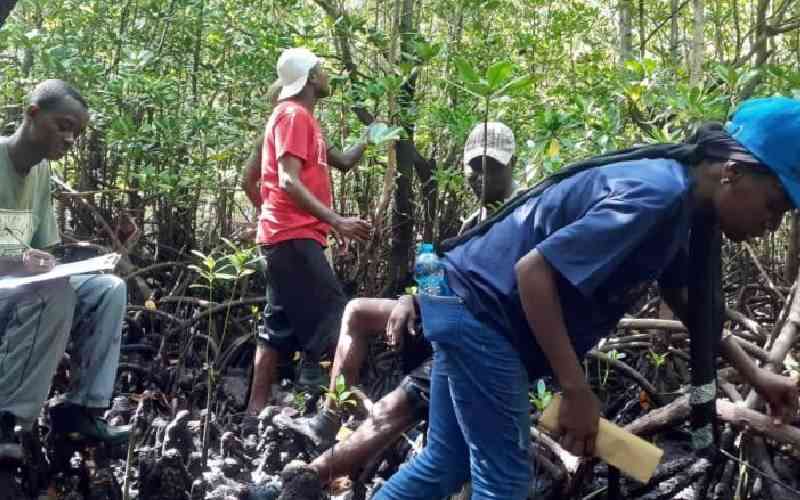
A section of the team managing the Mikoko Pamoja project. [File, Standard]
"Conserving mangroves and sea grass is simply incredible," says Bakari Mwakuzimu, a resident of Vanga in Lunga-Lunga constituency, Kwale county.
Bakari is fully committed to conservation because, he says, his community has witnessed development here that they haven't received from the government "since independence".
Economic life in Vanga is closely tied to its coastal heritage, a destination popular with tourists. Locals also engage in farming, fishing and commerce.
"By simply conserving the ecosystem, which is a cornerstone of our community's way of life, we have received funding that has allowed us to purchase desks for our schools, build classrooms for our children, equip our local health facility and build a laboratory for the secondary school giving our children a brighter educational future," he says.
The source of the funding that has Bakari singing the praises on conservation is carbon credits.
You might be wondering: What are carbon credits?
The term 'carbon credit' comes from the Paris Agreement, a legally binding international treaty adopted in 2015 to combat climate change. Its goal is to limit global warming by reducing or stopping emission of greenhouse gasses, such as carbon dioxide and methane, which contribute to rising surface temperatures.
Extreme weather events
According to the United Nations Environment Programme, increasing temperatures threaten life on Earth by fueling extreme weather events such as floods, severe droughts, pandemics, epidemics and other disasters.
Reducing greenhouse gas emissions is, therefore, essential for the continued survival of life on our planet. You might ask: why not simply order everyone who pollutes the environment to stop emitting green house gases?
Companies, factories and enterprises that emit greenhouse gases as part of their production processes cannot simply stop operations.
Their products are essential for human use and they employ millions of people. Halting all emitters would effectively take human progress back to the stone age.
Under the Paris Agreement, companies, factories, organisations and even countries that emit greenhouse gases can buy the right to pollute.They spend money to purchase 'carbon credits', which allow them to release a specified amount of carbon, essentially offsetting their emissions.
While global rules governing carbon credit trading are still being developed and refined, pioneering transactions are already taking place around the world.
Vanga, Bakari's neighborhood, is among the pioneering sites for carbon credit projects expected to shape how the global carbon credits market operates in the coming years.
Known as Vanga Blue Forest (VBF), the project is an off-shoot of Mikoko Pamoja, an earlier initiative in neighbouring Gazi. Together, they are the first community-led mangrove conservation projects in the world funded through the sale of carbon credits.
The project covers the mangroves of Vanga, Jimbo and Kiwegu (VAJIKI) spanning a total of 460ha.
Managed by the villagers themselves, the initiative was established under the Forest Conservation and Management Act of 2016, which allows co-management of national forests between local communities and Kenya Forest Service (KFS).
The law allows communities to form and register Community Forest Associations (CFAs), which enter into a Forest Management Agreement (FMA) with the Kenya Forest Service.
In addition, the community runs a parallel body-Vanga BMU (Beach Management Unit) - established under the Fisheries Management and Development Act of 2016.
"The Fisheries Management and Development Act allows the formation of BMUs to monitor and manage the marine spaces where these communities live," explains Dr Jacqueline Uku, Principal Research Officer at the Kenya Marine and Fisheries Research Institute (KEMFRI).
"As they manage these spaces, they are required to conserve that environment and uphold biodiversity. The law also allows them to generate income through activities such as fishing, hosting tourists and conducting other sustainable businesses within the ecosystem, while ensuring its conservation."
Both VBF and Vanga BMU share almost the same membership. Bakari serves as the Vice Secretary of the BMU. "Officially, our membership is 1,035 adults," he says. "We conserve mangroves, sea grass and generally protect ocean wildlife."
We met Bakari last October on the sidelines of a community engagement forum organised by KEMFRI and the Kwale county government. The forum sought opinions and ideas from residents on the on-going Marine Spatial Planning (MSP), carried out by KEMFRI through the World Bank funded Kenya Marine Fisheries and Socio-Economic Development (KEMFSED) project.
"It is great that we, the residents of the coast, are being consulted on how the natural resources in our villages can benefit both locals and the country," Bakari says. For us in Vanga, we are already seeing the benefits of being involved in marine planning which combines conservation with economic opportunities," Bakari says.
Bakari emphasizes that revenue from carbon credits has funded real infrastructural development.
Dr Amina Hamza, a senior research scientist at KEMFRI who participated in developing the VBF project confirmed to Planet Action that the carbon offset project has generated funds used for various community developmental projects. These include upgrading the local secondary school's laboratory, constructing two classrooms, providing girls with sanitary towels and furnishing the local dispensary with furniture.
Dr Hamza explains: "The carbon credit transactions are facilitated through agents who connect buyers and sellers. VBF works with the Association for Coastal Ecosystem Services (ACES). They find buyers and collect the payments on behalf of VBF.
"They retain six per cent and pass the remaining 94 per cent to the committee that manages VBF. The committee administers the funds according to the project's guidelines, with about 60 per cent going directly to the community. This portion is what funds local development projects."
The project pursues multiple objectives, with socio-economic development being a key priority. This is particularly significant given that the community has a poverty index of 0.25, close to the national average of 0.23.
Another central goal is the restoration and preservation of Vanga's mangrove forests, preventing emissions from deforestation and degradation while maintaining the integrity of this critical ecosystem.
Mwanarusi Mwafrica, the project coordinator at VBF, says: "Part of our work involves educating locals on the importance of mangrove forests as carbon sinks and promoting their sustainable use, whether for firewood, construction or the development of herbs and medicines."
The project also aims to uphold biodiversity and improve the survival chances of endangered species in the ecosystem, including dugongs, green turtles and birds such as the fork-tailed drongo, black kite and grey heron.
VBF directly supports SDG 13 (climate action) and SDG 14 (life below water), while also contributing to SDG 6 (clean water and sanitation), SDG 8 (decent work and economic growth) and Aichi Biodiversity Target 15 on ecosystem resilience and biodiversity.
Since 2021, VBF has earned approximately Sh34 million from carbon credits and is projected to earn more than Sh11 million in 2025. The project is planned to run for 20 years, until 2041, after which it will be reviewed for potential continuation.




