 The Standard Group Plc is a multi-media organization with investments in media
platforms spanning newspaper print
operations, television, radio broadcasting, digital and online services. The
Standard Group is recognized as a
leading multi-media house in Kenya with a key influence in matters of national and
international interest.
The Standard Group Plc is a multi-media organization with investments in media
platforms spanning newspaper print
operations, television, radio broadcasting, digital and online services. The
Standard Group is recognized as a
leading multi-media house in Kenya with a key influence in matters of national and
international interest.

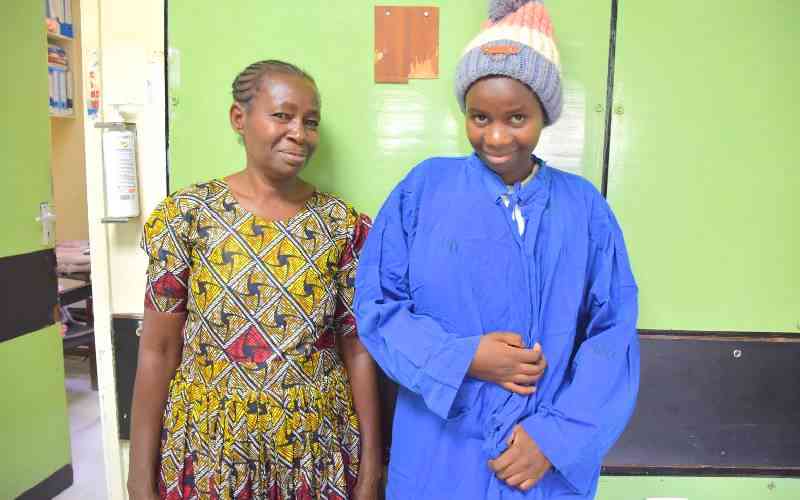
Naomi Mutendwa and her daughter, Lydia, after she underwent surgery to remove gigantomstia. [Courtesy]
Naomi Mutendwa remembers the day she gave birth to her daughter Lydia, as though it were yesterday. The sixth of Naomi's children, Lydian arrived into the world surrounded by the easy chaos of a large family, three lively older sisters and two boisterous brothers.
Naomi expected her youngest daughter to follow a familiar script: school, play, laughter, and the gentle unfolding of adolescence. For years, that is exactly what Lydia gave her - a bright child with a quick smile, a favourite of her teachers, and a girl already dreaming of becoming a teacher herself.
For a long time, life was ordinary. Her older sisters developed slowly and steadily, just as any parent expects. But as Lydia reached early adolescence, Naomi noticed something different. Around the age of 14, she began to see rapid physical changes.
"We noticed that while her sisters were developing slowly and steadily, Lydia's body was changing very quickly. She started complaining of discomfort and sometimes pain, but we thought it was just normal puberty," Naomi recalls.
The changes, however, were not ordinary. While her sisters' growth was gradual, Lydia's body seemed on a separate trajectory. Her breasts began to enlarge at an alarming rate, and soon the changes were impossible to ignore. By the time she was 16, the enlargement was painfully obvious. Naomi's initial belief that it was merely a hurried puberty phase gave way to real concern.
"Her posture changed," Naomi recalled. "She began to bend forward because of the weight. She complained of pain in her back and shoulders. She no longer wanted to run around with her friends. She stopped dancing, stopped playing football - the things she loved."
Despite the physical and social burdens, Lydia tried to hold on to a normal life. She missed classes. Physical education was difficult. Naomi could see the sadness behind her eyes. The girl who once dreamed of becoming a teacher seemed to shrink into her own body.
In early 2024, when Lydia was 15, Naomi took her to a hospital in Mwingi. A local doctor examined her and requested a biopsy, a small sample of tissue to test for cancer.
"We didn't have much money," Naomi recalls. "It was worrying, but I stayed with her, and we did what we could."

The team of doctors who performed surgery on Lydia Mutendwa at Kenyatta National Hospital, Nairobi. [Courtesy]
Despite the initial tests, Lydia's discomfort persisted. The family knew they needed more specialised care. Over the following year, consultations and referrals eventually led them to Kenyatta National Hospital (KNH).
At KNH, after a series of tests and consultations, she received a definitive diagnosis: juvenile gigantomastia, a rare condition characterised by extreme overgrowth of breast tissue. A surgery was scheduled for September 22, 2025.
Dr Benjamin Wabwire, Senior Medical Specialist in Plastic and Reconstructive Surgery, Head of the Department of Specialised Surgery at KNH, and the lead surgeon who oversaw the operation, explains: "Gigantomastia is abnormally large female breasts beyond what is considered normal for a given population. It leads to excessive weight pulling on the chest, shoulders, and back, and may cause skin ulceration, reduced sensation in the nipples, or recurrent fungal infections."
Lydia remembers being afraid. Her mother remembers being uncertain. There were medical consultations, scans and discussions of surgical options. The estimated hospital bill was overwhelming. The financial burden added to their worry.
"We did not know how we would manage it. The amount was high, and we had to find help. We prayed, we sold what little we had, we borrowed what we could," Naomi says. "We were fortunate that the Social Health Authority (SHA) contributed a significant part of the bill, and friends and the community donated some money all through her medical intervention. Without that, we could not have afforded it."
With funding in place and hope in their hearts, Lydia underwent surgery under the care of the plastic and reconstructive surgery team.
For Lydia, the operation would be long and complex. What made her case extraordinary was how much tissue had to be removed. The team excised 20.86 kilograms of breast tissue, roughly 37 per cent of her body weight. The removal was stepwise: 12.335 kilograms from the left breast, 8.53 kilograms from the right breast.
The procedure lasted 11 hours. Dr Wabwire described the risks. "The size of the breast tissue we were taking off was too large when expressed as a percentage of her total body weight. This meant prolonged operating time under anaesthesia and a shift in the blood circulating in her body as some was lost through the removed tissues."
There was also a risk for causing blood clotting problems if large amounts of blood needed to be transfused. For a growing adolescent, the stakes were high. For Naomi and Lydia, the decision felt inevitable. It was not a cosmetic choice. It was a chance for Lydia to reclaim her childhood, her schooling, her dignity.
"We had to act," Naomi says softly.
Surgery in such cases is not purely cosmetic. While reconstructive in nature, it was also lifesaving. "Reconstructive surgery is often lifesaving, like in Lydia's case. Sometimes it is performed to restore function or correct deformities," Dr Wabwire said.
The operation required careful planning and a multidisciplinary team of specialists to ensure both safety and a positive outcome. Lydia's immediate recovery was smooth. She did not need intensive care and was moved directly to the recovery ward.
Globally, gigantomastia is extremely rare. Juvenile benign breast hypertrophy, the type affecting Lydia, has been documented in fewer than 100 cases in the past century. Most girls and women will never encounter the condition. Kenya has no population-level data to show how often it occurs. Cases like Lydia's stand out for their medical and social impact.
According to the International Society of Aesthetic Plastic Surgery (ISAPS), the specialised surgery needed to manage gigantomastia is available in only a small number of centres worldwide. This makes every case both medically demanding and a marker of advanced surgical care.
In formal medical literature, gigantomastia remains scarcely recorded. A review published in the Journal of Plastic, Reconstructive and Aesthetic Surgery noted about 115 cases documented globally between 1910 and 2006, almost half of them in adolescents. More recent medical reviews, including summaries by the American Society of Plastic Surgeons (ASPS), suggest that all forms of gigantomastia combined, such as juvenile, pregnancy related, medication induced or unexplained, still number only in the low hundreds worldwide, with adolescent cases forming only a small share.
The rarity makes Lydia's case remarkable. In Kenya, there are no official registries capturing population-wide incidence. Yet for Naomi, that absence of data mattered less than the burden she saw in her daughter's life. She did not wait for national statistics. She just wanted help.
Emotional burden
The medical burden was not the only weight the family carried. There was the emotional cost: a daughter retreating from friends, from school, from her own dreams. Social stigma followed. Some neighbours gossiped. Some whispered. Others avoided mentioning the problem altogether. Naomi recalls one woman saying, "What kind of thing is this? Go to hospital or is it a curse?"
Public awareness of rare conditions like gigantomastia remains low. Medical literature frequently notes confusion with other causes of large breasts such as obesity, hormonal imbalance, drug effects, or even tumours. In some cases medication-induced enlargement is reported. When such growth happens during puberty and reaches extremes, the impact can be devastating physically and psychologically.
Before surgery, Lydia's life was constrained. She struggled with school, missed classes because carrying her books was painful. Physical education and sports were difficult. Social stigma followed her, as peers noticed the extreme growth. Despite these challenges, her mother says Lydia never lost her spirit.
"She wanted to be normal again. She wanted to dance, play, and study like other children. That determination was her courage," Naomi said.
Lydia herself reflects on the experience. "I am grateful the surgery was done and my life is back to normal. I am looking forward to going back to school in January next year," she said during a virtual interview.
She also shared what gave her courage. "What gave me courage was that I really wanted to be okay. I knew at Kenyatta, they would help me," she said.
For the family, SHA support was critical. Without it, the cost of a long specialist procedure of about Sh168,000 would have been out of reach. "It was not only a medical fight. It was financial, social, and emotional," Naomi said.
The surgery transformed more than Lydia's body. It restored her dignity. After her discharge, she returned for follow-ups. Her wounds healed well. Her energy returned. She has held on to her dream of becoming a teacher. The surgical team continues to monitor her for recurrence.
The transformation
Walking back to class with a light bag and a lighter heart will matter more than many will ever know. Her mother watches her with cautious joy. Lydia smiles again. She stands straight. She talks about school. She says she wants to teach children like she was once dreamt. For Naomi, the dreams and the hopes feel redeemed.
Dr Wabwire explains the medical aspects in more detail. Breast tissue is composed of fat and milk-producing areas known as lobules and ducts. "When a breast enlarges, all these are involved. This is what we removed. There was no fluid collection. Any abnormal growth of tissue is medically referred to as a tumour. Most tumours are not cancerous."
While the terminology can sound alarming, the condition is benign, though it imposes significant physical and psychological burdens. Causes of gigantomastia can be multifactorial. Hormonal imbalances, genetic predisposition, and certain medications can all contribute. In Lydia's case, her hormonal profile was normal, suggesting a genetic disorder as the main factor.
"All three can alone or in combination cause gigantomastia, but many times it is difficult to pinpoint a cause. The genetic predisposition could be inherited or occur sporadically with no family history," Dr Wabwire said.
He points out the medical importance of close monitoring after surgery. "Although the immediate risk has been resolved, the condition can reoccur if significant tissue is left behind during reduction. They can be spaced out to every three, four, or six months."
He also explains the delicate balance of future mothering including potential breastfeeding challenges. "She might have challenges with breastfeeding, but this will be assessed when the time comes. The surgery has no effect on conception as the ovaries were not part of the procedure, and we have not put her on any drugs that could affect her reproductive hormones," he added.
Psychological support is also available through the hospital's mental health department for patients undergoing such procedures.
The social dimension remains. Many girls, especially in Africa, live in small communities where superstition and stigma shape attitudes to bodily difference. Cases may go unreported because of shame or lack of trust in medical facilities. Among documented cases from sub-Saharan Africa are only a handful, in part because of under-reporting, limited access to surgical care, or social ostracism according to Scientific Research Publishing (SCIRP).
For that reason, Naomi hopes that sharing her daughter's story does more than retell events. She hopes it builds awareness. She wants other families to know that when something seems wrong, such as unusual growth, pain or discomfort, they should seek professional help. She wants girls in small towns to believe they are not cursed or alone.
Dr Wabwire emphasised the public health lesson of early diagnosis and intervention being key. "Women should not shy away from visiting a health facility if they have an issue with their health, particularly breast issues. If a girl or woman shows signs of abnormal breast growth, seek medical consultation from a recognised medical facility," he said. Awareness, trust in medical systems, and social support networks are as important as the surgery itself.
Gestational gigantomastia, which occurs in pregnancy, has an incidence of about 1 in 28,000 to 1 in 100,000 pregnancies. Even among benign cases, the physical burden can be immense. Some reports note tissue removal equal to 16 per cent of body weight. Lydia's 37 per cent is extraordinarily rare. Plastic surgeons emphasise early recognition, psychological and social support, and timely surgical intervention.
Lydia's laughter, once held back by the weight she carried, is returning. She moves freely, plays football, sings and dances. The mother watches her daughter reclaim the childhood and teenage life that had been interrupted. "Seeing her happy again is the reward. It makes all the worry, all the sleepless nights, all the prayers worth it," she said.




