 The Standard Group Plc is a multi-media organization with investments in media
platforms spanning newspaper print
operations, television, radio broadcasting, digital and online services. The
Standard Group is recognized as a
leading multi-media house in Kenya with a key influence in matters of national and
international interest.
The Standard Group Plc is a multi-media organization with investments in media
platforms spanning newspaper print
operations, television, radio broadcasting, digital and online services. The
Standard Group is recognized as a
leading multi-media house in Kenya with a key influence in matters of national and
international interest.

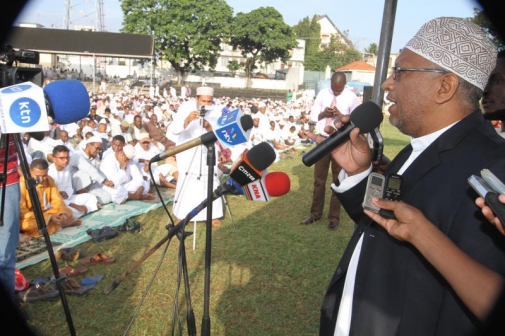
Chief Kadhi Ahmed Muhdhar candidly opens up to ISHAQ JUMBE about terrorism and why his job is more than sorting divorces and inheritance
Before every end of Ramadan, there is always controversy about the sighting of the moon. Do you think this will ever come to an end?
Honestly, it may continue for while, since the law is quite flexible on the sighting of the moon. One school of thought subscribes to the sighting of a local moon and by extension, a regional moon sighting. On the other hand, universal moon sighting is another option that is permitted by Shariah. Normally, I advise local moon sighting in keeping with the tradition of my predecessors.
I believe a local moon sighting reduces confusion and is good for the unity of Muslims. Further, it makes it easier to manage emerging situations. For example take the case of Iddat (this is the ‘period of waiting,’ or the period a woman must observe after the death of her spouse or after a divorce, during which she may not marry another man for example). A woman who is observing Iddat cannot rely on a foreign moon to calculate her months.
Some Muslims have alleged that you are a mere judicial officer whose mandate does not go beyond officiating marriage ceremonies, arbitrating divorce cases and overseeing the subdivision of inheritance. What is your take on this argument?
A judicial official can also be a leader. The Chief Kadhi has also been mandated by the Public Holiday Act to advise the government when the Idd ul Fitr celebrations should be held. These celebrations, as I have said before, solely depend on the sighting of the moon according to the directives of the Holy Quran and what we have learnt from the Sunna of the Holy Prophet.
So, what exactly does your job entail?
My job is to adjudicate disputes regarding divorce, inheritance and marriages for people who profess the Islamic faith and are willing to be tried according to the Shariah law. I also have a non-judicial function of announcing the beginning and ending of the holy month of Ramadan. This duty has been the preserve of the Chief Kadhi even before independence.
Which qualifications should one have to serve as a Chief Kadhi?
You must have a degree in Islamic law from a recognised institution. Further, one must have served as a Kadhi for a period exceeding 12 years.
The divorce rate among Muslims is perceived as high. Is that the case?
That is a misconception because divorce according to Shariah, is permissible and therefore, well documented. Among the benefits are that divorcees are allowed to take on new partners, making remarriage rate high as well.
According to our records, the rate of marriage among Muslims stands at 66 per cent, while divorce constitutes just a third of that.
How come all the Chief Kadhis since before independence are from the Coast. Does that mean other qualified Muslims cannot be appointed?
Before independence, most of the Chief Kadhis were hand-picked by the government from the 10-mile strip that stretches from Vanga all the way to Lamu. They were political appointees. That, however, changed with my appointment, which was openly advertised.
I underwent a rigorous vetting process. After my tenure, any of the Kadhis who have served long enough have a chance to be the new Chief Kadhi. We may not even have a Kadhi from the Coast, seeing that the office of the Kadhi represents diverse ethnic groups across the country. Maybe a Meru will be the next Chief Kadhi or even a Pokomo, or a man from any other tribe in the country.
Is it correct to say that there has been a conspiracy between the government and some families in Mombasa to maintain the status quo while keeping the office to themselves?
That rumour has no basis. The first Kadhi in this country was Abdalla Kassim and he was from Mazrui,Mombasa. He was succeeded by Swaleh Abdalla Farsy, all the way from Zanzibar. Later, it was Nassor Nahdy, who reigned the longest. His family was Nahdy, also from Mombasa. Then came Hammad kassim also a Mazrui whom I replaced. My family name is Muhdhar. Therefore, apart from the Mazruis who have had the privilege of having two of their members serve in this esteemed position, the rest of us have been from diverse families and backgrounds, and we expect even more diversity going forward.
Would you confidently say that you enjoy the support of Muslims in the country?
The only time there is contention among Muslims is during the sighting of the moon, which is a good thing for the community as this is a requirement in jurisprudence, whose literal Arabic translation is fiqh. Fiqh means think. People are allowed this diversity, but in a manner that is mature, positive and healthy.
What is your office doing to counter the terrorism narrative that has radicalised the youth and resulted in insecurity in areas that are predominantly habited by Muslims?
Terrorism is a security problem which we believe is being handled by security agents. As for the narrative, the ideology that is radicalising the youth, it is everyone’s duty to ensure that the material our children consume are safe and that they are not exposed to harmful messages. It is broad and cannot be entrusted only to institutions like say the madrassa. All others should be vigilant to ensure that they do not infiltrate the impressionable minds of the youth.
There has been so many reported cases of madrassa teachers sodomising their charges. What would you recommend?
This is not a problem affecting madrassas only, as we have heard of these cases even in the developed world and in Christian religious institutions as well. It is a societal problem that does not only affect Muslims. Society seems to be losing its moral focus. We might have to address the issue all the way from the family unit.




