 The Standard Group Plc is a multi-media organization with investments in media
platforms spanning newspaper print
operations, television, radio broadcasting, digital and online services. The
Standard Group is recognized as a
leading multi-media house in Kenya with a key influence in matters of national and
international interest.
The Standard Group Plc is a multi-media organization with investments in media
platforms spanning newspaper print
operations, television, radio broadcasting, digital and online services. The
Standard Group is recognized as a
leading multi-media house in Kenya with a key influence in matters of national and
international interest.

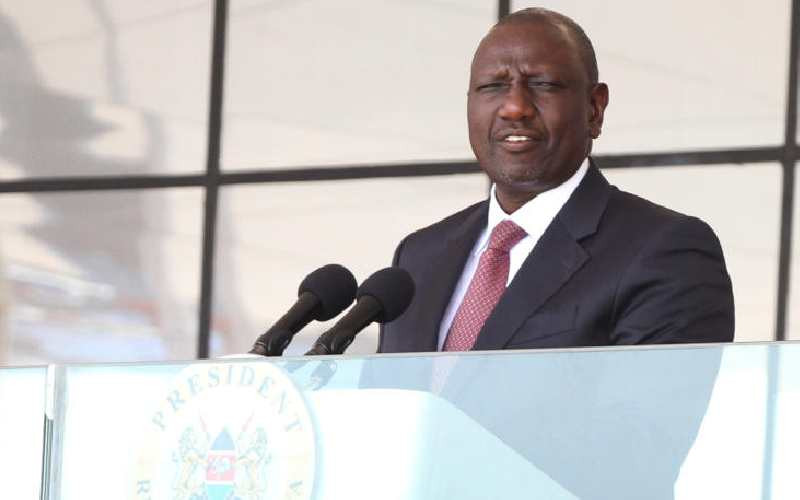
President William Ruto during the Mashujaa Day 2022 celebrations at Uhuru Gardens, Nairobi on October 2022. [Elvis Ogina, Standard]
The process of forming the Government is harshly long and painfully slow. It has been two-and-a-half months since the August 9 General Election. Yet the Government is far from fully formed.
The swearing-in of the Cabinet this week, and the vetting process before that, both remind us that it will be quite some time before the Kenya Kwanza Government is fully in place.
We have, of course, come from whimsical space. The forming government was previously sometimes mischievous. The government would itself be equally whimsical.
We often saw persons who could best fit into a kakistocracy appointed to high office. They understood that their role was anything but to serve the people.
We, accordingly, decided, with the 2010 Constitution, that we would make the process as rigorous as possible. The Constitution introduced vetting and other forms of background check and due diligence.
Do good intentions come with other heavy costs? The most obvious is the liminal space in which the country must wait. We live in the purgatory of an old government and new one that isn't coming to birth. In the process, we long for the delivery of electoral promises.
For two months now, the Presidency has held the fort. It has occasionally resorted to the now retired Cabinet - then in caretaker capacity - to pass resolutions of the Cabinet. Now the Cabinet is in place. But the country must wait for a while before the Principal Secretaries are finally appointed.
At this pace, as much as a quarter to a third of the Fifth Government's first year could be lost to the process of forming the Government. It is likely to be well into November, perhaps even December, by the time Kenya's missions abroad are populated with new envoys.
Recall that they, too, will have to be vetted by Parliament. Then there are other top jobs in state directorates, boards and parastatals. By December 9, it will be a quarter of the year gone.
The case for an alternative rigorous, credible and yet swifter avenue to these appointments speaks for itself. It is, of course, not realistic to expect that these state officers could be in place the morning after the presidential oath of office. Yet, four months is a luxurious extravagance.
The country can ill afford this kind of lavishness with time. There are pulsating questions in the in-trays of virtually every Cabinet Secretary. Yet, some must wait for the new principal secretaries and heads of semi-autonomous government agencies.
Ironically, the vetting process itself begins to morph into something of public drama, with questionable redeeming value. Individuals' reputations and histories are ripped open for doubtful prying and interrogation. Prurient and salacious allusions are made. Innuendo is cast on people's estates. And the Fourth Estate addresses people's net worth without reflecting on its history and the wider public relevance.
Headline news screams of 'millionaire cabinet secretaries.' The more relevant question for journalism ought to be just one. How has the individual come by such wherewithal?
A half-acre residential plot in upmarket Runda in Nairobi was worth about Sh4 million two decades ago. Today the same plot will set you back by Sh40 million. The Sh15 million house on the plot two decades ago will cost you Sh90 million to put up.
If this should be your property, you don't talk of the 19 million that was spent on it. You talk of Sh130 million that it's worth. It is unfortunate that anyone could skew this in reportage.
The question ought to be, what has happened to the value of money? Is it that it is lost, or is it that we have become more greedy - or both? Will these trends continue, or can we hope to arrest and possibly reverse them?
Significantly, if we are spending two-to-three months in liminal Executive space because of vetting nominees, there had better be some tangible premium in return. If we are only going through embarrassing motions and emotions, then we probably need to find another avenue.
Dr Muluka is a strategic communications advisor




