×

The Standard e-Paper
Stay Informed, Even Offline
 The Standard Group Plc is a
multi-media organization with investments in media platforms spanning newspaper
print operations, television, radio broadcasting, digital and online services. The
Standard Group is recognized as a leading multi-media house in Kenya with a key
influence in matters of national and international interest.
The Standard Group Plc is a
multi-media organization with investments in media platforms spanning newspaper
print operations, television, radio broadcasting, digital and online services. The
Standard Group is recognized as a leading multi-media house in Kenya with a key
influence in matters of national and international interest.

Audio By Vocalize
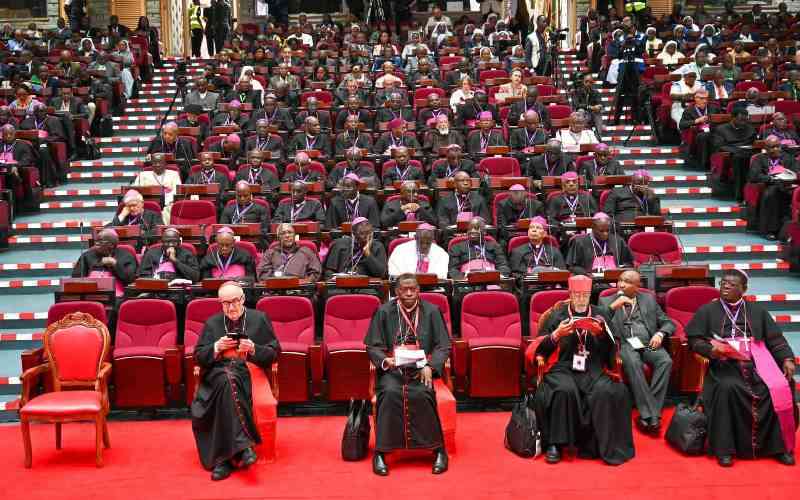
Church leaders, government officials, diplomats, and delegates from across Eastern Africa during the 21st AMECEA Plenary Assembly in Nairobi on July 20, 2026. [Courtesy]
The 21st Plenary Assembly of the Association of Member Episcopal Conferences in Eastern Africa (AMECEA), currently underway in Nairobi, has placed young people at the heart of the regional Church's agenda. The gathering has drawn bishops from across the nine member countries, together with several high-level religious leaders from the Vatican and beyond, all assembled under the theme of a synodal journey with young people.
The bishops have proposed youth as their pastoral priority for the next four years. Pope Leo XIV, in his message to the assembly, set the horizon by calling for "renewed trust in Christ, our hope, and in the capacity of young people to be agents of transformation." Cardinal Michael Czerny, preaching at the opening Mass, urged young people, "Do not let yourselves be robbed of hope," and called them to build bridges of hope in a turbulent world.
The presentations have been refreshingly honest about the terrain. Archbishop Maurice Muhatia Makumba captured the urgency at the official opening: "Not to pay attention to youthful society not only smacks of recklessness but is also tragically irresponsible." Bishop Martin Mtumbuka pressed for depth in formation, asking the Church to give young people "sound catechesis so that they have a sound understanding of their faith."
A notable searching contribution came from Archbishop Anthony Muheria, who named youth mental health as a defining conversation: "Mental health can mean I don't feel like waking up in the morning. That's the first mental health signal." He then posed the question that captures the assembly's spirit: "We are walking together. Can we also bring our leaders to walk with the young people?"
Taken together, these voices offer more than inspiration. They sketch the outline of what I would call a systems approach to youth transformation, and this is the insight I believe the assembly brings to the fore. Each speaker illuminated one part of an interconnected whole: Pope Leo XIV the trust, Czerny the hope, Muhatia the urgency, Mtumbuka the formation, and Muheria the wellbeing. No single institution, and no single intervention, can respond to all of these at once. That is precisely the point.
Systems thinking means seeing a problem as a whole rather than in pieces since a young person's faith, education, work, mental health and life online are all connected, and a difficulty in one area can jam a young person’s life.
Systems thinking teaches that young people live simultaneously in several worlds: Spiritual, economic, digital, civic and psychological. A young person struggling to get out of bed may also be struggling with unemployment, with an online world that overwhelms, and with institutions that speak about her rather than with her. The presentations, read side by side, point to this interdependence with remarkable clarity.
The assembly has also modelled the method. More than 30 youth delegates drawn from across the AMECEA region are sitting with the bishops, presenting their realities directly, a demonstration of a synodal Church where everyone sits at the table. This is what systems thinking looks like in practice. It happens when sectors speak with each other rather than past each other, when Church and state engage in genuine dialogue, and when policies emerge not from a single department but from all departments deliberating together.
It happens when interministerial agencies, religious bodies and civil society organisations coordinate their efforts around shared goals, and when political leaders consult and listen before they decide. The measure of such a system is simple: No actor works alone, and no voice, least of all that of young people, is left outside the room where decisions are made.
One need not be Catholic to draw inspiration here. What the assembly has provided is a vision and a vocabulary: Trust, hope, urgency, formation and wellbeing. The invitation before all of us, in Eastern Africa and beyond, is to connect these into a working system where formation has depth, economies have opportunity, technology has humanity, and institutions have open doors. If the region rises to that invitation, the young people gathered in Nairobi this week will be remembered as the generation an entire region chose to walk with.
- Dr Mokua is Director of Loyola Center for Media and Communications
Subscribe to our newsletter and stay updated on the latest developments and special offers!


 Prefer the Standard on Google




 join
join