×

The Standard e-Paper
Kenya’s Boldest Voice
 The Standard Group Plc is a
multi-media organization with investments in media platforms spanning newspaper
print operations, television, radio broadcasting, digital and online services. The
Standard Group is recognized as a leading multi-media house in Kenya with a key
influence in matters of national and international interest.
The Standard Group Plc is a
multi-media organization with investments in media platforms spanning newspaper
print operations, television, radio broadcasting, digital and online services. The
Standard Group is recognized as a leading multi-media house in Kenya with a key
influence in matters of national and international interest.

Audio By Vocalize

Kenya’s transition to the Competency-Based Education (CBE) system is steadily redefining learning, with a growing emphasis on critical thinking, creativity and practical skills over rote memorisation.
Education Cabinet Secretary Julius Ogamba said the reforms are equipping learners with competencies needed to thrive in a fast-changing world. He spoke during the 3rd Annual Educational Assessment Symposium hosted by the Kenya National Examinations Council (KNEC).
Ogamba noted that the new curriculum places learners at the centre of education, shifting focus toward practical application of knowledge.
“Participants, including schools exhibiting competency-based education, are able to exchange experiences, improve outcomes and identify areas that need change,” he said, referring to ongoing assessments such as KPSEA, KJSEA and KCSE, alongside continuous evaluation programmes.
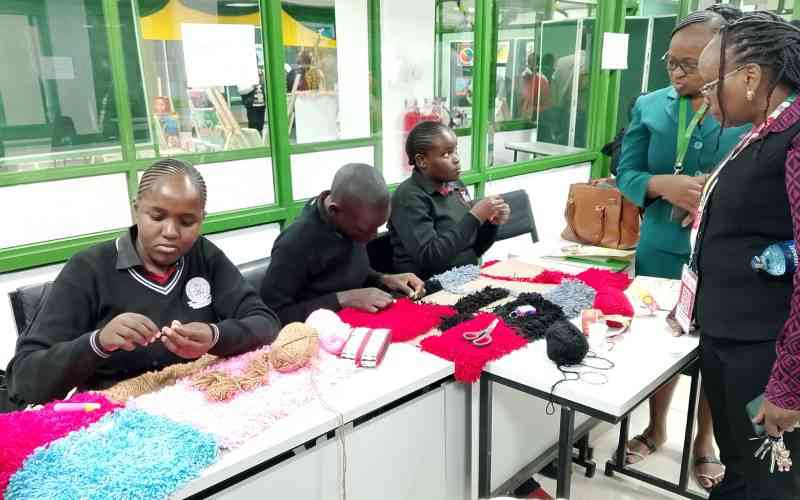
The symposium, themed “Reimagining Curriculum, Pedagogy and Assessment for Inclusive, Innovative and Future-Ready Learning,” brought together educators, policymakers and development partners to assess progress and chart the future of CBE.
Learners from both regular and special needs schools demonstrated hands-on skills in areas such as weaving, drawing and hairdressing—highlighting a clear shift from traditional exam-oriented learning.
“We have transitioned from Grade 9 to Grade 10 and through the exhibitions you can see what learners are doing. Education is no longer just about theory but about what learners can actually do,” Ogamba said.
He added that the approach is key to nurturing innovation and talent early, enabling learners to explore their interests while strengthening problem-solving abilities.
The CS further emphasised the need to view education as an economic investment rather than solely a social service.
“We are moving education sector programmes from being seen as social policies to being viewed as investments, attracting more partners who recognise the returns,” he said.
To support implementation, the government has established 235 senior school hubs across all 47 counties, providing platforms for collaboration and sharing of best practices. Digital transformation, he added, will play a critical role in improving access and quality as learner numbers grow.
KNEC Chief Executive Officer David Njengere underscored the importance of assessment in shaping learning outcomes.
“Assessment remains one of the most powerful tools for learning. What gets assessed is taught. When guided by data and context, it becomes a powerful driver of educational goals,” he said.
Njengere noted that reforms are promoting performance-based assessments that test not just knowledge but its application, preparing learners for the modern workforce. He added that technology, including artificial intelligence, is enhancing efficiency, inclusivity and credibility in assessment systems.

As Kenya prepares for the transition of the pioneer CBE cohort to universities in 2029, institutions of higher learning are aligning their programmes to accommodate the new system.
Stay informed. Subscribe to our newsletter
“I reaffirm KNEC’s commitment to building a robust, inclusive and future-ready assessment ecosystem while safeguarding ethics, fairness and validity,” Njengere said.
From a global perspective, Polycarp Otieno of UNICEF said the shift reflects evolving trends in education.
“Assessment is no longer just about measuring learning outcomes—it is about making learning visible, actionable and ultimately investable,” he said.
Otieno emphasised the need to link assessment data to classroom practice and broader economic planning, noting that real progress will be realised when results directly inform teaching approaches and learner support.
With its focus on critical thinking, innovation and hands-on skills, the CBE system is poised to transform education and produce a generation better equipped to tackle real-world challenges.
Subscribe to our newsletter and stay updated on the latest developments and special offers!

 Prefer the Standard on Google







 join
join