×

The Standard e-Paper
Stay Informed, Even Offline
 The Standard Group Plc is a
multi-media organization with investments in media platforms spanning newspaper
print operations, television, radio broadcasting, digital and online services. The
Standard Group is recognized as a leading multi-media house in Kenya with a key
influence in matters of national and international interest.
The Standard Group Plc is a
multi-media organization with investments in media platforms spanning newspaper
print operations, television, radio broadcasting, digital and online services. The
Standard Group is recognized as a leading multi-media house in Kenya with a key
influence in matters of national and international interest.

Audio By Vocalize
For years, diagnosing malaria at Kisumu County Referral Hospital has depended on a painstaking process that demands time, concentration and highly skilled laboratory hands.
A patient suspected of having malaria would have blood drawn, a slide prepared, stained and allowed to dry before a laboratory technologist sat behind a microscope, carefully moving from one field to another in search of parasites.
To declare a slide negative, the technologist may have to examine up to 100 fields, a process that can take between 10 and 15 minutes for a single sample.
But inside the hospital’s laboratory, that familiar routine is beginning to change.
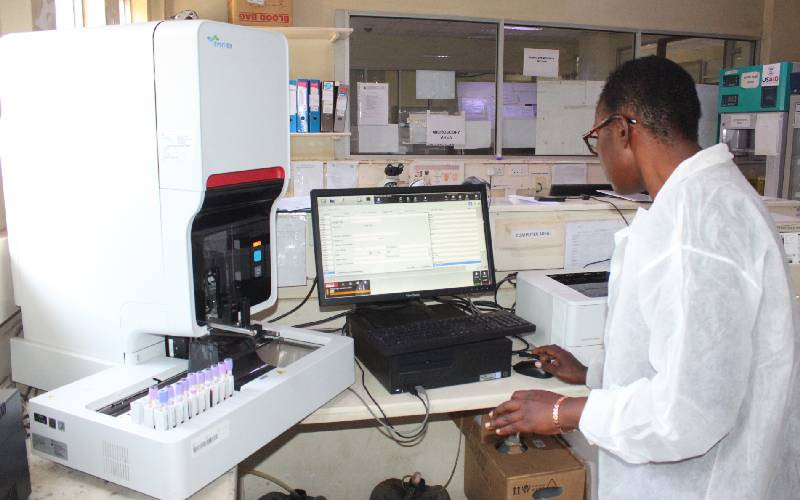
A small volume of blood can now be placed in an automated analyser and, in about a minute, the machine can detect malaria parasites while simultaneously performing a complete blood count (CBC), providing information that can help determine whether a patient is anaemic.
Known as the Sysmex XN-31, the analyser is being piloted in Kisumu as part of the Project to Standardise and Disseminate Automated Anaemia and Malaria Testing Technology in Kenya.
The initiative brings together Sysmex Corporation, Sysmex East Africa, the Japan Institute for Health Security (JIHS), the Ministry of Health and the County Government of Kisumu.
The technology was initially introduced at Ahero Sub-County Hospital, where it underwent validation before being deployed to selected facilities for piloting.
At Kisumu County Referral Hospital, medical laboratory technologist Josinta Achieng has been working with the machine and witnessing how it is changing the laboratory workflow.
As the Head of the Haematology Department, Achieng understands the demands of both traditional microscopy and automated testing.
She says the biggest difference is the speed and the ability to perform two important tests from the same blood sample. “The machine is able to diagnose malaria and anaemia at the same time,” she says.
The analyser can detect malaria parasites within red blood cells while performing a full blood count. It can process up to 30 samples at once and provide the malaria result in about a minute once the sample reaches the machine.
For Achieng, this offers a major advantage in a busy hospital where laboratory workers handle numerous samples while dealing with limited human resources.
“Microscopy is very much subjective. You need somebody who is skilled, trained and competent,” she explains.
Stay informed. Subscribe to our newsletter
Traditional microscopy remains an important malaria diagnostic method because it allows trained laboratory professionals to directly observe parasites, quantify them and identify species.
However, the method depends heavily on the competence and concentration of the person examining the slide.
The laboratory worker must collect the sample, prepare the blood film, stain it correctly and examine it under a microscope. If no parasite is seen, the technologist must examine numerous fields before confirming a negative result.
At Kisumu County Referral Hospital, malaria-related workload can reach about 1,500 tests in a month, depending on the season and the number of suspected cases.With such a workload, fatigue can become a challenge.
“Sometimes, because you are subjected to the microscope for some time, you get tired and exhausted because there are so many samples to examine,” Achieng says.
The hospital has two microscopes used for the work, meaning laboratory personnel have to dedicate time to examining slides. Yet staff shortages can sometimes make it difficult to have enough personnel available.
The XN-31 introduces a different approach. Instead of a technologist remaining at the microscope to examine one slide at a time, several samples can be loaded into the analyser. The machine then processes them while the laboratory worker can attend to other duties.
“This has really helped us in terms of human resources because you are able to operate the machine and do other things at the same time. You can multitask,” Achieng says.
That ability becomes particularly valuable in high-volume facilities.The machine's speed also changes the experience for patients.
Although a patient's overall laboratory turnaround time includes registration, billing, sample collection and processing, the actual testing process becomes significantly shorter once the sample reaches the analyser. “Once the sample reaches here, it is just one minute and you get the result,” Achieng says.
The technology also provides information that conventional malaria testing alone cannot offer.The same blood sample used to detect malaria can produce a complete blood count, allowing health workers to assess the patient's blood profile and identify anaemia.
This is significant because malaria and anaemia can occur together, particularly among vulnerable groups such as children under five and pregnant women.
Dr Gregory Ganda, Kisumu County Executive Committee Member for Medical Services, Public Health and Sanitation, says the analyser provides a more comprehensive picture from a single blood sample.
“It is able to perform a full blood count while simultaneously detecting malaria parasites in red blood cells,” Ganda says.
The technology has demonstrated an accuracy of about 96 per cent in detecting malaria and can identify malaria species, particularly Plasmodium falciparum.During comparisons conducted between the analyser and malaria microscopy, Achieng says the machine recorded an accuracy of about 95 per cent.
Beyond speed, the ability to identify malaria species could strengthen surveillance in a region where the disease remains endemic.
Ganda says the technology has already generated findings that suggest a significant number of malaria infections detected in Kisumu are caused by species other than P. falciparum, despite the latter remaining the dominant malaria parasite associated with severe disease in Kenya.
“This technology will help us diagnose patients earlier, improve treatment decisions and reduce the workload of our laboratory teams,” he says.
The county's proximity to Lake Victoria, combined with environmental and climatic conditions favourable to mosquito breeding, makes the region highly vulnerable to malaria transmission.
Health workers say malaria transmission occurs throughout the year, although cases can increase during particular seasons, especially after rainfall.
At Kisumu County Referral Hospital, the number of positive cases varies depending on the season. On some days, laboratory workers may identify one or two positive cases, while numbers increase during periods of higher transmission.
Children and adolescents continue to feature among those testing positive.But the number of cases detected in hospitals may not fully represent the actual burden in the community.
Kisumu is largely an urban setting, and some residents who develop symptoms they associate with malaria do not necessarily seek testing at health facilities.
Instead, they may visit nearby chemists and purchase antimalarial drugs without undergoing a diagnostic test.
Achieng says this practice can affect malaria surveillance because patients may arrive at the hospital after already taking medication.
“Sometimes a patient comes here after taking some antimalarial drugs without doing a diagnosis. When we take the sample, we may find the malaria parasite is no longer there,” she says.
Self-medication also creates another challenge because not every fever is caused by malaria.
Without testing, patients may take antimalarial drugs for another illness, potentially delaying appropriate treatment.
For Lilyana Dayo, the Kisumu County Malaria Control Coordinator, accurate and timely diagnosis remains central to malaria control. “Malaria is an endemic disease condition in our setting, with ongoing all-year transmission,” Dayo says.
She notes that Africa carries the overwhelming majority of the global malaria burden. Children under five and pregnant women remain among the most vulnerable.
Globally, an estimated 282 million malaria cases and 610,000 deaths were recorded in 2024, with sub-Saharan Africa accounting for about 94 per cent of cases and 95 per cent of deaths.
Kenya also continues to carry a significant burden, with about 75 per cent of its population considered at risk of malaria.
Although interventions such as mosquito nets, vector control, improved treatment, surveillance and the malaria vaccine have contributed to reducing the burden, malaria transmission has not disappeared.
In Kisumu, the introduction of the malaria vaccine in 2019 marked another milestone in efforts to protect children from severe malaria but prevention must go hand in hand with diagnosis.
For Dayo, the XN-31 is therefore more than a machine that produces faster results. “It is very efficient from both the healthcare provider’s and the patient’s perspective,” she says.
However, the future of the machines beyond the pilot phase will depend on sustainability.
The equipment was provided for piloting together with an initial supply of reagents. Once the reagents are exhausted, facilities will have to determine how to finance continued testing, maintenance and servicing.
The County Government of Kisumu is exploring a possible public-private partnership with the company involved in managing the equipment.
“We have an MOU on how best to retain the equipment and also how the company can benefit from providing us with the equipment,” Dayo says.
She adds that maintenance is essential and the county must find a model that allows it to retain the technology without forcing the company to operate at a loss.
Five facilities in Kenya have been selected for the programme. Four are in Kisumu County Aga Khan Hospital Kisumu, Ahero Sub-County Hospital, Lumumba Sub-County Hospital and Kisumu County Referral Hospital while the fifth is Mariakani Sub-County Hospital in Kilifi County.
At Kisumu County Referral Hospital, about 2,500 tests were targeted during the pilot period, with approximately 2,300 conducted by the time of the interview.
For health officials, the success of the project will ultimately be measured not simply by the number of samples processed but by whether faster diagnosis leads to earlier treatment and better patient outcomes.
The machine does not replace laboratory professionals or eliminate microscopy. Rather, it adds an automated option to a diagnostic system that continues to rely heavily on skilled human expertise.
For Achieng, its greatest advantage is the ability to combine speed, efficiency and information.
“You put a small volume of blood in the machine, and in less than one minute you know whether the patient has malaria and you also have a full picture of the blood count,” she says.
That could be particularly valuable for a child with malaria and anaemia or a pregnant woman whose condition requires urgent attention.
Dayo says Kisumu's position as a health and innovation hub makes it an ideal place to test technologies that could strengthen healthcare delivery.
“It is an innovation, and people want services that are of good quality. They want speed. They don't want to spend an entire day in hospital waiting for one test,” she says.




Subscribe to our newsletter and stay updated on the latest developments and special offers!








 join
join