×

The Standard e-Paper
Join Thousands Daily
 The Standard Group Plc is a
multi-media organization with investments in media platforms spanning newspaper
print operations, television, radio broadcasting, digital and online services. The
Standard Group is recognized as a leading multi-media house in Kenya with a key
influence in matters of national and international interest.

Audio By Vocalize
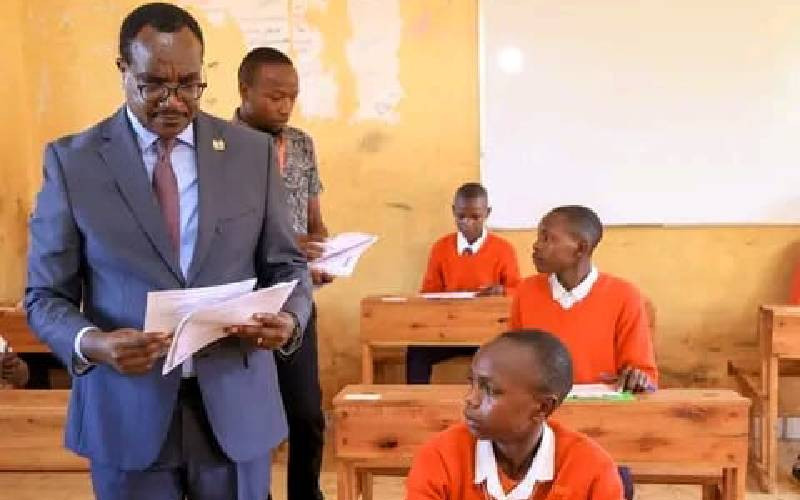
Education CS Julius Ogamba distributes examination papers to learners at Sotik Comprehensive School on October 30, 2026. [Courtesy]
The Kenya National Examinations Council (KNEC) has begun processing and marking the 2026 Kenya Junior School Education Assessment (KJSEA).
The exercise is expected to pave the way for the placement of 1.2 million Grade 9 learners into senior secondary schools in January 2027.
KNEC Chief Executive Officer David Njengere said early commencement of the exercise is intended to give the Ministry of Education sufficient time to process results and complete Grade 10 placement before schools reopen in January.
“The marking process of the KJSEA assessment has begun with multiple-choice questions, which are machine-marked, before examiners proceed to manually assess compositions, insha and other open-ended questions,” he said.
Dr Njengere further said this will also give parents and guardians adequate time to prepare for their children's transition to senior school.
“We will complete the exercise so that the results are available for the Ministry by December to place learners in Senior School. Parents will also have adequate time to prepare learners for admission in Grade 10 next year,” he said.
KNEC said contracted examiners are expected to report to their assigned marking centres on November 9, 2026. The marking is expected to take approximately three weeks.
Njengere said the council was keen to ensure the assessment results were processed within the required timelines to avoid delays in the transition to senior school.
“The use of optical mark recognition (OMR) technology in processing multiple-choice responses is expected to accelerate the exercise, while human examiners will concentrate on questions requiring interpretation, written expression, scientific reasoning and demonstration of competencies,” he said.
The distinction is particularly important under the CBE assessment framework, where learners are assessed on their ability to apply knowledge, demonstrate understanding and communicate ideas is also evaluated.
Unlike the previous 8-4-4 system, where learners progressed through a largely examination-driven placement framework, the CBE system places emphasis on a learner's strengths, interests, abilities and preferred areas of specialisation.
The KJSEA results will therefore play a central role in determining the senior school pathways and institutions learners will join.
The final placement assessment comprises 60 per cent from the Grade 9 KJSEA, 20 per cent from school-based assessments undertaken in Grades 7 and 8, and 20 per cent from the Kenya Primary School Education Assessment (KPSEA) administered in Grade 6.
Stay informed. Subscribe to our newsletter
Learners will be placed in one of three pathways: Science, Technology, Engineering and Mathematics (STEM), Social Sciences, or Arts and Sports Science.
Under this arrangement, the results are reported through performance levels across nine learning areas rather than a single aggregate score.
The eight-point scale ranges from Below Expectations to Meeting Expectations and Exceeding Expectations, helping identify individual strengths and areas where learners may require additional support.
Education Cabinet Secretary Julius Ogamba has assured parents that the placement exercise will be guided by learners' performance, interests and pathway choices, alongside other considerations.
Speaking during the conclusion of the 2026 national assessments, Ogamba said the government was committed to an orderly, transparent and equitable transition to senior school.
“The placement process will be undertaken in accordance with the established criteria, taking into account learners’ performance, interests, pathway choices and other applicable considerations,” he said.
The experience of the first Grade 10 placement cycle in December 2025 also demonstrated the importance of adequate preparation. Following the initial placement, the Ministry received 355,457 applications for review, with 211,636 eventually approved.
The Kenya National Parents Association Chairman Silas Obuhatsa hailed the arrangement, saying it will allow parents to prepare adequately for admission of learners in Grade 10 next year.
“The timely communication of results, clarity on placement procedures and adequate preparation for the financial demands of senior school ease parents burden,” he said.
He further said early results will provide an opportunity to establish where their children have been placed, understand the subject combinations available and make the necessary arrangements for school fees, uniforms, learning materials and transport.
School heads through the Kenya Secondary Schools Heads Association (KESSHA) chairman Willy Kuria have welcomed the move, saying this will give institutions adequate time to plan for the admission based on the numbers allocated.
“School administrators need sufficient information about learners assigned to their institutions to plan admissions and provide appropriate support,” he said.
KNEC has designated several institutions as marking centres for different learning areas. Mathematics scripts will be marked at Mang'u High School, Social Studies at Limuru Girls, while English will be handled at Lenana School.
“The uncertainties that characterised the inaugural transition allowed us to plan ahead this year to ensure learners have adequate time to prepare before reporting to senior schools in January 2027,” Ogamba said.


Subscribe to our newsletter and stay updated on the latest developments and special offers!