×

The Standard e-Paper
Stay Informed, Even Offline
 The Standard Group Plc is a
multi-media organization with investments in media platforms spanning newspaper
print operations, television, radio broadcasting, digital and online services. The
Standard Group is recognized as a leading multi-media house in Kenya with a key
influence in matters of national and international interest.
The Standard Group Plc is a
multi-media organization with investments in media platforms spanning newspaper
print operations, television, radio broadcasting, digital and online services. The
Standard Group is recognized as a leading multi-media house in Kenya with a key
influence in matters of national and international interest.

Audio By Vocalize
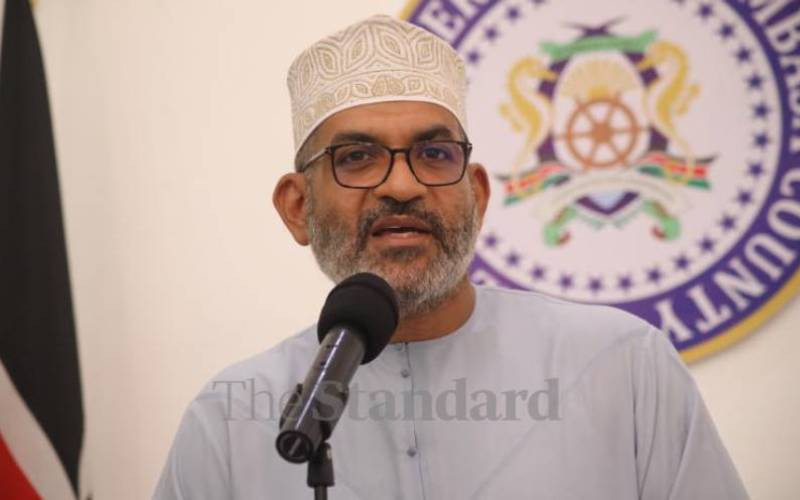
The county government of Mombasa is mooting the idea of coming up with a fisheries training college.
Mombasa County Executive Committee Member in charge of Blue Economy, Cooperatives and Agriculture, Mr Ibrahim Khamis Mutwafy, said that the Governor Abdulsamad Sharrif Nassir-led administration is keen to have such a facility in Mtongwe, Likoni sub-county.
"It is our vision to have a fishermen's training college set up to equip the fisherfolk with knowledge on modern-day fisheries," Mutwafy said.
He added that Mombasa and Kenya stand at a pivotal moment in harnessing their blue economy should such a facility be established.
Adequate funding will be required for such a noble venture. We are talking with both the Chinese and Italians on partnership and technical support,'' the CEC said.
At the same time, Mutwafy announced that a team from his department will be visiting Tanzania to do benchmarking at a fisheries college in Bagamoyo soon.
Maritime commentator Mr Andrew Mwangura said that with over 640 kilometres of coastline and an Exclusive Economic Zone (EEZ) rich in high-value species like tuna, the nation’s marine fisheries potential far exceeds current reality.
Estimates place Kenya’s offshore fishery potential at 150,000 to 300,000 metric tonnes annually, but actual marine landings hover at only a fraction of that.
The actual harvest ranges between 9,000 and 24,000 tonnes from coastal areas, with almost no deep-sea contribution from local fleets. Instead, distant water fishing nations dominate the exploitation of these waters using purse seiners and longliners, while Kenyan participation remains marginal," he said.
Mwangura said this dependency on foreign fleets limits job creation, revenue retention, and skills development for coastal communities. Establishing a specialised deep-sea fisheries training institute is not a luxury but a strategic necessity.
'Kenya has made some commendable efforts, such as training over 950 marine fishers through the Kenya Fisheries Service and running short courses on safety at sea. However, these initiatives remain fragmented and short-term. Deep-sea operations demand far more than basic seamanship,'' he explained.
He noted that current programmes, whether at Sagana’s School or through ad hoc vessel-based training, cannot deliver this depth of instruction.
"Without institutionalised, practical, and certification-aligned training, Kenyan youth and fishers will remain sidelined from well-paying jobs on industrial vessels operating in our own waters. A dedicated training institute would transform this situation by equipping thousands of young Kenyans from coastal counties with employable skills, offering higher incomes than artisanal nearshore work,'' Mwangura said.
He said that the college will also improve safety at sea, as fishing remains one of the world’s most dangerous occupations and Kenya’s ratification of key international conventions requires robust training in vessel stability, firefighting, and survival.
Stay informed. Subscribe to our newsletter
Furthermore, Mwangura said that trained Kenyan crews would help combat illegal, unreported, and unregulated fishing by supporting monitoring and data collection, thereby strengthening Kenya’s sovereignty over its EEZ.
"Training in quality assurance and cold chain management would also enable higher-value exports, reducing the current pattern of raw fish leaving Kenyan waters for processing elsewhere. Kenya can learn from successful models in both the Global South and the Global North. From the Global South, Tanzania’s Mbegani Fisheries Training Institute offers a proven regional model with hands-on programmes in master fisherman skills and marine engineering," added Mwangura.
He said that Namibia’s Maritime and Fisheries Institute similarly demonstrates how a country emerging from heavy foreign fleet dependence can build local capacity and increase national crewing levels.
From the Global North, Norway’s Måløy Vocational School provides world-class training using advanced simulators for purse seine and longline operations, linked directly to apprenticeship models on working vessels. Canada’s Fisheries and Marine Institute offers another benchmark, with internationally recognised certification pathways and at-sea practicums that Kenya could adapt for tropical waters,'' he said.
He echoed sentiments by the Mombasa County government on the establishment of a fisheries training facility.
The government, through the State Department for the Blue Economy and Fisheries, should prioritise establishing a National Deep-Sea Fisheries Training Institute, ideally in Mombasa or Lamu. Key features should include modular curricula from certificate to diploma levels, modern facilities with simulators and training vessels, public-private partnerships for job placement, and inclusive programmes for women and youth,'' said Mwangura.
Mwangura points out that essential funding could be drawn from blue economy investments, development partners like the World Bank and FAO, and licence fees from foreign vessels.
"The return on investment in terms of jobs, revenue, food security, and reduced import dependency would be substantial. Kenya cannot afford to watch its marine wealth sail away on foreign decks while coastal communities struggle. The time for bold investment is now,'' explained Mwangura.


Subscribe to our newsletter and stay updated on the latest developments and special offers!