×

The Standard e-Paper
Fearless, Trusted News
 The Standard Group Plc is a
multi-media organization with investments in media platforms spanning newspaper
print operations, television, radio broadcasting, digital and online services. The
Standard Group is recognized as a leading multi-media house in Kenya with a key
influence in matters of national and international interest.
The Standard Group Plc is a
multi-media organization with investments in media platforms spanning newspaper
print operations, television, radio broadcasting, digital and online services. The
Standard Group is recognized as a leading multi-media house in Kenya with a key
influence in matters of national and international interest.

Audio By Vocalize
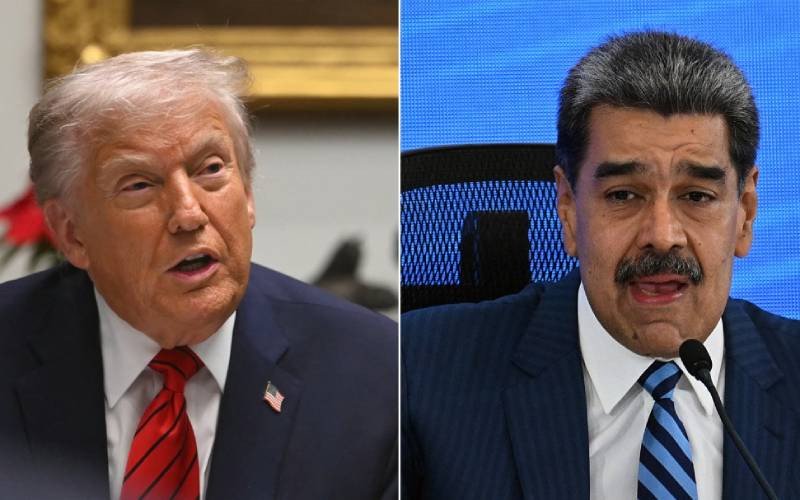
President Donald Trump said Saturday that US forces had captured Venezuelan leader Nicolas Maduro after launching a "large scale strike" on the South American country.
"The United States of America has successfully carried out a large scale strike against Venezuela and its leader, President Nicolas Maduro, who has been, along with his wife, captured and flown out of the Country," Trump said on Truth Social, around two hours after explosions rocked Venezuela's capital Caracas.
There was no confirmation from Venezuela's government of the fate of the leftist Maduro, in power since 2013.
His government accused the United States of an "extremely serious military aggression" which follows a months-long campaign of increasing military and economic pressure by Trump.
In a dramatic night of fast-moving events, Caracas was rocked by explosions, accompanied by the sound of helicopters, around 2:00 am (0600 GMT).
The blasts continued for nearly an hour, AFP journalists said.
Trump said he would give a news conference at 11:00 am (1600 GMT) at his Mar-a-Lago residence in Florida, where he is on vacation.
A 'brilliant' operation
In a brief phone interview with The New York Times, he hailed a "brilliant" operation which involved "a lot of good planning and lot of great, great troops and great people."
Fuerte Tiuna, Venezuela's largest military complex, situated in the south of Caracas, and Carlota airbase in the north were among the targets of the strikes.
AFP saw flames and huge plumes of smoke billowing from Fuerte Tiuna.
Blasts were also heard in La Guaira, north of the capital, where Caracas's airport and port are located.
"I felt like (the explosions) lifted me out of bed, and I immediately thought, 'God, the day has come,' and I cried," María Eugenia Escobar, a 58-year-old resident of La Guaira, told AFP.
"Venezuela rejects, repudiates, and denounces before the international community the extremely serious military aggression perpetrated by the current government of the United States of America against Venezuelan territory and people," the government said.
The government said Maduro had declared a state of emergency but the 63-year-old socialist was himself nowhere to be seen.
Stay informed. Subscribe to our newsletter
The defense ministry accused the United States of targeting residential areas and announced a "massive deployment" of its military resources.
The leftist president of neighboring Colombia, Gustavo Petro, called on X for an emergency meeting of the United Nations and said he was deploying troops to the Venezuela border.
As the strikes began in the dead of night, residents of Caracas rushed to their windows and terraces to try to make sense of events.
Others hid in safe, windowless spaces, fearful of breaking glass.
Videos shared on social media showed helicopters silhouetted against the night sky.
Power has been cut in certain parts Caracas, according to residents.
'They're bombing'
Francis Pena, a 29-year-old communications professional living in eastern Caracas, told AFP that he was sleeping and his girlfriend woke him and said "they're bombing."
"I can't see the explosions, but I hear the planes. We're starting to prepare a bag with the most important things at home -- passport, cards, cash, candles, a change of clothes, canned food," Pena said.
Trump, who deployed an aircraft carrier and warships to the Caribbean as part of what he initially presented as an anti-drug smuggling campaign, had repeatedly threatened strikes on Venezuelan soil.
On Monday, he said it would be "smart" for Maduro, whose re-election in 2024 was widely dismissed by the international community as fraudulent, to step down.
He also said the United States had hit and destroyed a docking area for alleged Venezuelan drug boats.
Maduro had said Thursday he was open to cooperation with Washington.
The Trump administration has accused Maduro of heading a drug cartel, but the Venezuelan leader denied any involvement in the narcotics trade, saying Washington was seeking to overthrow him because Venezuela has the largest known reserves of oil on Earth.
In an apparent bid to force him out, Washington in recent weeks informally closed Venezuela's airspace in recent weeks, imposed more sanctions and ordered the seizure of tankers loaded with Venezuelan oil.
US forces have also carried out numerous strikes on boats in both the Caribbean Sea and eastern Pacific Ocean since September, targeting what Washington says are drug smugglers.
The strikes have killed at least 107 people, according to the US military.

Subscribe to our newsletter and stay updated on the latest developments and special offers!






 join
join