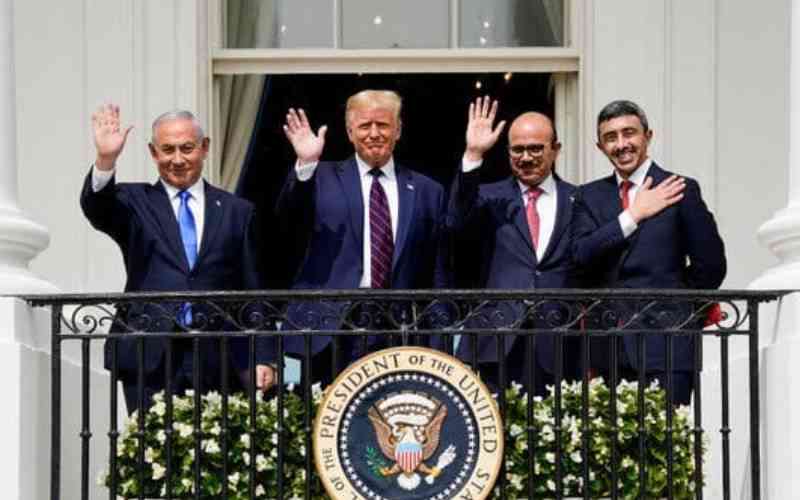
US President Donald Trump, Israel Prime Minister Benjamin Netanyahu with UAE and Bahrain ministers during the signing of the Abraham Accords at the White House in 2020.
Saudi Arabia has opposed Arab states that normalised relations with Israel under the Abraham Accords, raising questions about its role in the region and the unity of the Arab bloc, analysts have noted.
Since the United Arab Emirates, Bahrain and Morocco signed normalisation agreements with Israel in 2020, Riyadh has criticised those moves while not imposing sanctions or direct pressure on Israel, analysts observed.
Saudi Arabia has framed its position as a defence of Palestinian rights, insisting that no normalisation should occur without a Palestinian state.
Political analyst Dr Qadem Ahmed Qadem argued that the issue is less about Palestinian principles and more about control of the Arab-Israeli diplomatic file.
"The Abraham Accords broke Riyadh's traditional monopoly over relations with Washington, and what followed was political opposition rather than new diplomacy," he explained.
Jeremy Pressman, a Middle East researcher at the Quincy Institute for Responsible Statecraft, noted that the accords did not advance Palestinian-Israeli conflict resolution.
He added that Saudi Arabia's insistence on being the gatekeeper to any future normalisation deal risks leaving leverage unused that could otherwise be applied directly on Israel.
The UAE received the most public Saudi criticism among the normalising states, analysts noted. Abu Dhabi framed its normalisation as a move to halt an Israeli annexation plan.
Riyadh dismissed it as a departure from Arab "constants," analysts observed. Bahrain and Morocco faced similar rhetoric, with Saudi-aligned media questioning their decisions.
Saudi Arabia has offered its own account of its position. Crown Prince Mohammed bin Salman told President Donald Trump during his White House visit on November 18, 2025, that Riyadh wanted to join the Abraham Accords but needed a credible path to Palestinian statehood first.
"We want to be part of the Abraham Accords, but we also want to be sure that we secure a clear path to a two-state solution," the crown prince explained.
Foreign Minister Prince Faisal bin Farhan stated earlier that "without finding a pathway to peace for the Palestinian people, any normalisation will have limited benefits."
Jonathan Panikoff, a former deputy national intelligence officer on the Middle East and now at the Atlantic Council, commented that Trump will continue to push Saudi Arabia toward normalisation but observed that any lack of progress is unlikely to stop Washington from pursuing a broader security pact with Riyadh.
He added that the two sides have strong economic and defence incentives to cooperate regardless of the Palestinian question.
Stay informed. Subscribe to our newsletter
Qadem noted that Riyadh could have updated the 2002 Arab Peace Initiative, the landmark proposal endorsed by all 22 Arab League members at the Beirut Summit, and built a consensus that respected individual state sovereignty.
The absence of such a step, he added, has contributed to divisions within the Arab bloc.
The broader regional picture remains unsettled. Trump has called Saudi normalisation his "dream" and has been actively pushing for it since returning to office.
Saudi Arabia has signalled openness but maintains its condition that normalisation requires a credible path to Palestinian statehood, which Israel has not indicated it will accept, analysts observed.