×
App Icon
The Standard e-Paper
Join Thousands of Readers
★★★★ - on Play Store
Download Now

Captured Maduro first casualty in US push to stamp supremacy in Western hemisphere

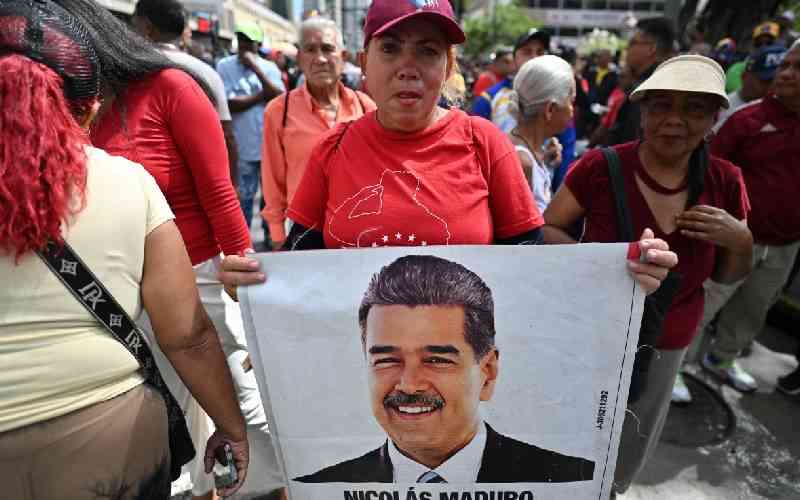
A supporter of ousted Venezuela's President Nicolas Maduro during a demonstration in Caracas on January 4, 2026, a day after he was captured in a US strike. [AFP]

Venezuela’s political crisis took a dramatic turn over the weekend, with President Nicolás Maduro experiencing one of the most consequential reversals of his decades-long grip on power.

Maduro, who until recently controlled the levers of the Venezuelan state, was detained alongside his wife, Cilia Flores, following a large-scale US military operation in Caracas on January 3, 2026.

US President Donald Trump confirmed the raid on Saturday, saying American forces had captured the Venezuelan leader. He also announced that the United States would temporarily assume control of Venezuela, a move that prompted celebrations in some quarters and sharp international condemnation in others.


Born in 1962, Maduro whose other name is Moros rose from humble beginnings as a bus driver and trade union leader to become a close ally of Venezuela’s late president, Hugo Chávez.

Maduro entered politics in 2000 as a member of the National Assembly and later served in several senior roles under Chávez, including president of the National Assembly, minister of foreign affairs from 2006 to 2012, and vice president from 2012 to 2013.

After Chavez died in 2013, the ruling United Socialist Party of Venezuela selected Maduro as its presidential candidate. He narrowly won that year’s election. Critics, however, argue that subsequent elections, including the 2024–25 presidential vote, were neither free nor fair.

Maduro’s rule has widely been described as authoritarian, marked by allegations of electoral manipulation, corruption, human rights abuses, and severe economic decline.

Minutes after his swearing-in in January 2019, the Organisation of American States (OAS) approved a resolution declaring his presidency illegitimate. Several countries also downgraded or closed their diplomatic missions in Venezuela.

By March 2019, more than 50 countries, including the United States, Canada, and Brazil, had refused to recognise Maduro as Venezuela’s legitimate president.

Some reports by the United Nations and Human Rights Watch have accused Venezuelan security forces of widespread abuses, including extrajudicial killings, during Maduro’s tenure. Millions of Venezuelans have fled the country, which has a population of about 28 million.

In 2021, the International Criminal Court (ICC) announced it was opening an investigation into alleged crimes against humanity in Venezuela.

Maduro has since denied all allegations, accusing the United States of conspiring to destabilise Venezuela and engineer regime change.

The US government has accused Maduro of leading a narcotics trafficking network tied to the ‘Cartel of the Suns,’ a term used for Venezuelan military and government officials allegedly involved in the drug trade.

The US charged him with narco-terrorism, conspiracy to import cocaine, weapons offenses, and other serious crimes, allegations that Maduro dismissed, calling them a pretext for US intervention.

Security expert Elkana Jacob says that despite the narcotics charges by the US, it will be an uphill task for the courts to directly link Maduro with the ‘Cartel of the Suns’ since it is a complex and loosely defined network.

“It is debatable to link him directly to the cartel. In the same way locally, we associate political figures with cartels or illegal gangs, proving that, especially in a court of law, it is tricky,” says Elkana, who spoke to The Standard.

According to former Foreign Affairs Principal Secretary Macharia Kamau, Trump stands to greatly benefit from the arrest of Maduro.

“The US will also have free access to the world’s greatest oil reserves and gold as well. Actually, we are watching a replay of the script of Libya, Kuwait, and Iraq,” Kamau told The Standard.

The diplomat says that politically, America will be trumpeting its democratic credentials by getting rid of a dictator. Geopolitically, the US is now repositioning its supremacy in the western hemisphere. “The Trump administration is positioning itself for a possible takedown of the Cuban regime. 60 years after Fidel Castro, the revolutionary and former President of Cuba,” he said.

Under international law, using military force to seize a sitting Head of State without consent or United Nations authorisation violates core principles of sovereignty and international law.

Many Venezuelans celebrated the news, seeing it as an end to years of economic hardship, political repression, and corruption that drove millions into poverty and mass migration abroad.

“For these citizens, Maduro’s removal represented hope for democratic renewal and relief from decades of mismanagement and crisis,” Foreign Relations expert Edwin Kipyegon observed.

Maduro maintained mutual friendships with Russia, China, Cuba and Iran. However, the bilateral agreements were purely based on oil, military cooperation, and geopolitical alignment against US influence. “His relations with Latin America were mixed, considering that Colombia’s leftist president criticized US actions but also distanced from Maduro’s governance,” says historian and professor Macharia Munene.

Maduro’s regime rested on a tight network of political and military officials often accused of corruption, repression, and links with criminal groups. Some of the known inner circle include Cilia Flores, who is the First Lady and longtime political ally, Vice President Delcy Rodriguez and Vladimir Padrino Lopez, who is the Defense Minister with strong army ties.

Vice President Delcy Rodríguez is now the interim president, having assumed presidential powers upon Maduro’s arrest on Saturday.

The US claimed she was sworn in under their oversight, though Rodriguez herself disputed this, demanding his release and insisted Maduro remained the legitimate president, deepening the constitutional crisis.