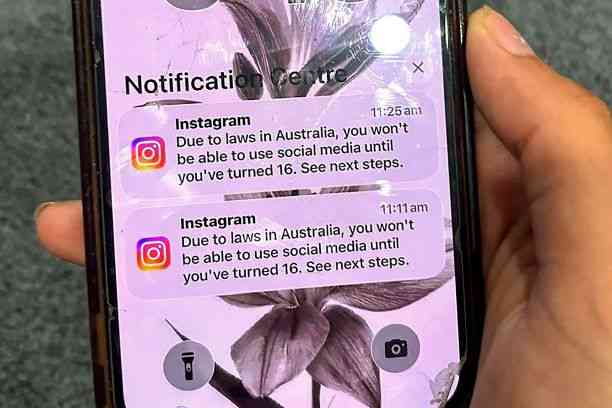
Australia banned young teenagers from social media on Wednesday, launching a world-first crackdown designed to unglue children from addictive scrolling on the likes of Facebook, Instagram and TikTok.
A raft of the world's most popular apps and websites face US$33 million fines if they fail to purge Australia-based users younger than 16.
Australia becomes one of the first nations to so forcefully push back against tech titans wielding immense political power.
The government says unprecedented measures are needed to protect children from "predatory algorithms" filling phone screens with bullying, sex and violence.
"Too often, social media isn't social at all," Prime Minister Anthony Albanese said ahead of the ban.
"Instead, it's used as a weapon for bullies, a platform for peer pressure, a driver of anxiety, a vehicle for scammers and, worst of all, a tool for online predators."
The laws came into effect after midnight local time across Australia.
Hundreds of thousands of teenagers will wake up to find themselves locked out of apps they once scrolled for hours each day.
"I don't think the government really knows what they're doing and I don't think it's going to have any impact on children of Australia," said 15-year-old Layton Lewis ahead of the ban.
Blacklisted
Facebook, Instagram, YouTube, TikTok, Snapchat and Reddit are forbidden from creating or keeping accounts belonging to users in Australia under 16.
Streaming platforms Kick and Twitch are also on the government's blacklist, as are message boards Threads and X.
The ban is a godsend for parents sick of seeing children stuck to their phones.
Mia Bannister blamed social media for the suicide of her teenage son Ollie, who killed himself last year after he was bullied online.
He was also being served endless dieting videos that fuelled an eating disorder, she said.
Stay informed. Subscribe to our newsletter
"I'm sick of the social media giants shirking responsibility," she told AFP in the lead up to the ban.
"The problem is we hand them a phone, and we hand them the greatest weapon we could hand them."
A growing body of research suggests too much time online is taking a toll on teen wellbeing.
But it is hard to draw firm conclusions that separate phone use from other lifestyle factors.
Father-of-five Dany Elachi said the restrictions were a long-overdue "line in the sand".
"We need to err on the side of caution before putting anything addictive in the hands of children," he told AFP.
'Really distracted'
Tech-savvy teenagers the world over have already taken an interest in Australia's ban.
"Students nowadays, they are really distracted," said Nigerian high-schooler Mitchelle Okinedo, 15.
"Social media today is very important for expressing yourself, no matter how old you are," said Santiago Ramirez Rojas, 16, from Mexico City.
Meta, YouTube and other social media giants have lined up to condemn the ban, which robs their platforms of masses of dedicated users.
While most have begrudgingly agreed to comply, for now, legal challenges are in the wind.
Online discussion site Reddit said Tuesday it could not confirm local media reports that said it would seek to overturn the ban in Australia's High Court.
An Australian internet rights group has already launched its own bid to have teenagers re-instated to social media.
'Rushed' or reasonable?
YouTube has attacked the laws as "rushed" and said they would only push children into deeper, darker corners of the internet.
"At YouTube, we believe in protecting kids in the digital world, not from the digital world."
Australia's efforts will be closely watched by all those worried about the dangers of social media.
Already, New Zealand and Malaysia are mulling similar restrictions.
The Australian government concedes the ban will be far from perfect at the outset and canny teenagers will find ways to slip through the cracks.
But platforms face the threat of Aus$49.5 million (US$33 million) fines if they fail to take "reasonable steps" to stop this happening.
It remains to be seen how Australia's internet safety regulator will interpret what counts as reasonable.
Social media companies bear the sole responsibility for checking users are 16 or older.
Some platforms say they will use AI tools to estimate ages based on photos, while young users may also choose to prove their age by uploading government ID.
Which platforms fall under the ban continues to be debated.
Popular apps and websites such as Roblox, Pinterest and WhatsApp are currently exempt -- but the government has stressed that the list remains under review.
Most social media platforms already require users be at least 13 -- a legacy of US laws setting the minimum age for data collection without parental consent.