×

The Standard e-Paper
Smart Minds Choose Us
 The Standard Group Plc is a
multi-media organization with investments in media platforms spanning newspaper
print operations, television, radio broadcasting, digital and online services. The
Standard Group is recognized as a leading multi-media house in Kenya with a key
influence in matters of national and international interest.
The Standard Group Plc is a
multi-media organization with investments in media platforms spanning newspaper
print operations, television, radio broadcasting, digital and online services. The
Standard Group is recognized as a leading multi-media house in Kenya with a key
influence in matters of national and international interest.

Audio By Vocalize
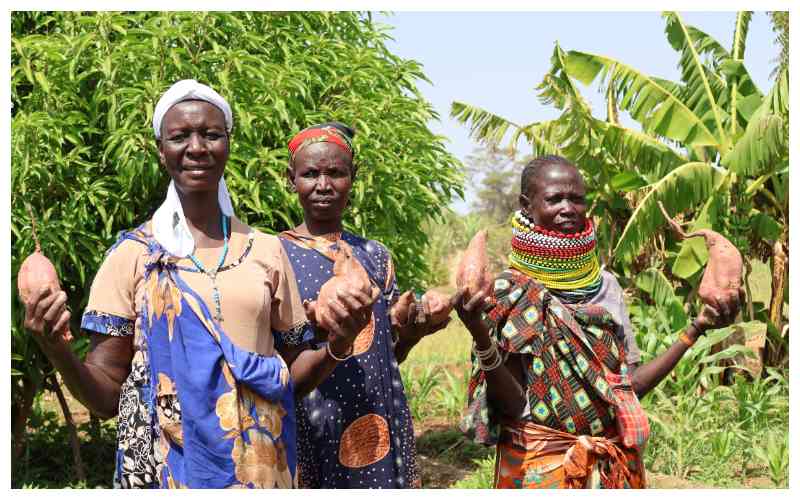
After a more than 50km drive from Lodwar town through sweltering heat and sandy roads, past manyatta homesteads and market centres, we arrive at Nanyee Irrigation Scheme in Loima Constituency, Turkana County.
At the farm, busy women, men, youth and children use hoes to uproot orange-fleshed sweet potatoes (OFSP) from their small plots, which measure 4m by 5m, 5m by 5m or 6m by 7 metres.
Some are preparing for the next planting season, while others fetch water or dig waterways to irrigate their plots.
Some women are seen harvesting sweet potato leaves before uprooting the vines.
According to them, the leaves make a good vegetable when cooked with ugali, underscoring the many uses of OFSP.
Inside the Nanyee Arinyot Farm, a three-acre plot, are various crops, including bananas, maize and vegetables such as cowpeas, as well as a few fruit trees, including oranges, mangoes and lemons.
We meet Mary Ekuwam, a widow and mother of eight whose farm is equivalent to seven plots. She is also the chairlady of the Etic Women Group.
“Before starting potato farming, I used to weave mats, one selling at Sh20, tiresome work. Around 2020, we were introduced to these types of sweet potatoes by ChildFund Kenya through Frontiers Children Development Organisation (FCDO).
We went through a training on how to plant and use them for various purposes,” said Ms Ekuwam to Smart Harvest.
“Today, we plant, harvest and use vines for our livestock, leaves as vegetables and potatoes for food, eaten raw or boiled.
They are sweet and loved by even children. We also dry them and make flour for porridge or sell raw to Lodwar for income.”
Ekuwam says farming has made it possible for schoolchildren to drink porridge at early childhood centres (ECDs), giving them time for other activities.
“Last November, I harvested 40 bags of 50kg each from my plots, sold 35 bags and consumed and shared the rest with neighbours,” she said.
To make flour, the Etic Women Group owns a factory in the Nadapal area, where the potatoes are milled after the peeled ones are solar-dried and packaged for sale.
Stay informed. Subscribe to our newsletter
Today, the 20 women in the group have their own Arinyot Meals flour brand, which comes in two varieties: mix and pure. Arinyot is the traditional name for potatoes in Turkana.
The mix flour has been blended with sorghum and millet flour and sells for Sh250 per half kilo, while the pure flour goes for Sh150 at the factory.
She prides herself in the fact that one of her children has been able to reach university through farming potatoes. As a group, they also have a table banking arrangement where they save earnings from potato farming.
Ekuwam and her fellow farmers have faced challenges, mainly market access and water shortages at the scheme. On market access, she said locals have traditionally not farmed potatoes, relying mostly on cereals such as sorghum and millet, and are therefore slowly adapting to potatoes and flour.
“Few people around us buy the flour, unlike raw potatoes, forcing us to take it to places like Lodwar, 10 kilometres away, where we have a shop for one of us. Recently, we lost 150 kilos of potatoes after they went bad due to lack of buyers,” Ekuwam said.
Scheme secretary Meshak Lokai said a 50kg sack of potatoes fetches Sh2,000.
“We are 51 farmers here, with some owning up to eight plots. Farmers are happy to have embraced this potato farming because of the benefits they get from it, including money and nutrition,” said Lokai.
He says the water challenge has denied them the ability to farm throughout the year.
“The water we use comes from over 1km away from the Turkwel River through a canal, and sometimes we are forced to all go and desilt the canal to get water,” said Lokai, who appealed to well-wishers to intervene.
“If we could get a piped water connection to this farm or tanks installed on our farm, we would farm throughout the year and feed.”
Lokai said the farmers have opened a bank account and now have some savings, which they share towards the end of the year.
According to Faith Nzivo, the OFSP project coordinator at Child Fund Kenya, the project started in 2020 in the Loima and Turkana Central subcounties, with funding from Germany's Federal Ministry for Economic Cooperation and Development (BMZ), to initially combat malnutrition in Turkana County.
After three years, farmers had quickly adopted the crop, which is drought-resistant, fast-maturing, high-yielding, and edible from every part.
“Later, production increased, and vitamin A deficiency was addressed. The farmers then asked where they could take the surplus beyond eating it at home, and that is when the idea of value addition came in to increase shelf life and reach those who are not near Lodwar,” said Nzivo.
“After Child Fund Kenya selected the women group, it supported them with around Sh100 million through BMZ funding for the project’s commercialisation phase, from 2022 to January 2025, when the project ended.”
The OFSP has also been introduced in Samburu County to fight malnutrition.
Nzivo said the organisation has continued to support the group to make the investment more sustainable.
“We want to sustain demand and production since we have discovered the potatoes have financial benefits apart from nutritional value,” said Nzivo.
“The aspect of food fortification has not been adopted in this place by locals, and that is why we are trying to do awareness to increase uptake of fortified flour.”
The OFSPs are gluten-free because they have high beta-carotene content, which the body converts into vitamin A.
“They do not have acidity and are therefore useful for people who have stomach issues when they eat the white variety,” she said.
To expand market access beyond the county, the organisation has developed the Etic application, which allows people to order potatoes and related products online.
“We are also planning to approach shop and supermarket owners in Nairobi to stock our flour, but in Lodwar town we have a shop where one can visit and buy,” she said.
According to Charles Losuru, project manager at FCDO, the potatoes have increased school enrolment and reduced malnutrition levels in the two sub-counties of Loima and Turkana Central, where they are grown.
“In 2025, when we received financial support, we bought flour and raw potatoes from the women and distributed them to schools. Today, the schools buy potatoes or flour for cooking porridge for nursery pupils, and the reports we are getting show that malnutrition has reduced significantly,” said Losuru.
According to Nzivo, 8,000 children have improved their vitamin A uptake in the two sub-counties, food diversity has increased, production has risen to up to 128 metric tonnes of potatoes, and farmers’ incomes have improved by over 50 per cent, with more than 12,000 households consuming the potatoes.
Subscribe to our newsletter and stay updated on the latest developments and special offers!

 Prefer the Standard on Google







 join
join