×

The Standard e-Paper
Join Thousands Daily
 The Standard Group Plc is a
multi-media organization with investments in media platforms spanning newspaper
print operations, television, radio broadcasting, digital and online services. The
Standard Group is recognized as a leading multi-media house in Kenya with a key
influence in matters of national and international interest.
The Standard Group Plc is a
multi-media organization with investments in media platforms spanning newspaper
print operations, television, radio broadcasting, digital and online services. The
Standard Group is recognized as a leading multi-media house in Kenya with a key
influence in matters of national and international interest.

Audio By Vocalize
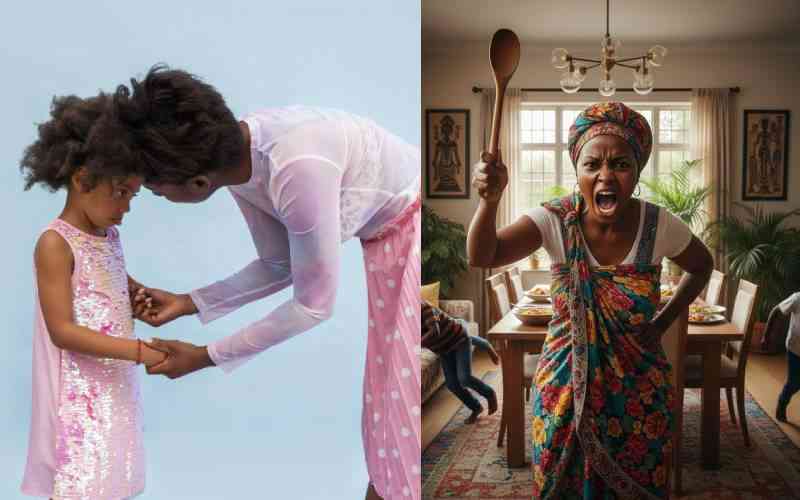
Trends come and go on social media every day, but few feel as relatable as the phrase “African mums be like” on TikTok, which has become a genre of its own.
From skits about being sent to fetch the remote that is right next to the person asking, to being compared with the neighbour’s clever child, getting a beating for crying after a beating, to dramatic lectures delivered with a wooden cooking spoon in hand, the content may be funny, but it is painfully accurate.
Behind all the viral humour sits a difficult truth. Many African mothers raised their children with a complicated mix of love, fear, duty and inherited trauma.
This is not to say that we are ungrateful or rebellious in the way many of the skits suggest. A little understanding and perhaps some patience here and there would go a long way in breaking what feels like a generational cycle, not just in Kenya but across the continent.
Yet even as parenting styles evolve, many parents are still keen to remind their children that gentleness does not mean permissiveness. They still believe in instilling discipline, only in a way that teaches responsibility without fear.
Generation Z may seem to be leading the charge in normalising change, but millennials are also raising their children differently, with more intention and compassion.
Many millennial mothers are choosing to abandon the methods they grew up with and are challenging long-held ideas around parenting, mental health, money, relationships and gender roles. The journey is not the same for everyone, but it is a start.
Eve Waruingi, a counselling psychologist in Nairobi, believes that discipline and emotional intelligence can coexist. She believes children need boundaries that come from a place of guidance rather than intimidation.
In her words, it is entirely possible to correct a child firmly while still making them feel safe and loved. She echoes Unicef’s position that discipline should focus on teaching rather than hurting, helping children understand choices and consequences without shaming them.
Linda Achieng, now a high school teacher, grew up in a home where crying was considered disrespectful and any form of sadness was met with dismissal or even punishment. As a mother to a four-year-old boy, she is very deliberate about how she raises him.
“When my son cries, I do not tell him to man up or stop crying. I ask him what is wrong and we talk about it calmly. It matters to me that he knows it is all right to express his feelings,” she says.
Linda explains that after she gave birth, she struggled with postpartum depression and it was during therapy that she realised how emotionally distant her own mother had been.
“To realise I had been bullied my whole life by my own mother was quite a discovery. Sadly, it was not out of cruelty. No one had ever taught her any different,” she says.
Ms Waruingi believes many parents were simply in survival mode. They did not have the tools or even the space to focus on emotional intelligence.
“For our parents, the priority was feeding and clothing children. They were also dealing with their own issues without any guidance. The good news is that this generation of parents is making emotional well-being a priority,” Waruingi explains.
Stay informed. Subscribe to our newsletter
Stacy Amondi, a businesswoman, stayed in her first marriage for almost ten years, enduring physical abuse because she lacked a stable income and had been raised to believe a woman must keep the family together at all costs.
“Growing up, my father was an alcoholic and I watched my mother endure abuse every day. She always said she stayed because of us. It was the same with my aunts. They made endurance look noble, but at what price?” she says.
Stacy left her marriage when her daughter turned eight.
“I remember one day my daughter asked why her father kept hitting me. I had to ask myself what she was learning about love and womanhood by watching me. That was when I knew I had to leave.” She says.
Now remarried and co-parenting peacefully, Stacy teaches her daughter about boundaries, self-worth and clear limits in relationships.
“Before getting into another relationship, I was very intentional about the kind of man I wanted in my life and around my daughter. I want her to grow up knowing the difference between love and control. We talk openly about these things and she understands why I had to leave her father,” Stacy says.
For Carol Nekesa, being the firstborn came with the heavy but unspoken burden of the black tax. When she moved from Bungoma to the city to begin her career, what she thought was her path to financial freedom quickly became her family’s safety net. Her dreams were pushed aside so her siblings could go to school.
“It was like a switch flipped. The moment I got my first job, my parents let go of all responsibility. Suddenly, they were constantly broke and I was expected to provide school fees for my younger siblings even though I was barely surviving in the city,” Carol recalls.
The pressure continued to build. The calls became more frequent and the demands constant. She even remembers a time when her parents sent one of her siblings to visit, only for them to reveal they had been sent to investigate how she was spending her money.
“I kept telling myself they were family, but it felt wrong. I was constantly stressed and drowning in debt. No one ever asked if I was all right. It was just demand after demand,” she says.
Now a mother of two daughters, Carol is committed to teaching them financial boundaries early.
“We save as a family. My daughters have piggy banks. They know money is a tool and not a burden. I also make sure they understand that they are not my retirement plan.” She says proudly.
“We have normalised the idea that a woman’s value lies in how much of herself she gives up,” says Ms Waruingi. “But when we teach children to be kind and self-respecting, we interrupt generations of learned neglect.”
Growing up in Kisumu, Linet Atieno’s mother constantly called her lazy, stubborn and moody. In truth, Linet was dealing with undiagnosed ADHD and depression.
“I was the black sheep, the stubborn one who could never fall in line. You could always hear my mother calling me nyathi ma jachien ni (this devil child). There was no language for mental health in our home. You were either straight or stubborn.” Linet says.
Now a mother to a seven-year-old, Linet uses affirmations with her son, practices mindfulness with him and attends therapy herself.
“When he is frustrated, I let him draw or take deep breaths. I tell him it is all right to ask for help. I do not lash out when he gets things wrong, something I never heard growing up,” she says.
Not all cycle breakers are young. Grace, a retired banker from Nakuru, only began her healing journey at 50. Her children were already adults when she realised how much of her parenting had been driven by fear and strictness.
“My children would not call or check in. They had pulled away completely. At first, I was hurt and thought I had raised ungrateful children, but after talking with my daughter and allowing her to speak freely, I realised I had not been the best version of myself as a mother,” she says.
Grace is now showing up differently as a grandmother. She helps with school runs, looks after the children and apologises when she oversteps.
“The first time I apologised to my daughter, she was shocked but relieved to see I could take responsibility. It opened up a new kind of relationship between us,” says Grace.
Ms Waruingi notes that healing is not limited by age. We often think trauma is fixed, but the human heart and mind can change.
She explains that being a cycle-breaking mother does not mean perfect parenting. It means conscious parenting. It means taking a breath before raising your voice, going to therapy, setting boundaries with your own parents and choosing presence over performance.
“Teach your sons that empathy is not weakness and your daughters that love should not hurt. Help children develop emotional language, encourage rest without guilt and remind them their worth has nothing to do with how much they sacrifice,” says Ms Waruingi.
Subscribe to our newsletter and stay updated on the latest developments and special offers!








 join
join