×

The Standard e-Paper
Smart Minds Choose Us
 The Standard Group Plc is a
multi-media organization with investments in media platforms spanning newspaper
print operations, television, radio broadcasting, digital and online services. The
Standard Group is recognized as a leading multi-media house in Kenya with a key
influence in matters of national and international interest.
The Standard Group Plc is a
multi-media organization with investments in media platforms spanning newspaper
print operations, television, radio broadcasting, digital and online services. The
Standard Group is recognized as a leading multi-media house in Kenya with a key
influence in matters of national and international interest.

Audio By Vocalize
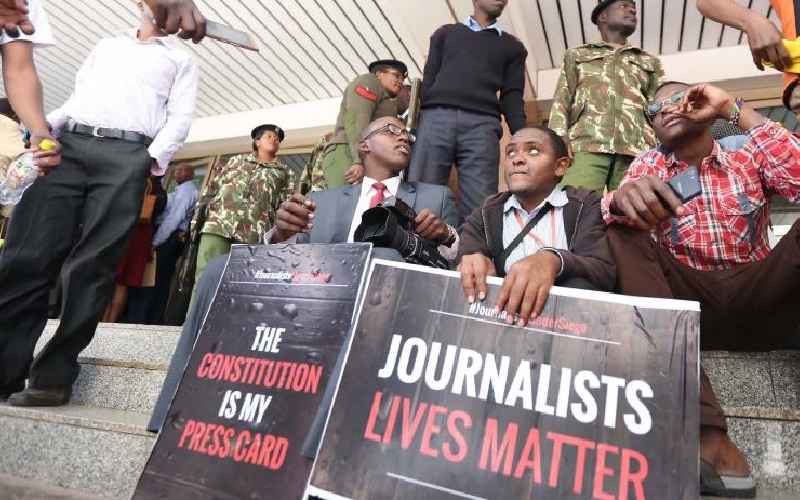
The roles of the media are to inform the public, act as a democratic watchdog, and promote accountability, all while operating under constitutional guarantees of freedom and independence as guided by Article 34 and 35 of the Constitution.
Article 33 of the Constitution of Kenya equally guarantees every person the right to freedom of expression, including the freedom to seek, receive, or impart information and ideas, subject to narrow exclusions in Article 33(2). These exclusions include propaganda for war, incitement to violence, hate speech, advocacy of hatred and ethnic incitement.
The recent commemoration of the sixteenth anniversary of the Constitution saw President William Ruto reaffirm the sovereignty of the Constitution, declaring that peaceful protests, criticism and dissent are essential tools in a democracy, and citizens ought not to be punished for questioning the government.
But the reality seems to be the exact opposite. The abduction of Standard Group Associate Editor Alex Kiprotich shows just how wide that gap runs. What should we make of Mr Kiprotich’s abduction? Is it an isolated incident or does it carry consequences for the journalists who have not yet been targeted?
Journalists occupy a singular place in a democracy, as the Fourth Estate. Their independence is not incidental but foundational, and never more critical than as the country heads to the polls.
The State is obligated to observe, respect, promote and fulfill the rights enshrined in the Bill of Rights. This is not merely a negative duty of restraint; it is a positive duty to protect journalists from third-party and State-agent interference alike. Yet where the very agents entrusted with this protection are themselves implicated, the question answers itself uncomfortably; the guardians cannot credibly investigate the gate they left open.
Kiprotich’s case is not statistically anomalous but sits within a broader documented pattern of enforced disappearances, extrajudicial killings, and attacks on journalists that predates and postdates his own abduction. Restrictions need not be formal law to violate constitutional rights and freedoms for journalists.
The chilling effect doctrine becomes a viable reference in this case. It is sufficient that a credible pattern of intimidation, harassment or violence produces the same practical result of censorship. It demands that a journalist withholds certain stories, softens coverage or avoids certain stories altogether, not because the law forbids but because the risk of reprisal makes silence a better choice.
The broader constitutional challenge is what that kidnapping conveys to all Kenyan journalists covering government behaviour when it is built over an established pattern that preceded it. One unresolved occurrence can be written off as an aberration but in light of a wider proven increase in enforced disappearances, a second attempt on the same journalist within two months is no longer a threat to a single individual but rather a warning to a whole profession.
It is salient to note that there is an accountability gap that translates to a constitutional breach and is by no means simply a policy failure. In instances where a vehicle used in an attempted abduction, and later an actual abduction, is traced to a specific security unit, the question that follows is inescapable: Who investigates and who is held to account when the suspect and the investigator may sit within the same institution?
IPOA's mandate exists precisely for this scenario; an independent civilian oversight of the police, yet the absence of a published, time-bound investigation into either incident leaves that mandate untested here, and the resulting silence reads as institutional non-compliance rather than mere oversight. Article 2(4) of the Constitution renders any conduct inconsistent with the Constitution void; a state that affirms press freedom in speech and on paper, while an accountability vacuum persists in practice, risks constitutional performativity.
Consequently, the imperative is not merely rhetorical solidarity but structured protection and concrete accountability. The constitutional guarantee of media freedom is not self-executing; it demands sustained institutional follow-through. The National Police Service Commission, the Independent Policing Oversight Authority (IPOA), the Directorate of Criminal Investigations (DCI), the Kenya National Commission on Human Rights (KNCHR), the Office of the Director of Public Prosecutions (DPP) and the Media Council of Kenya must each discharge their distinct mandates in this chain: Investigation, discipline, and, where warranted, prosecution of those responsible, rather than statements of condemnation alone.
Abduction is not the sole pressure point either. Subtle types of coercion, such as the withholding of government advertising income, regulatory harassment, and selective licensing action, have also been used against journalists and media outlets. These tactics can have the same deterrent impact without the obvious physical assault. Therefore, a structured protection system has to deal with both the overt and the economic registers of intrusion.
Stay informed. Subscribe to our newsletter
Where institutional accountability stalls on either front, the courts remain the ultimate constitutional backstop. Article 22 of the Constitution of Kenya entitles any person to institute proceedings for violation of a Bill of Rights right whereas article 23 empowers the High Court to grant appropriate reliefs.
Kenya's constitutional order is tested not in its text but in this practice. Sealing that gap is a task for the State's institutions in the first instance but it is also, in no small part, a task for the media and its stakeholders, ourselves included, to keep insisting upon.
Subscribe to our newsletter and stay updated on the latest developments and special offers!


 Prefer the Standard on Google