×

The Standard e-Paper
Smart Minds Choose Us
 The Standard Group Plc is a
multi-media organization with investments in media platforms spanning newspaper
print operations, television, radio broadcasting, digital and online services. The
Standard Group is recognized as a leading multi-media house in Kenya with a key
influence in matters of national and international interest.
The Standard Group Plc is a
multi-media organization with investments in media platforms spanning newspaper
print operations, television, radio broadcasting, digital and online services. The
Standard Group is recognized as a leading multi-media house in Kenya with a key
influence in matters of national and international interest.

Audio By Vocalize
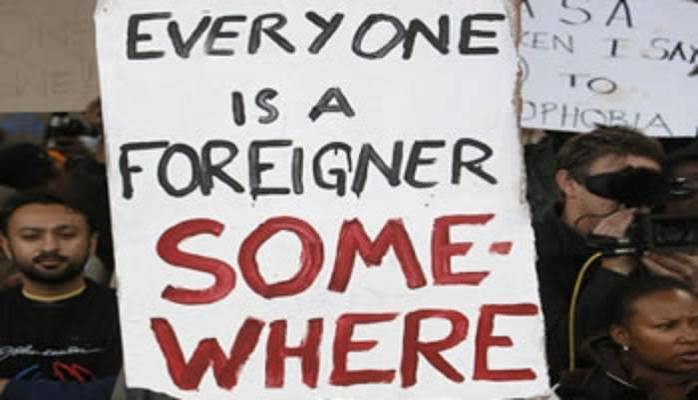
Lately, scenes out of South Africa have been of terror-gripped, effects-schlepping foreigners lining up to catch the next plane or bus out of the country following the latest wave of xenophobic attacks.
Close to 30,000 people, including tens of Kenyans, had, as of May 30, 2026, been deported, according to the government of President Cyril Ramaphosa. And thus continues the idiocy of visceral, Black-on-Black hate, with South Africa as a jurisdictional constant.
At the heart of the problem are economic opportunities—hard-to-find for the locals, while proving an irresistible pull for foreigners—and, of course, crime. When Apartheid ended in May 1994, it was hoped that the Freedom Charter, a re-founding document that promised equity, fair distribution of national resources and fair factory wages and dividends, would be implemented fully—and sooner.
What followed, instead, was betrayal as resource-endowed White entrepreneurs co-opted hitherto Black champions of economic justice, including now-president Ramaphosa, palming them off with positions on big-business boards that saw to their becoming both wealthy and threat-blunt.
Dividends owed to workers were diverted to enrich venal, perk-cheapened former African National Congress firebrands who, in turn, looked the other way as settler-owned banks aggravated Black South Africans' pain with extortionate interest rates on car and mortgage loans. The betrayal-enabled status quo preservation ensured much of the country's wealth and land—up to 80 per cent—remained in the hands of the minority Whites. And a very important part of Black South Africans' plight typified by abject resource privation remains the long-unaddressed question of historical White-on-Black predation.
Settlers' proprietorial control over South Africa's national resources may be traced back to the expansionist clashes pitting Europeans—the Dutch and the British—against the natives, including the Xhosa Wars of 1779-1879, which saw to the displacement and dispossession of local tribal groupings while enabling inbound migration as well as simultaneous, foreigner-perpetrated land takeover.
In 1820, poverty-fleeing migrants from the UK arrived and settled, under a government scheme, in the Zuurveld region (now Albany), and the First and Second Anglo-Boer Wars of 1880-81 and 1899-1902, respectively, resulted in the victories and treaties that only promoted, and ensured resource augmentation for, settler privilege.
It is this White minority privilege that should be addressed to, not only end once-and-for-all the ill-aimed intermittent, host-instigated attacks on immigrant fellow Africans, but also achieve full post-Apartheid reconciliation in ‘the Rainbow Nation’. While, in the last about 20 years, the world has been treated to scenes of senseless, host-on-immigrant attacks—2008, 2009, 2012, 2013, 2015, 2018, 2019, 2022 and 2026—across South Africa; and as local politicians and businesspeople almost always exploit the situation to attain hollow advantage, the opportunity to forge the necessary, leadership-enabled progress of, and for, all remains woefully missed.
Despite a 2005-to-2019-time-period-focused report by the United Nations International Organisation for Migration that shows South Africa to have been the continent's single-largest recipient of immigrants lately, the country is, no doubt, fast becoming one of the world's most dangerous places to live, work and do business in as a dark-skinned non-native, particularly.
At least 62 per cent of native South Africans evince negative sentiment towards foreign nationals, according to a 2018 Pew Research poll, while up to 61 per cent reportedly believe immigrants to be more responsible for the high crime rate than other groups— with contested evidence.
South Africa—arguably Africa's last bastion of the otherwise long-extolled Ubuntu zeitgeist—appears bent, and strangely so, on leading, and presenting the rest of the continent with an archetypal goad for, xenophobia-fuelled intraregional self-ruination.
Today, the Nelson Mandela-exemplified spirit of forgiveness, reconciliation, embrace and mutual empathy for which the world once recognised, idealised and celebrated post-1990 South Africa, is barely identifiable for the slow but certain, hate-ensured atrophy.
South Africa has, over nearly 20 years of nugatory xenophobic ferment, ‘successfully’ courted the unenviable position of a pariah state redolent of the UK's Brexit-moment near-isolation in Europe. Part of the goad for the UK's 2016 plebiscite vote to exit the European Union was a negative, often-politician-stoked anti-immigrant sentiment on the part of the people. Soon enough, though, both the people and politicians across Britain and the larger UK would realise that the ballyhoo-filled Brexit, indeed, was a case of costly national self-harm.
Stay informed. Subscribe to our newsletter
In a world that's more integrated, and where events more increasingly call for interdependence and closer cooperation among nations for both common welfare and prosperity, choosing national self-isolation proved for the UK—as it soon could for South Africa—to be suicidal.
Indeed for South Africa, the just-concluded 2026 Fifa World Cup, and during which the vast majority of those watching across Africa chose to—in retaliation for xenophobic attacks—cheer opponent teams against Bafana Bafana, ought to serve as a taste of things to come.
The lesson is that, in the investment of relations, constancy is its own return. The real loser in the South Africa-caused, xenophobia-fuelled relational falling-out that we've been witnessing as a region in the last few months, though, is the Ubuntu cooperation spirit.
Our history shows that our accomplishments, including the successful struggle against Apartheid as well as the attainment of self-rule elsewhere on the continent, have all been the triumph of our choice, courage, commitment and ability to forge a togetherness bosom. It is this intraregional heritage of understanding, shared values, history, spirit and tradition that's ultimately at stake for us all even as we watch, and are indignant at, one nation's imputation of own job-crisis pinprick to the rest of us.
Subscribe to our newsletter and stay updated on the latest developments and special offers!

 Prefer the Standard on Google






 join
join