×

The Standard e-Paper
Smart Minds Choose Us
 The Standard Group Plc is a
multi-media organization with investments in media platforms spanning newspaper
print operations, television, radio broadcasting, digital and online services. The
Standard Group is recognized as a leading multi-media house in Kenya with a key
influence in matters of national and international interest.
The Standard Group Plc is a
multi-media organization with investments in media platforms spanning newspaper
print operations, television, radio broadcasting, digital and online services. The
Standard Group is recognized as a leading multi-media house in Kenya with a key
influence in matters of national and international interest.

Audio By Vocalize
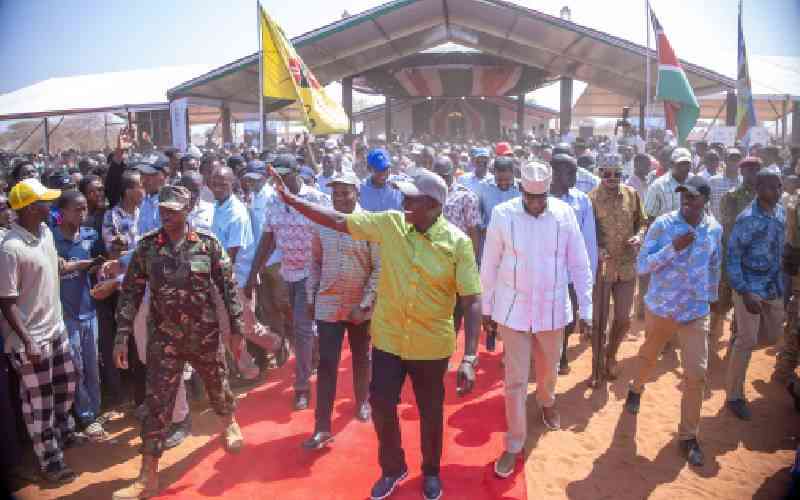
President William Ruto during disbursement of Sh120 million Nyota funds to youth at Wajir Stadium, Wajir County. [File, Standard]
“The greatest injustice in a democracy is not losing an election. It is never being counted in the first place.”
Kenya has lived for decades under the shadow of what has become known as the tyranny of numbers. Every election cycle begins with arithmetic. Political strategists study census reports, voter registers and ethnic voting patterns before they study manifestos. Coalitions are assembled around demographics long before they are assembled around ideas. Development promises are too often calibrated according to electoral weight rather than constitutional need. The result is a politics in which numbers appear to matter more than citizens.
Yet an even greater danger confronts the Republic: the tyranny of ignorance.
The tyranny of ignorance is not about literacy or academic qualifications. It is about civic awareness. It is what allows fear to defeat facts, ethnicity to overshadow accountability and short-term inducements to replace long-term development. It is what convinces citizens that democracy begins and ends on election day. A healthy democracy does not merely require universal suffrage; it requires an informed electorate capable of holding leaders accountable between elections.
Nowhere is this challenge more significant than in Kenya's frontier counties of Mandera, Wajir, Garissa, Marsabit, Isiolo and Tana River. For decades these counties have been discussed through the language of insecurity, drought and marginalisation. Rarely have they been viewed through the lens of democratic opportunity.
Yet that opportunity is enormous.
According to the IEBC’s 2026 enhanced continuous voter Registration (ECVR) and the region’s eligible population profile If every eligible citizen obtained a National Identity Card, registered to vote and participated in elections, these six counties could collectively mobilise approximately 2.5 million voters compared to the last election where only 1,105,033 registered. In constitutional terms, that number is transformative. Under Article 138 of the Constitution, a presidential candidate must secure more than fifty per cent of all votes cast and satisfy the geographical threshold. A cohesive voting bloc of this size could determine whether a candidate wins outright or whether Kenya proceeds to a presidential run-off.
The comparison with Kenya's most recent presidential election is striking. In 2022, President William Ruto was declared elected with 7,176,141 votes (50.49 per cent), defeating Raila Odinga's 6,942,930 votes (48.85 per cent). The winning margin was only 233,211 votes. The Frontier's potential electorate of approximately 2.5 million voters is more than ten times that margin. That is not simply another regional constituency; it is an emerging constitutional force.
To Kenya's political parties, the message is unmistakable: ignore the Frontier at your own peril.
The Frontier will become indispensable to any credible route to State House. Coalitions built solely around yesterday's arithmetic risk becoming prisoners of yesterday's politics.
The implications extend beyond elections. Population significantly influences the Commission on Revenue Allocation's formula for sharing national revenue. Accurate demographic recognition strengthens the region's claim to roads, schools, hospitals, water infrastructure, climate resilience and economic investment. Being counted is therefore not merely a statistical exercise. It is a constitutional imperative linked directly to equity and development.
This is why the controversy surrounding the 2019 Kenya Population and Housing Census became a constitutional question rather than a statistical disagreement.
In Sheikh & 24 Others v Kenya National Bureau of Statistics & 4 Others (Consolidated Petitions 4, 102, 103, 106, 107, 110, 111 & 3 of 2020) [2025] KEHC 3212 (KLR), communities from Garissa, Wajir and Mandera challenged the published census figures, arguing that they did not accurately reflect the enumeration conducted on the ground.
Justice John Onyiego held that the Kenya National Bureau of Statistics failed to uphold the basic standards of data integrity expected of a national census. The Court considered it highly implausible that parts of Garissa, Wajir and Mandera could have experienced population decline or stagnation between the 2009 and 2019 censuses without evidence of a comparable natural disaster, epidemic or large-scale migration. The judgment affected parts of Garissa, Wajir and Mandera, including Mandera North, Mandera West, Banisa, Lafey, Eldas, Tarbaj, Balambala and Garissa Township.
Stay informed. Subscribe to our newsletter
Local leaders argued that the published figures had understated the region's population, with some alleging reductions of up to forty per cent, the Courts conclusion was the disputed results for the affected areas could not stand. The consequences were profound. The High Court quashed the disputed census results, prohibited constitutional agencies—including the Independent Electoral and Boundaries Commission—from relying upon them for revenue allocation, electoral boundary reviews and related constitutional functions, and ordered KNBS to conduct a fresh mini-census.
The lesson is larger than northern Kenya. Census data determines representation, influences the sharing of billions of shillings and shapes the balance of political power. Communities that are not accurately counted risk being underrepresented politically and underserved economically.
A politically awakened Frontier would also reshape Kenya's national agenda. Article 204's Equalization Fund would become a measurable constitutional obligation rather than a campaign slogan. Identity card issuance would be recognised as a democratic right. Infrastructure such as the LAPSSET Corridor, investments in security, education, health and pastoral livelihoods would become issues of national significance because millions of informed voters would insist upon delivery.
But numbers alone are not liberation.
A voting bloc mobilised solely through ethnicity merely reproduces the politics it seeks to overcome. The objective is not to create another tyranny of numbers. The objective is to replace it with informed citizenship.
Nelson Mandela recognised this principle during his testimony in the Treason Trial, where he defended universal adult franchise rather than a qualified vote reserved for the educated. His insight remains relevant today. Democracy is strengthened not by excluding citizens with limited formal education, but by ensuring every citizen enjoys an equal vote while being equipped through civic education to exercise that vote wisely.
The Frontier's mission is therefore clear: document every citizen, register every eligible voter and educate every community. Registration creates voters. Civic education creates citizens.
If that mission succeeds, the Frontier will become more than a decisive electoral constituency. It will become a model for constitutional participation. It will demonstrate that the answer to historical marginalisation is neither grievance nor isolation, but informed democratic engagement.
The Frontier’s destiny will ultimately be determined not only by the size of its population, but by the quality of its leadership and the strength of its unity. When numbers find purpose and leadership finds vision, the forgotten margins become the centre of history. For visionary leadership turns numbers into influence, and unity turns influence into a legacy that can reshape a nation for Generations to come.
The writer is a Governance and Communication Expert
Subscribe to our newsletter and stay updated on the latest developments and special offers!

 Prefer the Standard on Google