×

The Standard e-Paper
Join Thousands Daily
 The Standard Group Plc is a
multi-media organization with investments in media platforms spanning newspaper
print operations, television, radio broadcasting, digital and online services. The
Standard Group is recognized as a leading multi-media house in Kenya with a key
influence in matters of national and international interest.
The Standard Group Plc is a
multi-media organization with investments in media platforms spanning newspaper
print operations, television, radio broadcasting, digital and online services. The
Standard Group is recognized as a leading multi-media house in Kenya with a key
influence in matters of national and international interest.

Audio By Vocalize
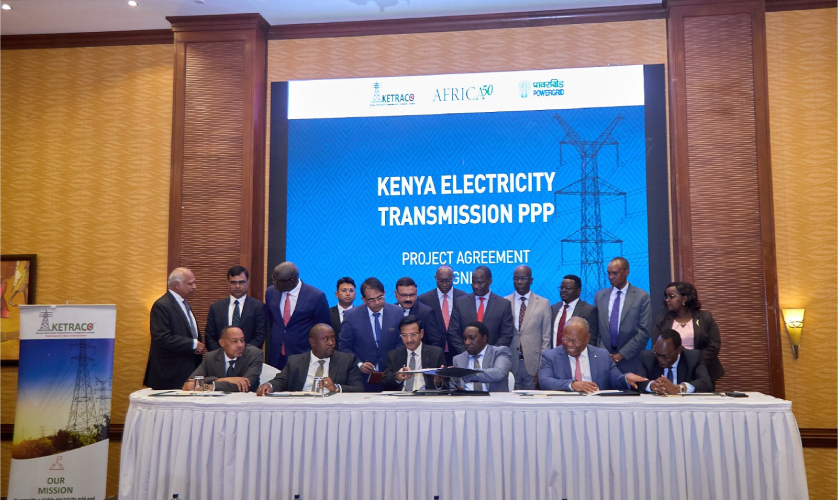
Kenya’s energy sector has long been regarded as commercially viable, demonstrating sector revenues exceeding Sh231 billion annually and attracting private investment in power generation for decades. Yet, for all this success, private capital has largely stopped at the power plant gate. The recent commercial close of energy transmission PPP between KETRACO, Africa50 and POWERGRID Corporation of India marks an important shift in Kenya’s energy story, one that extends private sector participation beyond generation and into the national grid itself.
Transmission assets share several characteristics that align well with PPP structures. They demand significant upfront capital investment, but once built, their operating costs are relatively predictable, and their economic value is realised steadily over long asset lives. This combination produces stable, long-term cash flows, an attractive proposition not only for project lenders, but also for institutional investors such as pension funds seeking core or core-plus infrastructure assets aligned with patient capital.
At the same time, the rapid expansion of renewable generation is placing new demands on the grid. Evacuation corridors must be built and existing networks reinforced if clean power is to reach consumers. Kenya is therefore facing estimated transmission investment needs of about USD 200 million annually over the next decade. In this context, transmission PPPs offer a practical and timely response to a growing financing and delivery challenge, one that ambition alone cannot solve.
While the asset class may be well-suited to PPPs, Kenya’s experience shows that private capital does not mobilise itself. Successful projects depend on rigorous preparation and credible structuring. In practice, three key conditions must be in place if transmission PPPs are to reach financial close.
First, robust planning and early-stage feasibility work are critical. In Kenya’s case, the Least Cost Power Development Plan provides a transparent, data-driven roadmap for generation and network expansion. For investors, this clarity reduces uncertainty around future electricity demand and ensures that load growth and associated risks are well understood, even when the public sector retains the demand risk.
Second, legal and regulatory clarity plays a decisive role. Kenya benefits from a relatively mature framework anchored in the PPP Act and the Energy Act, which clearly define institutional mandates, approval processes and procurement rules. Recent regulatory developments, such as the Energy (Electricity Market, Bulk Supply and Open Access) Regulations, further signal the government’s intention to expand private participation not just in transmission, but also in battery storage, and potentially even distribution.
Third, stakeholder coordination is critical to maintaining momentum. Close collaboration among government agencies, project sponsors, regulators, and legal advisors helps prevent bottlenecks and ensures alignment across approvals. Equally important is structured public engagement, which mitigates social risk and reduces the likelihood of delays further down the line.
One of the most consequential structuring decisions for Independent Transmission Projects is the choice between availability-based and user-pay models. Under the availability-based payment model, the private partner is paid for keeping the asset operational in accordance with stipulated performance standards, rather than for the actual flow of power. This model is suitable for national grid systems, whereby transmission operators typically have no control over how much power flows through the network. In Kenya, this approach has been adopted, reflecting the reality of the grid’s utilisation driven by system dispatch and planning decisions. This mirrors international best practice and has been widely adopted in markets such as Latin America and India.
That said, user-pay models remain viable where the customer base is clearly defined and demand is predictable. For example, for dedicated transmission lines serving mines, industrial parks, or data centres from a specific generation source. Kenya’s Open Access framework could support such arrangements, particularly for clean energy supply from geothermal fields serving energy-intensive users in our special economic zones.
Ultimately, the choice of payment model shapes the project’s risk profile, influences the cost of capital, and determines investor appetite. Choosing the right approach is therefore critical to making transmission PPPs bankable and sustainable.
Public Concerns about tariff affordability often dominate debates around private sector participation in the energy sector. Consequently, careful selection and prioritisation of transmission projects for implementation based on the system benefits that they will deliver is crucial.
The recently concluded ITP transaction in Kenya includes two strategically significant assets. The 400kV Lessos–Loosuk transmission line that will provide an alternative evacuation route for renewable energy from the Lake Turkana Wind Power project and traverses the North Rift geothermal complex, positioning it as a primary evacuation corridor for upcoming geothermal generation. This will enable the gradual displacement of expensive thermal generation. Meanwhile, the 220kV Kibos–Kakamega–Musaga line extends high-voltage supply into Western Kenya, improving reliability, increasing renewable energy penetration and expanding access to historically underserved areas.
Collectively, these projects will enable greater integration of low-cost renewables, reduce system losses, connect new users and improve reliability, thus addressing suppressed demand. All of these will contribute to lowering the long-run marginal cost of electricity. Therefore, while availability payments will result in a modest near-term increase in tariffs, the long-run effect is expected to be positive for the end-users.
Stay informed. Subscribe to our newsletter
Subscribe to our newsletter and stay updated on the latest developments and special offers!

 Prefer the Standard on Google








 join
join