×

The Standard e-Paper
Join Thousands Daily
 The Standard Group Plc is a
multi-media organization with investments in media platforms spanning newspaper
print operations, television, radio broadcasting, digital and online services. The
Standard Group is recognized as a leading multi-media house in Kenya with a key
influence in matters of national and international interest.
The Standard Group Plc is a
multi-media organization with investments in media platforms spanning newspaper
print operations, television, radio broadcasting, digital and online services. The
Standard Group is recognized as a leading multi-media house in Kenya with a key
influence in matters of national and international interest.

Audio By Vocalize
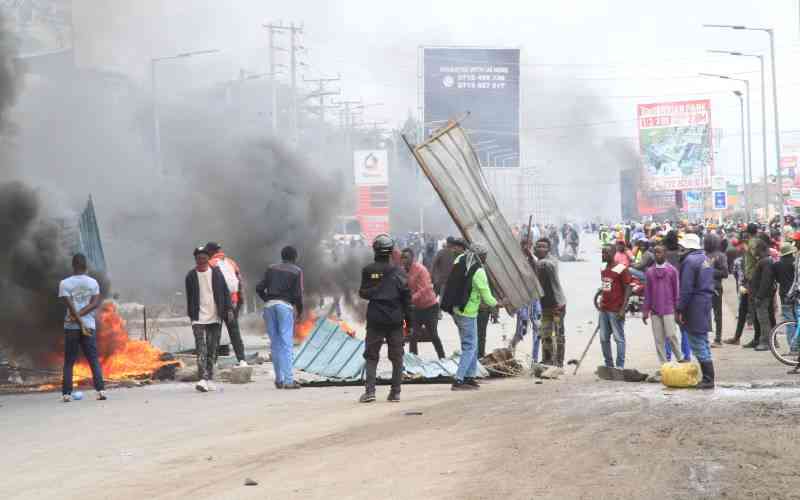
Protesters barricade the Nairobi-Namanga highway at Kitengela town in Kajiado County during demonstrations against high fuel prices. [Peterson Githaiga, Standard]
There is a sound rising from the streets, the markets, the matatu stages and the cramped rental rooms of this republic. It is not theatre. It is pain — unfiltered and undeniable. When Kenyans say they are pressed, they mean it. These are the same people who, when things ease, will tell you with equal candour that life has become manageable. They do not dramatise in either direction. Their testimony is their economics.
And yet something disturbing has become a signature feature of our national governance: a leadership that responds to the cries of its citizens not with compassion, but with scorn. We have a leadership that is telling its crying citizens, “Shut up! And if you do not shut up, we will shut you down.” It is not always said in those words. But this indifference is communicated unmistakably in the tone of press briefings and the posture of spokespersons. The people do not feel felt. And because they do not feel felt, they do not feel loved - they feel abused.
The tragedy of Kenya’s governance moment is not primarily economic. It is relational. The hard-times speech — the belt-tightening calls, the assurances that the global economy is to blame — is written for the poor and delivered from a helicopter.
The decision-makers know the crisis is global. So does the ordinary Kenyan. That is not the dispute. The dispute is: Why does the pain land exclusively on those already on the ground? Politicians and others in power can pay Sh5,000 per litre without feeling the impact. When they speak of austerity, they do not speak from inside it. They speak from above it.
There is a word for this in the prophetic tradition: injustice. Not merely inequality — injustice. Because injustice is not simply the gap between the wealthy and the poor; it is the wilful refusal to feel the weight of that gap while wielding the power to close it.
Economic formulas without moral imagination is a sophisticated machine with no soul. A soulless machine, however precise, cannot govern a people. Soullessness will soon turn into the very void it created.
Governance is not arithmetic. It is covenant — the oath that power shall be exercised for the welfare of all, not the comfort of the few. When that covenant is replaced by manipulated statistics, the citizen hears one thing clearly: you are a variable, not a person.
What Kenya requires is more human beings at the table of power — minds committed to compassionate creativity, where the system exists for the people, not the people for the system.
Prideful power wielders in the broadbase formation have declared themselves custodians of superior brains and dismissed the opposition as intellectually unqualified to govern. The nation has been waiting, patiently, for the evidence.
It has not been easy to find.
What the country has witnessed instead is sunroof thinking — governance announced from moving vehicles before the dust has settled, policies unveiled before the people who must live under them have been asked a single question. Real brains know the non-negotiable value of reflection, consultation, and careful thought. Kenya cannot be governed through the sunroof philosophy — allergic to depth, fluent in shallow jibes and propped up by a chorus of hired claps.
Someone needs to tell the politicians in government something they may not want to hear: they look incapable of compassion. Not because compassion is beyond them as human beings — but because they have spent so much time attacking the people and protecting their own interests that when they show up in places where compassion is required, we cannot feel what they are saying.
The emotional credibility has been spent. The moral account is overdrawn. Their volume is up - but their crowd is cut.
Compassion
Stay informed. Subscribe to our newsletter
When a leader who spent Monday manufacturing narratives that vilify citizens shows up on Friday to comfort parents whose children perished in a dorm fire, the optics may be managed — but the people are not moved. They can tell the difference between solidarity and performance. More so when a prayer breakfast goes uninterrupted, unmoved by the wailing of grieving parents.
Compassion, to be felt, must be consistent. It cannot be switched on for public consumption and switched off in the policy room. A government that squeezes the poor through taxation and then appears at their bedsides is not demonstrating care — it is demonstrating contradiction.
Kenya’s local strain of corruption multiplies suffering exponentially. It is not only the siphoning of funds. It is the culture of contempt — the silent message embedded in every corrupt transaction: the people do not matter. Your taxes are our perks. Your suffering is our inconvenience. Your voice is our problem. And as we pray, the poor are the breakfast.
That perception does not merely discourage citizens — it radicalises them. In a democracy, when the oppressor grows harder, the freedom seeker grows bolder.
Nehemiah hears something that stops him cold - the cry of his own people, being crushed by debt and the indifference of those with power. He heard. He felt. He acted. He did not convene a press conference to explain why economic conditions were globally challenging. He called the powerful to account and gave back what had been taken. Leadership, in the biblical imagination, is not the management of the people’s expectations. It is the stewardship of the people’s welfare.
The church must move from commentary to action — from description to production. It must take its redemptive responsibility seriously, assemble its faith-based thinkers, and offer public solutions for easing the suffering of the people.
At the root of Kenya’s crisis is the crisis of a people who do not feel felt. Human beings can endure extraordinary suffering when they believe that someone in power knows their name and is losing sleep over their welfare. They cannot long endure ordinary hardship when they are made to feel invisible.
This is governance theology - power choosing proximity over distance. Kenya’s leaders are yet to learn what the manger taught — that the greatest authority belongs not to those who can afford to stay removed, but to those with the courage to come close.
The people are pressed. They are not pretending. Someone must feel that — and act accordingly.
@edward_buri

Subscribe to our newsletter and stay updated on the latest developments and special offers!











 join
join