×

The Standard e-Paper
Stay Informed, Even Offline
 The Standard Group Plc is a
multi-media organization with investments in media platforms spanning newspaper
print operations, television, radio broadcasting, digital and online services. The
Standard Group is recognized as a leading multi-media house in Kenya with a key
influence in matters of national and international interest.
The Standard Group Plc is a
multi-media organization with investments in media platforms spanning newspaper
print operations, television, radio broadcasting, digital and online services. The
Standard Group is recognized as a leading multi-media house in Kenya with a key
influence in matters of national and international interest.

Audio By Vocalize
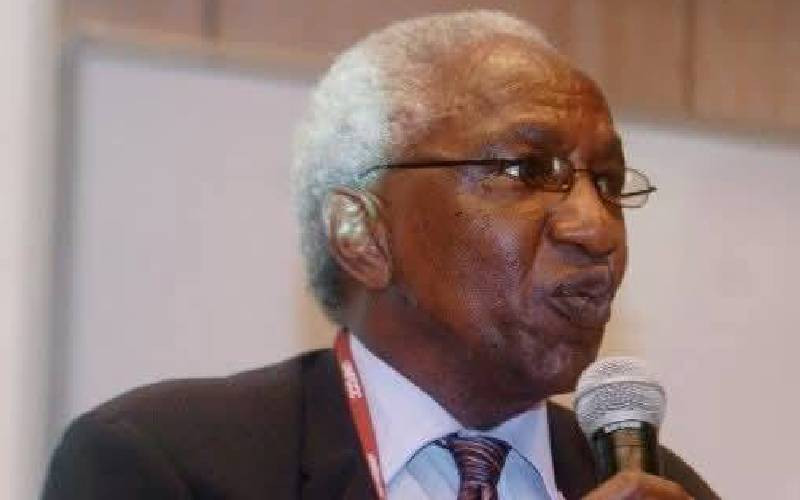
I met Prof Shem Oyoo Wandiga on several occasions since 2024 for hours‑long interviews. The first time, he corrected my pronunciation of his name. “It is Wa‑ndi‑ga,” he said, “not Wan‑de‑ga.” I asked him why that distinction mattered. He smiled and said nothing. The second time, after hours of conversation about chemistry and climate change, he told me the story of his name.
He was born Shem Oyoo Wandiga. Oyoo is as Luo as the nyatiti and the shores of Lake Victoria. He left the country for further studies in the US, but when he returned in 1972 after nearly a decade, a PhD from Case Western Reserve University in his pocket, he learned quickly that an overtly Luo identity closed institutional doors. So he stopped using Oyoo in official settings. He became simply Shem Wandiga. “Wandiga”, he told me quietly, sounded close enough to Central Kenya names like Wanjiga. It created a phonetical ambiguity. In a system built on tribal gatekeeping, it forced bureaucrats to pause and wonder. They did not know for sure.
To mute that single syllable and survive Kenya’s toxic tribal environment, a brilliant man was forced to hide a name that foretold his exact destiny. The system tried to block his path, yet his entire life became an unyielding crusade to carve out pathways for others.
He was not ashamed of being Luo. He was strategic. That small act of self‑erasure – the muting of a single syllable – is the key to understanding his entire life and the quiet tragedy of an entire community.
His father, Pastor Mathayo Wandiga, was a close friend of Jaramogi Oginga Odinga. That generation of Luo leaders sent their children to school with a simple instruction: the fish in the lake will not last forever. Your only inheritance is your mind. Study hard.
Shem listened. He became one of the brightest minds of his generation. But he learned that education alone does not guarantee a full life in Kenya.
There are countless tales of Luos who had to adjust their names to survive. Prof Rok Ajulu, born Richard Odero Ka‑Rosa, creatively turned his name into Rok Ajulu while still a university student. Ajulu is also a Luo name, but it lacked the obvious identifier Odero. The goal was the same as Wandiga’s: to slip through the gatekeeping. Ajulu later became a towering figure in the anti‑apartheid struggle, strategised for the final defeat of white minority rule, and was never properly honoured by the ANC. His death in 2016 received coverage largely because one South African‑based Kenyan journalist pushed Kenyan media to notice. The South African press did its duty, but at home, a man of his calibre might have been buried in silence.
In my own family history, a gravestone carries a stark verdict. The late Colonel Joseph Quincy Mbewa spent far longer as a major in the Kenya Defence Forces than any man of his competence should have. On his stone, he left an instruction: “Life is a big joke.” My late mother, Margaret Judy Akinyi Mbewa, added her agreement: “And I completely agree with him.” That agreement was not cynicism. It was a mother’s testimony that the system had failed even the most deserving.
The French philosopher Frantz Fanon observed that the system forces the most brilliant and upright natives to live a fragmented existence – never fully recognised, never fully rewarded. The joke is that you play by the rules, you refuse to steal, and the system rewards you with a glass ceiling that is invisible but unbreakable.
Prof Wandiga knew this joke intimately. In our interviews, he expressed quiet pride that he never abused his positions to amass wealth. He served as deputy vice‑chancellor of the University of Nairobi from 1987 to 1994, chairman of multiple university councils, and chancellor of Egerton University. He was a Fellow of the Royal Society of Chemistry and a recipient of the UNESCO Medal Prize. Yet he lived modestly. He wondered, without bitterness, why those who had done the opposite were richer, more celebrated, and never held to account.
There is one achievement that has touched nearly every educated Kenyan household, yet has never been covered by the Kenyan press. He was the primary technical architect of the higher education funding system. As deputy VC, he chaired the Policy and Planning Task Group for the Ministry of Education. In the late 1980s, the public university system was collapsing. The government was paying for everything – tuition, room, board, and allowances – for every student. Enrolment was surging, the Exchequer was empty, and student riots were shutting down campuses.
Wandiga designed the shift to cost‑sharing and targeted means testing. That blueprint became the Higher Education Loans Board (HELB) Act of 1995. Using his global credibility as a scientist, he personally negotiated a $60 million World Bank credit line to fund the transition. Millions of Kenyans – doctors, engineers, teachers, journalists – went through university on a HELB loan he designed. He did not administer the board. But the architecture is his.
And here the hidden meaning of his birth name finally breaks through. In Luo, Yoo means a pathway or a road. Oyoo literally translates to a pathway or, properly, a pathway man. The gatekeepers could not stop the destiny embedded in his name. As the hidden pathway, he engineered the ultimate pathway for the youth.
That quality – the refusal to trade integrity for comfort – is found disproportionately among Luo professionals. From Jaramogi to Tom Mboya, from Raila Odinga to Pheabe Asiyo, and from Grace Ogot to Shem Oyoo Wandiga – these Luos share a painful, paradoxical nobility. They were too smart to steal. Too principled to cheat. Too proud to beg. And the system, which fears their intelligence, starved them of the rewards that should have come with their excellence.
Even when the state offered token recognition, the underlying joke remained. During the NARC government’s honeymoon phase, he was awarded the Moran of the Order of the Burning Spear. But he watched the award lose all operational value the moment President Kibaki and Raila fell out.
Stay informed. Subscribe to our newsletter
When he died on May 18, the press barely noted his passing. That is the joke.
But the pathway builder was not finished. In his final years, he championed a multi‑billion‑shilling nuclear power plant on the shores of Lake Victoria in Bondo, Siaya County. As chairman of the Council of Jaramogi Oginga Odinga University of Science and Technology, he anchored the academic framework to train local brains to run this infrastructure. Traditional green energy is intermittent. A modern industrial nation needs an unbreakable, climate‑resilient baseload of zero‑carbon electricity. That is what nuclear provides. Light so that children could study at night. Light to power factories so that the pathways he built through HELB did not lead to empty promises. He also served as an advisor on energy policy to the late Raila, a role confirmed by Dr Oburu Oginga in his public tribute.
But the Kenya he returned to in 1972 had not yet learned to celebrate such logic.
I am writing this because silence is another form of marginalisation. The media dedicates thousands of hours to politicians who have done far less for the structural foundation of this country. A man who changed global environmental policy – who proved that DDT degrades in three months in the tropics, not 10 years – dies, and the press barely stirs.
Some who knew him might say he would have shunned the spotlight. That is true. But the French sociologist Émile Durkheim wrote that when a person dies, their legacy becomes a “social fact” – a possession of the collective. Wandiga’s story is no longer his alone. It is a blueprint for every child from a marginalised community who wonders whether brilliance will ever be enough. A forest does not ask the tallest tree whether it wishes to be seen.
Though he was speaking of Africa’s need to adapt to climate change rather than wait for outside help, the same logic applied to his own life. He told me once: “When a snake comes into your house, you use what you have to kill it or get it out.” He used what he had: a mind that could outthink the world, a patience that outlasted insults, and a quiet strategy of survival that included hiding his own name.
He is gone now. The snake of underdevelopment still lives in the house. But we can choose to remember him fully – not as Shem Wandiga, the safe name, but as Shem Oyoo Wandiga, the Luo boy from Simbi Village who became a titan.
And if life was a big joke, at least he laughed last – with a discovery that changed global science, a loan system that educated millions, a nuclear plant on the horizon, and a lesson that the truly educated do not need to steal.
Rest, professor. The pathway you hid now leads millions forward.
Subscribe to our newsletter and stay updated on the latest developments and special offers!

 Prefer the Standard on Google





 join
join