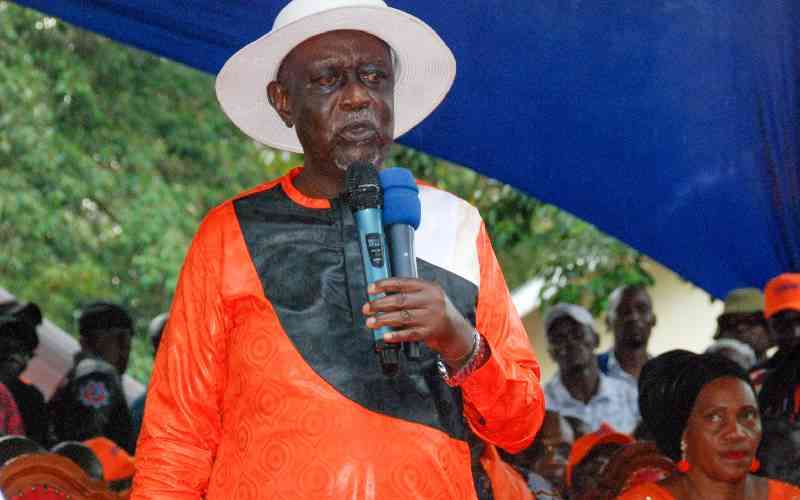
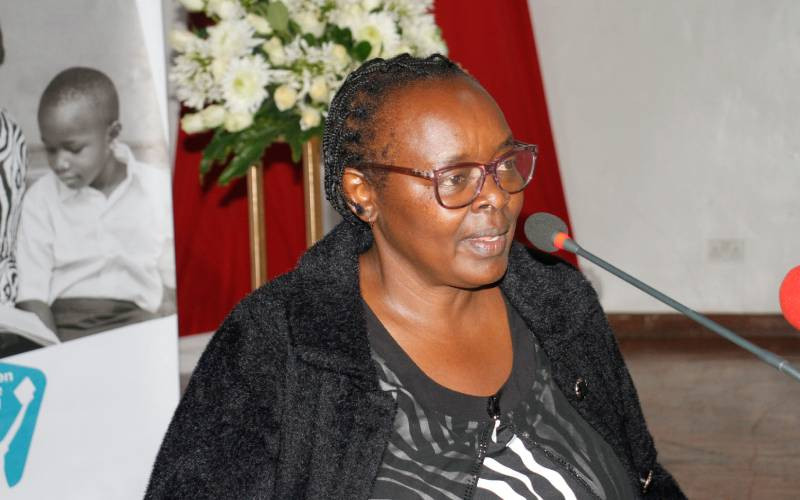
ODM leader Oburu Oginga addresses party delegates at his home in Bondo, Siaya. [Michael Mute, Standard]
The demise of former Prime Minister Raila Odinga in October has presented the Orange Democratic Movement (ODM) with its biggest challenge ever: Succession.
Raila had become synonymous with ODM in its 20 years of existence, so much so that many could not envisage ODM without him. Raila had a towering, imposing personality and political cunning that commanded respect across the political divide. Filling his shoes is a daunting task.
Greek philosopher Aristotle opined that “nature abhors a vacuum”. This maxim was later modified to “power abhors a vacuum”. In actualising its ideals, ODM moved with speed to fill the vacuum left by Raila’s death.
The manner and speed with which this was done attests to the power of political organisation and strong institutional structures within ODM, which clearly place it head and shoulders above other political entities. There was no shortage of possible candidates, which basically pitted Young Turks against the Old Guard. The contest would have been divisive and bruising, but mercifully, it did not get to that.
The appointment of Oburu Oginga as the party leader on an interim basis immediately after Raila’s death precluded an internal power struggle that would have hurt the Orange party. The National Executive Council later confirmed Oburu as the party leader during ODM’s 20th anniversary celebrations in Mombasa.
With Oburu’s appointment and the party’s succession headache behind it, at least for now, ODM must now focus on not just continuing, but also solidifying Raila’s legacy. The party must navigate emergent mine fields around the intricacies surrounding the broad-based government. Whether ODM should honour this arrangement or not has become a flashpoint within the party whose members now appear to be pulling in different directions.
ODM Secretary General Edwin Sifuna and Siaya Governor James Orengo are unequivocal that the memorandum of understanding between UDA and ODM does not extend beyond 2027, which, effectively, means that ODM could be planning to field a presidential candidate in 2027.
On the other hand, former ODM chairman and the National Treasury Cabinet Secretary (CS) John Mbadi, Energy CS Opiyo Wandayi and Homa Bay Governor Gladys Wanga, who took over ODM’s chairmanship from Mbadi, favour an arrangement in which the party supports the government until 2032 should Ruto’s re-election bid succeed.
With these two competing positions, the choice of Oburu as party leader makes sense and should be applauded. He is not just Raila’s elder brother; he was his confidant and, no doubt, top-most advisor who kept tabs on all the goings-on in the party.
Continuity requires such in-depth knowledge of an institution, and Oburu understood his brother better than anyone else. Furthermore, Oburu is clearly a transitional leader given his advanced age. Part of his job is to steady the ship as the party shops around for a new captain with the competence to steer it through turbulent political seas at a time when youth in Africa and Asia are threatening the status quo.
That he has struck a conciliatory tone, acknowledging Sifuna as the party’s spokesman and meeting with youthful, non-conformist MP Babu Owino, attests to this. Almost effortlessly, Oburu has contained a rebellion inside ODM.
Moreover, ODM, the oldest opposition party in the country, requires an old hand at the helm. Someone with a calm demeanour, someone who is not saddled with the impetuosity of youth and has a calming effect on party members. Someone the government can accept as a negotiator. Oburu, like his younger brother Raila, embodies these attributes.
It was not for nothing that Raila was called the enigma, someone who, as easily, made incumbent governments rely on his wisdom to govern as he would hold them to account over political and financial indiscretions.
Oburu must, however, take a stand on the matter of ODM being part of the broad-based government, which has become the elephant in the room and threatens to divide the party that Raila and other stalwarts painstakingly built over decades.
Stay informed. Subscribe to our newsletter
ODM owes it to Raila to honour the broad-based government arrangement. Many benefits accrue from this arrangement.