×

The Standard e-Paper
Kenya’s Boldest Voice
 The Standard Group Plc is a
multi-media organization with investments in media platforms spanning newspaper
print operations, television, radio broadcasting, digital and online services. The
Standard Group is recognized as a leading multi-media house in Kenya with a key
influence in matters of national and international interest.

Audio By Vocalize
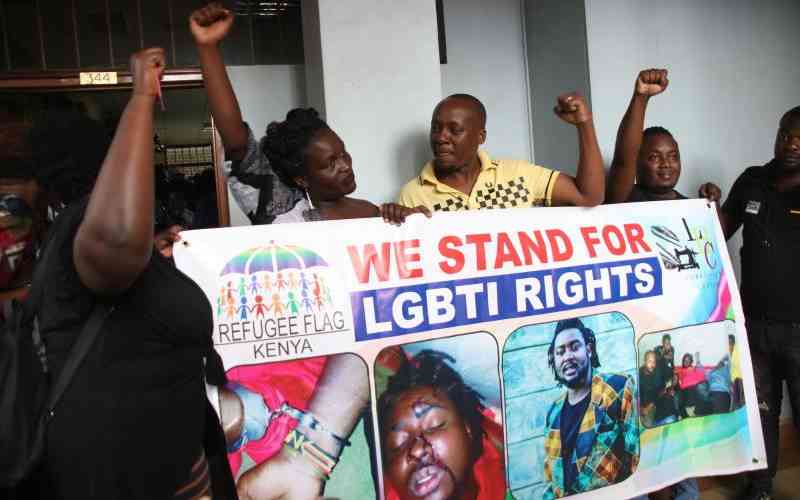
A new index tracking the inclusion of LGBTI people in Kenya has been launched, exposing gaps in national data on discrimination in schools, workplaces and public institutions.
The Kenya LGBTI Inclusion Index 2026 was launched at PrideInn Azure Hotel in Westlands, Nairobi, by the United Nations Development Programme (UNDP) in collaboration with government institutions, human rights organisations, civil society groups and development partners.
Speaking during the launch, UNDP Kenya Deputy Resident Representative (Programme) Gilbert Okango called on institutions to use the findings to improve policymaking and public service delivery.
The index found that 12 of the 51 indicators used to assess LGBTI inclusion lacked sufficient or nationally representative evidence, raising concerns about the ability of policymakers to measure exclusion and develop targeted interventions.
Of the 51 indicators, 39, representing 76.5 per cent, had supporting evidence. The assessment examined five areas: health, education, economic well-being, political and civic participation, and personal security and violence.
“Reliable data is essential to effective policymaking. When the experiences of certain populations are missing from official statistics, their needs can remain invisible in public planning, resource allocation, service delivery, and accountability,” Okango said.
Education emerged as the area with the weakest evidence coverage, with only three of eight indicators supported by available information.
The report noted that small-scale studies had documented bullying and exclusion of LGBTI learners, but Kenya’s Education Management Information System does not capture data disaggregated by sexual orientation, gender identity and expression, and sex characteristics.
In economic well-being, five of nine indicators had supporting evidence, pointing to gaps in information on workplace discrimination and exclusion from formal employment.
The report also identified a lack of explicit employment non-discrimination protections based on sexual orientation, gender identity and expression, and sex characteristics.
In health, evidence was available for all 13 indicators, although gaps remained in national data on mental health, reproductive health, gender-affirming care and non-communicable diseases.
On personal security and violence, 10 of 11 indicators had supporting evidence. However, the index noted that police and justice records lacked systematic disaggregation to capture the experiences of LGBTI people. Civil society organisations have documented violence and hate crimes affecting the community.
The assessment also examined political and civic participation, noting that court decisions had expanded space for LGBTI associations, while criminal provisions in the Penal Code continued to affect freedom of assembly and expression.
Okango said the index was intended to provide a practical framework for identifying gaps and improving institutional responses rather than simply documenting the situation.
“The Index is therefore not simply a research publication. It is a practical tool to inform dialogue, strengthen institutions, identify gaps, and support more responsive and inclusive development policies and programmes,” he said.
Stay informed. Subscribe to our newsletter
He urged government agencies to strengthen national data systems so that evidence could inform planning and service delivery in health, education, employment and justice.
He also called for closer collaboration among public institutions, the Kenya National Commission on Human Rights, civil society, academia and community-led organisations to implement the recommendations and monitor progress.
The report emphasised the importance of ethical data collection, including confidentiality, informed consent and safeguards against harm when handling information about people’s identities and lived experiences.
The initiative received support from Germany’s Federal Ministry for Economic Cooperation and Development under UNDP’s #WeBelongAfrica programme.
Okango said the impact of the index would depend on whether its findings informed decisions and improved institutional practices.
“The value of this Index will ultimately be measured not only by the quality of the report, but by how effectively its findings inform decisions, improve institutional practices, and contribute to more inclusive development outcomes,” he said.
The findings are intended to support evidence-based development planning in line with Kenya’s Vision 2030 and the Sustainable Development Goals, particularly those concerning reduced inequalities and accountable institutions.
“Together, we can advance a Kenya in which development policies and institutions respond to the realities of all people and in which no one is left behind,” Okango said.
Subscribe to our newsletter and stay updated on the latest developments and special offers!


 Prefer the Standard on Google