×

The Standard e-Paper
Kenya’s Boldest Voice
 The Standard Group Plc is a
multi-media organization with investments in media platforms spanning newspaper
print operations, television, radio broadcasting, digital and online services. The
Standard Group is recognized as a leading multi-media house in Kenya with a key
influence in matters of national and international interest.
The Standard Group Plc is a
multi-media organization with investments in media platforms spanning newspaper
print operations, television, radio broadcasting, digital and online services. The
Standard Group is recognized as a leading multi-media house in Kenya with a key
influence in matters of national and international interest.

Audio By Vocalize

Interior Cabinet Secretary Kipchumba Murkomen has warned drug traffickers and their financiers that the Government will go beyond seizing narcotics to pursue the money, property and networks supporting the illicit trade.
Murkomen described the exercise as a major step in the Government’s intensified war against drugs and illicit alcohol.
The CS said the Government would deepen cooperation with the Judiciary while tightening enforcement at the country’s borders and targeting trafficking networks.
“Following the directive of President William Samoei Ruto to rein in drugs and illicit alcohol, a decisive, multi-agency war on the twin menace is underway,” he said.
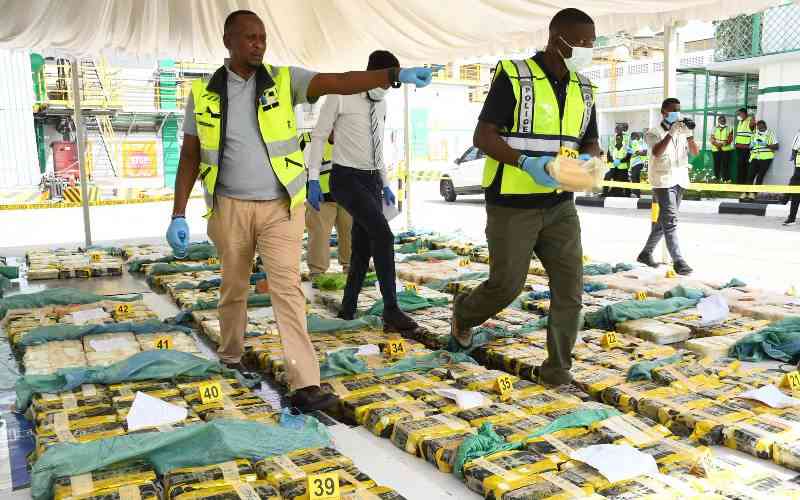
He was speaking at Bamburi Cement Company in Mombasa where he witnessed the destruction of more than one tonne of crystal methamphetamine valued at Sh8.2 billion.
The haul, weighing more than 1,000 kilogrammes, was seized by a multi-agency security team in the Indian Ocean last October.

Its destruction brought together agencies involved in the investigation, seizure and prosecution of narcotics cases, including the National Police Service, Kenya Defence Forces, National Intelligence Service, NACADA, Financial Reporting Centre, Kenya Revenue Authority, Kenya Bureau of Standards, Anti-Counterfeit Authority, Assets Recovery Agency, Office of the Director of Public Prosecutions and Kenya Coast Guard Service.
The CS said Kenya’s position as both a market and transit country made the narcotics threat particularly serious, requiring stronger enforcement alongside prevention, treatment and rehabilitation.
“The wider narcotics threat remains great,” he said, warning that traffickers continued to exploit the country’s routes and networks to move illegal substances.
But Murkomen also placed responsibility on communities, urging Kenyans to report people involved in drug trafficking and protect young people from the consequences of substance abuse.
“Help us protect our children,” he told the public.
The Coast region, he said, remains among the areas most affected by drug abuse, with Mombasa recording a prevalence of 34.4 per cent, according to the figures he cited.
He further said one in six Kenyans aged between 15 and 45 had used one type of drug or another, highlighting the scale of the challenge facing the country.
Murkomen said plans were under way to establish 164 drug rehabilitation facilities across the country, with 11 counties having already indicated their willingness to participate.
“We must match enforcement with prevention, treatment and rehabilitation,” he said.
Stay informed. Subscribe to our newsletter

He warned people profiting from the narcotics trade saying the Government would pursue assets acquired through drug proceeds, arguing that seizures should not stop with the substances themselves.
“We are not just taking drugs off the streets, we are taking the profits off the pockets of the beneficiaries,” he said.
Murkomen warned that premises used to store or manufacture illicit substances could also be targeted.
“If we find you storing drugs or illicit [substances], we will not only destroy the product but we will also take over the land and the factory that you used to process the illicit drugs,” he said.
The CS said such measures were intended to make drug barons and traffickers bear the financial consequences of their activities.
He also warned government officials against colluding with narcotics dealers, saying those found assisting traffickers would face dismissal and prosecution.
Over the past year, he said, 3,331 people had been arrested in connection with drugs and illicit brew across the country, while 675,535 litres of alcohol had been seized.
The Government faces the twin task of disrupting sophisticated trafficking networks while addressing addiction and helping victims recover.
“We will hunt down traffickers, but we will not abandon victims of the drugs,” Murkomen said.
He warned that the consequences reach beyond poor or vulnerable households, saying he had witnessed the damage drugs can cause even among children from well-off families and those of people in positions of authority.
Murkomen said sustaining that effort would require political will and cooperation from residents, insisting that the fight against drugs cannot be won by Government agencies alone.
Subscribe to our newsletter and stay updated on the latest developments and special offers!


 Prefer the Standard on Google





 join
join