More than 400 delegates from Kenya and across the East African region gathered in Nairobi for the 5th Annual Community Land Summit (CLS 2025), marking one of the most significant regional conversations on land rights, climate justice, pastoralism and indigenous community protection in recent years.
Participants drawn from over nine counties in Kenya, alongside representatives from Uganda, Tanzania, South Sudan and Ethiopia, converged at the Kenya Institute of Monetary Studies (KIMS) for four days of intense dialogue, cultural celebration and policy engagement.
Unlike previous editions held closer to pastoralist heartlands such as Nanyuki, Maralal, Isiolo and Ilngwesi Cultural Manyatta, this year’s summit was deliberately brought to the capital closer to policymakers, Parliament, ministries and national decision-making centres.
Organisers said the move was strategic to ensure that the voices of pastoralists, hunters and gatherers could no longer be ignored in national development, climate and land governance conversations.
Culture, identity and power in one space
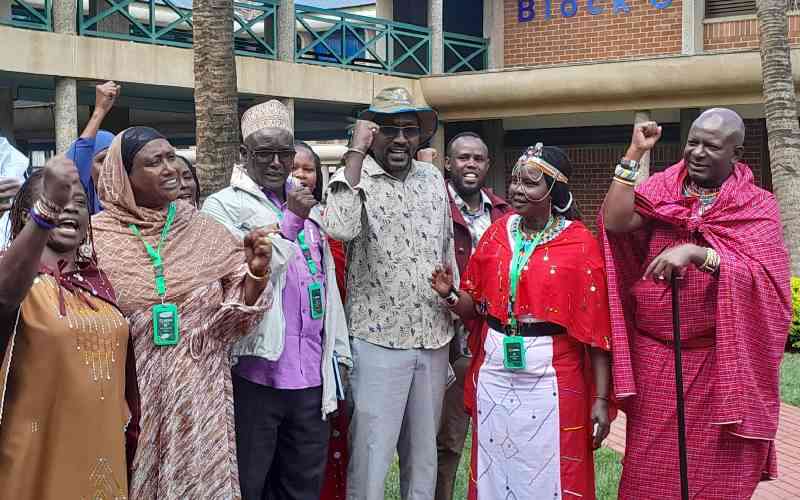
From the opening day, the summit unfolded as both a political and cultural statement. Delegates arrived clad in vibrant traditional attire, from the bold patterns of Turkana dress to the beadwork and wraps of Maasai, Samburu, Rendille and other indigenous communities.
Song, dance and traditional performances punctuated formal proceedings, reminding participants that land is not just an economic resource but a deeply cultural, spiritual and ancestral heritage.
Despite a quiet but visible security presence, the atmosphere remained disciplined, peaceful and deeply purposeful. Elders, youth, professionals, activists and researchers shared space with confidence and mutual respect.
One of the most striking features of the summit was the strong presence of young people, many of whom spoke with clarity and courage while still recognising the authority of elders, a signal of generational continuity within indigenous advocacy.
Mali Ole Kaunga: Quiet authority, loud impact
At the centre of the summit stood Mali Ole Kaunga, founder and long-serving leader of IMPACT, whose steady leadership since the mid-1990s has shaped Kenya’s indigenous peoples’ movement.
Without fanfare, his presence carried the weight of decades of advocacy for community land rights, environmental justice and indigenous inclusion in national policy.
“Community land is not empty land. It is living land, ancestral land and economic land,” he reminded participants during one of the plenary sessions.
For many in attendance, especially first-time delegates, interacting with Ole Kaunga was a moment of personal inspiration, a reminder that change often grows quietly but persistently.
A defining political moment
Stay informed. Subscribe to our newsletter
Perhaps the most electrifying moment of the summit came on Day Two with the arrival of Defense Cabinet Secretary Soipan Tuya
Dressed in a suit accented with bold red and white, colours deeply symbolic within many pastoralist cultures, her entrance triggered ululation, drumming and sustained celebration.
In an emotionally charged address, Tuya traced her own roots in pastoralist communities and declared, unequivocally, that she remains a daughter of the land.
“I am one of you,” she told the gathering as the auditorium erupted in rhythmic chants and applause.
Her declaration resonated deeply with delegates who have long viewed political power as distant from indigenous realities. For many, it was not just a speech. It was validation.
Regional solidarity across borders
The 2025 summit underscored that community land struggles do not respect colonial borders. Delegates from Uganda, Tanzania, South Sudan and Ethiopia shared strikingly similar challenges: land dispossession, climate shocks, extractive development, shrinking grazing routes and policy marginalisation.
Yet alongside the shared challenges was also shared resilience. From pastoralist engineers and lawyers to environmental researchers and community educators, the summit revealed a new generation of indigenous professionals shaping resistance from inside institutions of power.
One Turkana elder, unable to speak English or Kiswahili, hired a translator to ensure his voice was heard on the floor, a quiet reminder that language must never become a barrier to justice.
Nearby, an elderly woman sat through sessions with unwavering attentiveness, embodying the patience and steadfastness that have sustained communities through decades of struggle.
Land, climate and livelihoods at the core
Across panels, workshops and breakaway sessions, discussions centred on: protection of community land tenure, climate change and drought resilience, pastoralism as a viable economic system, youth participation in land governance, women’s leadership in indigenous movements, extractive industries and land exploitation.
Experts emphasised that pastoralism, often misunderstood as backward, remains one of the most climate-adaptive livelihood systems in arid and semi-arid lands. Speakers stressed that without secure land rights, communities remain vulnerable to displacement, poverty and conflict.
The power of collective memory and momentum
Participants noted that the four previous Community Land Summits have steadily built the capacity of indigenous communities to articulate their demands with growing confidence and legal sophistication. What once began as a marginal conversation has now matured into a structured regional platform for advocacy and engagement.