×

The Standard e-Paper
Join Thousands Daily
 The Standard Group Plc is a
multi-media organization with investments in media platforms spanning newspaper
print operations, television, radio broadcasting, digital and online services. The
Standard Group is recognized as a leading multi-media house in Kenya with a key
influence in matters of national and international interest.

Audio By Vocalize
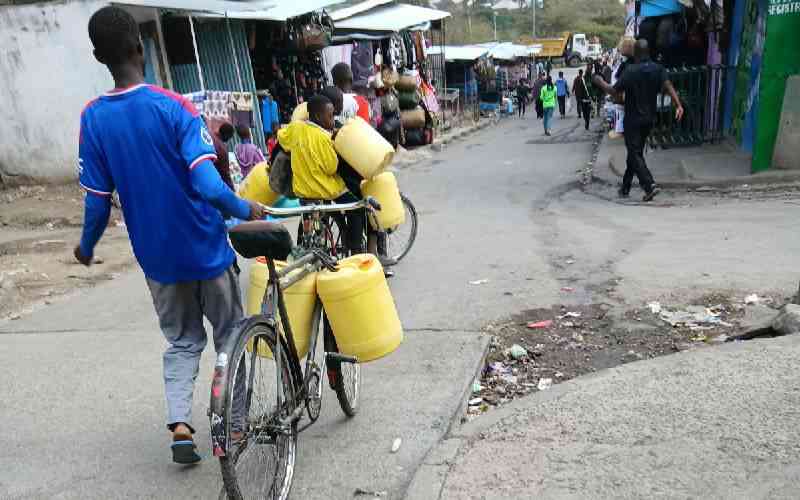
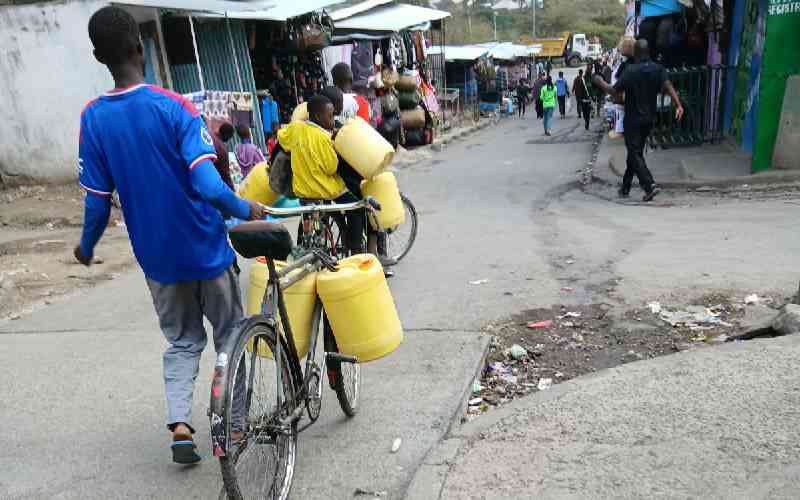
Residents of Kamere troop to Lake Naivasha in search of water following an acute shortage raising fears of disease outbreak. [Antony Gitonga, Standard]
Last week, the Nairobi City Water and Sewerage Company issued a public notice announcing an immediate 35 per cent reduction in water production at the Ngethu and Kigoro treatment plants following declining water levels at Thika/Ndakaini Dam.
Instructively, following the notice, one is left to wonder whether Nairobi, or indeed Kenya, suffers from a shortage of water or it suffers from a shortage of imagination, foresight and competent leadership in the management of this very important resource.
There is an enormous amount of human capital, technical expertise and institutional investment that ensure that Kenya can develop sufficient water resources for domestic consumption, industrial production, agriculture and economic development. As a country, we have hydrologists, engineers, environmental scientists, economists, planners and development specialists whose professional lives are dedicated to understanding how water can be harvested, stored, distributed and sustained. Yet, despite this abundance of expertise, we continue to approach water management as though it were a seasonal emergency rather than a permanent national development responsibility.
That Kenya has an entire ministry for water, sanitation and irrigation, is not by accident. This is an acknowledgement that water is so fundamental to national development that its management requires dedicated political leadership, institutional capacity and long term planning. Unfortunately, very little imagination appears to be going into ensuring that this ministry and the other institutions established under the Water Act, 2016, delivers on their full mandate.
Indeed, one of the greatest tragedies of our water sector is the governance of the institutions entrusted with managing it. If anything, the composition of the boards of many water companies and related institutions leaves a lot to be desired. It should not be a surprise if an independent assessment established that an overwhelming majority of board appointees have little or no meaningful background in water resource management, infrastructure development, environmental sustainability or public utility governance.
In fact, for most of these appointees, their greatest qualification in water management before joining these boards may well have been the remarkable discovery that water is useful for drinking, washing clothes and taking a shower. Those with slightly more advanced technical knowledge probably understood that when it rains, water should be stored in a tank. And armed with these “impressive” credentials, were then entrusted with overseeing institutions responsible for the water security of millions of Kenyans.
Of course, one does not have to be a hydrologist to sit on the board of a water company, especially because corporate governance requires diverse expertise, including finance, law, management and public administration. However, it is unreasonable to expect institutions responsible for such technically demanding and strategically important resource to succeed when appointments are driven more by political considerations than by competence, experience and a demonstrated understanding of the sector.
Perhaps it is time that we seriously considered extending the principles underpinning the Government Owned Enterprises Act to the governance and management of our water companies, with the necessary legal and institutional adjustments. While the National Government has rightly placed considerable emphasis on improving the governance, profitability and operational efficiency of strategic State enterprises such as KenGen, Kenya Pipeline Company and other corporations, we must ask ourselves why similar attention is not being directed towards water service providers, whose performance has an even more immediate bearing on the lives and livelihoods of millions of Kenyans.
We need not look far for examples of what effective public utility governance can achieve. The Dubai Electricity and Water Authority (DEWA), a government controlled utility responsible for electricity and water services in Dubai, demonstrates how public ownership can coexist with commercial discipline, professional management, operational efficiency and financial sustainability.
Similarly, private entities, like Coca-Cola, whose operations depend heavily on water have invested considerable resources in water stewardship, efficiency assessments and monitoring systems that establish how much water enters their production processes, how much is consumed, how much is recovered and where losses occur. Coca-Cola understands that without guaranteed access to water, there can be no sustainable business and thus their investment in Water Security in countries like Namibia.
While the Water Act, 2016, already provides an institutional framework through which national and county governments can develop water services, strengthen water infrastructure and facilitate investment, little is being done in this regard.
The recent announcement on the reduction of water supply in Nairobi should concern every Kenyan, not simply because of the inconvenience it will cause households and businesses, but because of what it reveals about the vulnerability of the water supply system serving our capital city.
How is it that a city of Nairobi's economic importance can remain so heavily dependent on rainfall patterns in one principal catchment system that reduced inflows can trigger such a significant reduction in production?
Notwithstanding the fact that Nairobi already has serious challenges with sewerage infrastructure, sanitation and the management of wastewater, the city is currently experiencing a looming water crisis that is unfolding in slow motion. What makes the situation even more disturbing is that technological and engineering solutions are not beyond our reach.
Stay informed. Subscribe to our newsletter
Kenya should be thinking seriously about the technical, environmental and economic feasibility of ambitious water-transfer infrastructure, including whether water from the Lake Victoria basin could sustainably support other parts of the country through carefully planned systems.
The conversation should not be limited to whether Ndakaini Dam has received sufficient rainfall this month, but it should be about what additional water sources Nairobi will depend on in 2040, 2050 and beyond.
We must also confront the enormous problem of non-revenue water, including losses through leaking pipes, illegal connections, inaccurate metering and inefficient distribution systems. Before asking consumers to endure extended rationing, water utilities must demonstrate what they are doing to ensure that the water already treated and introduced into their networks reaches its intended users.
The announcement by Nairobi Water should serve as a national wake-up call. We cannot claim to be planning for industrialisation, urbanisation and economic transformation while failing to guarantee one of the most basic inputs required to sustain them.
Subscribe to our newsletter and stay updated on the latest developments and special offers!


 Prefer the Standard on Google