×

The Standard e-Paper
Kenya’s Boldest Voice
 The Standard Group Plc is a
multi-media organization with investments in media platforms spanning newspaper
print operations, television, radio broadcasting, digital and online services. The
Standard Group is recognized as a leading multi-media house in Kenya with a key
influence in matters of national and international interest.
The Standard Group Plc is a
multi-media organization with investments in media platforms spanning newspaper
print operations, television, radio broadcasting, digital and online services. The
Standard Group is recognized as a leading multi-media house in Kenya with a key
influence in matters of national and international interest.

Audio By Vocalize
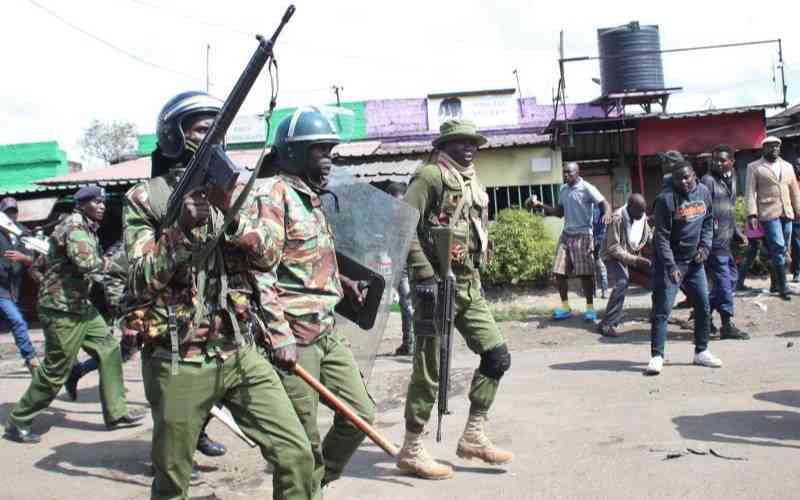
Police officers patrolling Shauri Moyo during the Saba Saba demonstrations in Nairobi on July 7, 2025. [Kanyiri Wahito, Standard]
Let’s pick three random events this week. First, the on-off public protests scheduled for today, ostensibly on account of fuel price increases, but mostly, the latest call to our national leadership for good governance, including transparency at the beginning and accountability at the end.
When the Kenya Kwanza administration prepares an honest diary of this term, it will be pock-marked with annual public dissent – cost of living “sufuria” protests in 2023 in the face of official tone-deafness, Finance Bill, then accountability, protests in 2024 in disgust at officious “bling bling” arrogance, a repeat in 2025 that suggested lessons had not been learnt, and now, to close the cycle of discontent, 2026 cost of living protests, again.
My take is our 20th-century leadership mindset is misaligned with Kenyans’ 21st-century aspirations, which is why Gen Z voices matter. It is logical to conclude that protest could beat progress in the 2027 election.
Which is not to say that 2027 isn’t about “development”. It’s that the development paradigm we seek, as Julius Nyerere once put it, isn’t “vitu” (things), but “watu” (people). A book will one day be written about how Kenya Kwanza vividly captured the public imagination, then tossed it in the dustbin. Now look at how the administration has suddenly doubled down on infrastructure since the June 2024 protests, after lambasting the previous one for its own infrastructure binge.
Remember the manifesto promise about “making Kenya not just a middle-income country in terms of GDP averages, but a middle-class society in every sense of the word”? How’s that going? To get there, we were asked to make impoverishing sacrifices as politicos enriched themselves. It seems the only difference between our past and current leaders is stylistic, not substantive.
Whether or not today’s protest happens, you sense that Kenyans are looking for something from someone, then someone with something, that’s elevated from today’s choiceless choices.
But let’s stick with events while turning to a more positive note. My second pick, ironically, is the 2026 Africa We Build Summit that happens this Thursday and Friday. Jointly hosted by our government and the surprisingly little-known Africa Finance Corporation, the summit is themed “Infrastructure as the Engine of Industrialisation” (though one is not sure why they didn’t put African in front of infrastructure, engine and industrialisation). Mindset, right?
Yes, it’s infrastructure we’re talking about. The necessary building of things that we need. This is the metaphysical problem I have with this administration. On the one hand, what looks like an important meeting to, hopefully not just talk, but walk the talk, on a home-grown pathway to Kenya’s, and Africa’s, infrastructure challenge.
Add that it’s also a great marketing opportunity for our brand new National Infrastructure Fund. Yet, on the other hand, there is the image of leaders on sun roofs announcing roads and other projects willy nilly, when, like Ngong-Suswa, we see a poor quality product. While the ideation is correct, the implementation always seems far from.
For the record, this Summit seeks to, among other things, streamline policy and regulation across Africa while mobilising affordable domestic and international capital for our most important trade corridors and industry clusters, including mining, for the long-term. As we position ourselves at the centre of this big conversation, we must also sit at the helm of the critical action that follows.
My third random event is decidedly local, the Annual Own Source Revenue (OSR) Growth Conference to be held from Wednesday to Friday. This is the place where counties come together to talk about ways in which they can boost their internal revenue generation beyond what they equitably share with the national government. This year’s theme speaks to the ideas of sustainable financing and revenue innovations. Hopefully, there will be lots of best practice benchmarking as well, and while no program is available online, there is a laundry list of speakers.
As with everything these days, the common thread between these three events seems to be revenue or resources. The crude thread is that they are about extraction from the people, not mobilisation of the people. So, let’s create a fourth imaginary event we might have had this week.
There would be four strands to this hopefully people-driven event. First, some discourse on the role of the state versus the role of markets in defining our pathway of socio-economic (and political) progress. That’s where we begin to discuss the economy we want. It is honestly difficult to see, in the case of the OSR growth conference, how we have a county revenue discussion that doesn’t begin from service delivery on one hand, and local economic development on the other.
Which brings us to the second strand. Why aren’t we having a country revenue conference that takes a consolidated view of both national and county government revenue imperatives? The closest we get to a national-level revenue discussion is KRA’s controlled and only online annual tax summit, yet at the end of the day, as we pigeonhole these events, it’s the same people and businesses who are paying national and county taxes, levies and all manner of extractive charges.
Stay informed. Subscribe to our newsletter
You can also see that government spending – both national and county – would have to feature prominently in this country revenue conference, but my fourth event would also aim to develop a proper Medium-Term Revenue Strategy for Kenya that captures tax and non-tax revenue, appropriations in aid as ministerial own-source revenues and county own-source revenues.
Which brings us to the larger picture that moves beyond revenue to resource mobilisation for wealth creation. There’s a bit of this in the Africa We Build summit, but the idea here is a real discussion that builds up county economic potential from our wealth-creating resources. In other words, a conversation that speaks to what I call our seven capitals – human, social, knowledge on one hand; physical, land, economic/fiscal and financial on the other. Kenya We Build summit? The outcome of which is a Medium-Term Resource Mobilisation for Wealth Creation Strategy
The final strand of my imaginary fourth event would be the most controversial, since it is about institutions. Yes, we have the county economic and revenue discussion, the country economic and revenue debate, and then the country resourcing for wealth discourse. Now we need the institutions to get this going. Is this the point where we enforce the true role of the Commission of Revenue Allocation, as mandated to make recommendations on both national and county revenues, not its current focus on counties? Or more dramatically, is this where we go to a world unique, fully independent Country (not National or County) Treasury, whatever that means? Remember the argument here, that our current Treasury is subject to Executive whim.
Yes, think of an event, to go back to the first one about protests, that provides good governance answers to the hard transparency and accountability questions that flow naturally, as they did in 2023 and 2024, from tax proposals or cost-of-living pains, as daily lives and livelihood concerns. Or more colourfully, think of the event where we get to sit down and discuss the social contract.

Subscribe to our newsletter and stay updated on the latest developments and special offers!






 join
join