Audio By Vocalize
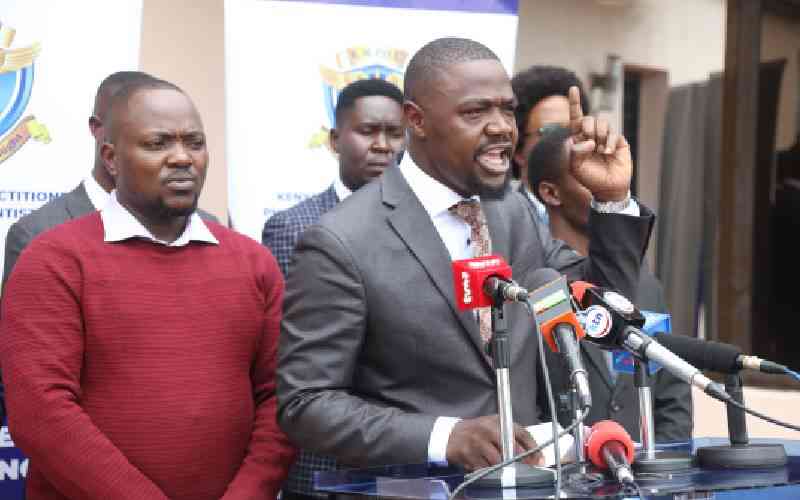
KMPDU Secretary General Devji Atellah addresses a press briefing in Nairobi, on February 23, 2026. [Wilberforce Okwiri, Standard]
The death of a patient at the Coast General Teaching and Referral Hospital (CGH) and the subsequent interdiction of its chief executive officer is threatening to cause a major labour dispute as the umbrella doctors’ union issues a strike notice over political interference at the facility.
The patient, Ali Kibwana, 52, allegedly died after the hospital refused to admit him to the ICU even after a deposit was paid by Mvita MP Masoud Machele.
On Sunday, Mombasa Governor Abdulswamad Nasir interdicted the facility’s CEO Iqbal Khandwalla, sparking protests from doctors at the hospital and the Kenya Medical Practitioners, Pharmacists and Dentists Union (KMPDU). Doctors said Dr Khandwalla’s sacking was politically instigated by Machele, who accused the CEO of negligence and gross misconduct after the death of Kibwana.
On Monday, senior doctors said CGH has been operating without medical supplies for six months.
According to a statement from the doctors, the patient died because of a lack of a coil that was required to stop severe bleeding in the brain artery.
According to the CGH consultant neurosurgeon Benjamin Okanga, the patient was admitted with a ruptured artery in the brain.
Dr Okanga explained that the patient was referred from a private facility within Mombasa County.
“The extent of the bleed was so severe with brain swelling that an open surgery would have been detrimental. Endovascular coiling in the cath lab was the preferred treatment option. The patient was scheduled for the procedure.
“Unfortunately, the coil was not available due to a disruption in supplies occasioned by a huge outstanding debt from the Social Security Authority (SHA) and subsequent non-payment of supplies by the hospital,” said Okanga.
The neurosurgeon said efforts were made to procure the coil, and the patient was subsequently scheduled for surgery.
“However, the patient’s condition rapidly deteriorated, and they had to be admitted to ICU for stabilisation before undergoing surgery. This was a joint decision by the core medical team and not the CEO,” said Okanga.
The doctor said that despite the optimum treatment, the patient progressively developed complications from brain injury leading to progressive and irreversible brain injury and ultimately his death.
“The incident highlights the systemic issues plaguing the health sector and the impact on service delivery. The CEO of the hospital cannot be held liable for systemic issues. The relevant county authorities should be held to account as per the Health Act 2017 and Mombasa County Health Act,” Okanga said.
Stay informed. Subscribe to our newsletter
In Nairobi, KMPDU threatened to call for a downing of tools within seven days if the hospital’s CEO is not reinstated.
Legally hollow
The union condemned the removal of Khandwalla, saying the decision was procedurally defective, legally hollow and emblematic of growing political interference in the management of public health facilities.
Addressing the media, the union said the interdiction was politically motivated and rushed.
“What we are seeing is a blatant display of political interference and a total abandonment of the law,” KMPDU Secretary General Davji Atellah said, warning that doctors across the Coast region would withdraw services if the decision is not reversed.
The interdiction followed a special board meeting convened amid public outcry over the death of Kibwana, whose family alleged the hospital delayed a life-saving brain surgery while demanding an upfront payment of Sh350,000.
According to the union, the patient had been admitted with subarachnoid haemorrhage, a severe and often fatal brain condition, and was reviewed by neurosurgeons, admitted to the Intensive Care Unit and managed in line with established medical protocols.
“The patient received emergency care, was stabilised in ICU and reviewed by specialists. Doctors are trained to make these decisions, not politicians,” the union said, adding that the decision not to proceed with immediate surgery was based purely on clinical judgment.
Following the meeting, the hospital board cited governance concerns, deteriorating stakeholder relations and declining public confidence in the leadership of the hospital as grounds for suspending the CEO.
However, KMPDU argued the decision scapegoated an administrator for systemic failures beyond his control.
Atellah noted that the facility has faced repeated crises, including an April 2025 incident in which at least three patients died after an oxygen supply disruption, triggering public outrage and calls for accountability.
“These are failures of supply chains, funding and infrastructure, not individual leadership,” he said, adding that chronic underfunding has left the hospital struggling to meet demand while serving a wide regional catchment area.
The SG further said Khandwalla was interdicted without being issued a show-cause letter or granted an opportunity to respond, in violation of Article 47 of the Constitution and Section 41 of the Employment Act.
Records show the board convened an online meeting at 8:30pm on a Saturday, with the interdiction letter finalised by the county secretary the following morning.