 The Standard Group Plc is a multi-media organization with investments in media
platforms spanning newspaper print
operations, television, radio broadcasting, digital and online services. The
Standard Group is recognized as a
leading multi-media house in Kenya with a key influence in matters of national and
international interest.
The Standard Group Plc is a multi-media organization with investments in media
platforms spanning newspaper print
operations, television, radio broadcasting, digital and online services. The
Standard Group is recognized as a
leading multi-media house in Kenya with a key influence in matters of national and
international interest.

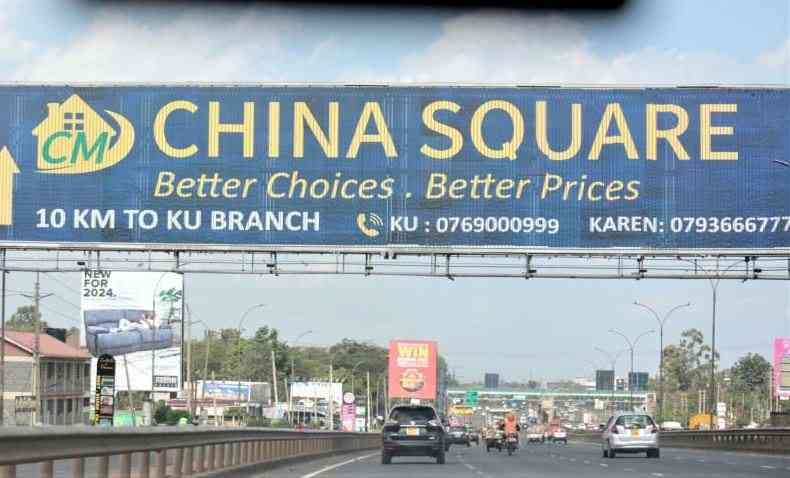
It was once a national issue, China Square at Kenyatta University's Unicity. The storm died, and China Square now has several branches, including in Kisumu City.
Complaints ranged from Chinese control of the supply chain from manufacturing to retail. Some felt different players should control sections of the supply chain.
Price finally won us over to China Square, a retailer with a range of unique products; you will not buy Jogoo or rice there.
It was part of China's long game, use price to penetrate the market. Remember the Great Wall television (TV) that made TVs accessible to every home?
Seen Chinese cars on display? Will they use the same strategy to gain our market? Once in the market, you can adjust the prices and quality too.
Could some car brands be raising their prices to leave the "low market"? China is way ahead in electric cars, and the West is worried. Seen BYD around? Will China replicate Japanese success in selling cars in the African markets?
China was a late entry into the African market, but it was well prepared. Build the infrastructure and use it to get into the market. This is best exemplified by the Thika superhighway and the standard gauge railway (SGR).
China Square is located on a Chinese-built superhighway. A big signboard near Ruiru indicates a China Village somewhere along the same superhighway. We can predict just like China Square, it will be an outlet for Chinese products.
Where does SGR get her wagons and engines? Noted the Chinese restaurants? Their apartment blocks built before the housing levy?
Expect more Chinese investments and trade with Kenya and Africa. The US tariffs mean less access to Western markets. The factories in China will not close; they will look for new markets in Africa and Asia, good candidates.
Will it be easy for Chinese entry into the Kenyan market? I think so. One, China is visible with big projects like roads and SGR. That has endeared China to Kenyans.
The ordinary citizens care little whether the road was built through debt or taxes. The big projects are seen as signs of Chinese engineering prowess and benevolence. That is why the "debt diplomacy" tag has not stuck.
Two, trade with China has been rising, never mind its surplus. Many small-scale traders source their merchandise from China, citing low prices.
The beauty of the Chinese market is that you can source anything. No wonder the country is the workshop of the world. We are helping China make inroads into our markets. Contrast that with colonialism and "forced markets."
Three, the Chinese government subsidises her firms. That gives them an edge in the global market till they are old enough to compete. Does the Kenyan government help local firms compete in the global market?
Many economists argue that the government should not subsidise local firms or protect them with tariffs. An inconvenient truth is that, based on national interests and some patriotism, governments help firms grow.
One easy way is becoming a pioneer purchaser and creating a critical mass market. Suppose the government bought BJ50 cars made in Laikipia for all ministries? Who can fail if the visible hand of the government holds your hand against the invisible hand of the market?
Many economists argue that the government should not subsidise local firms or protect them with tariffs. An inconvenient truth is that, based on national interests and some patriotism, governments help firms grow.
One easy way is to become a pioneer purchaser and a critical mass. Suppose the government bought BJ50 cars made in Laikipia for all ministries? Who can fail if the visible hand of the government holds your hand against the invisible hand of the market? How do we compete with State-backed Chinese firms when we cite our government as an obstacle to our business growth?
Four, China has already laid the groundwork; it's filling the gaps. She built Highways, ports and other hardware. The only missing link is software.
And it is filling that with Confucius institutes, scholarships to China, acrobats training, newspapers, TV stations and less talked about politics. Did I hear the UDA (United Democratic Alliance) and the Chinese Communist Party talk to each other? Five, China has opened its markets to 53 African countries, with tariffs free. Will that make it easy for African countries to also open their markets to Chinese products?
China has not made as much headway in services. Culture might be the missing link. Once Mandarin become widespread, more Chinese services will be available.
Six, diplomacy has worked. The Chinese "silence "on political matters is loved in Africa. Rarely does China comment on internal politics in Africa. The West talks, which is a counterweight to the excesses of African governments.
Seven, despite coming late into Africa, China had a long-term strategy. The opportunity opened with the end of the Cold War. Africa is now welcoming new friends: remember the Russians in the Sahel?
South Africa in BRICS (an intergovernmental organisation comprising ten countries - Brazil, China, Egypt, Ethiopia, India, Indonesia, Iran, Russia, South Africa and the United Arab Emirates)?
Will the West take more care of Africa to stop it sliding into the Chinese orbit? Will the US renew Agoa as a counterweight to China's free access to African products? Maybe I am too sanguine about Chinese success in Kenya and Africa. But few can dispute that the Chinese influence, mostly economic, has been rising in Africa.
The US "disinterest "in the rest of the world could be further exploited by China. It's not just China that is interested in Africa. New play City?




