 The Standard Group Plc is a multi-media organization with investments in media
platforms spanning newspaper print
operations, television, radio broadcasting, digital and online services. The
Standard Group is recognized as a
leading multi-media house in Kenya with a key influence in matters of national and
international interest.
The Standard Group Plc is a multi-media organization with investments in media
platforms spanning newspaper print
operations, television, radio broadcasting, digital and online services. The
Standard Group is recognized as a
leading multi-media house in Kenya with a key influence in matters of national and
international interest.

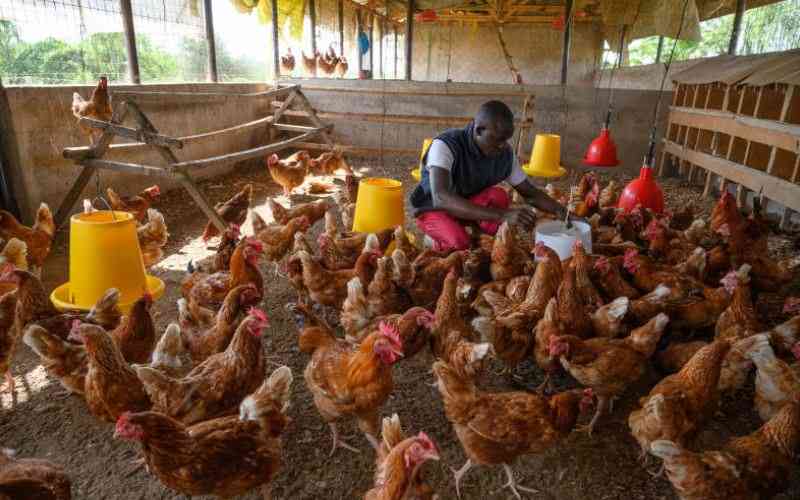
Sibius Ouma feeding his chichen from the feeders inside the big poultry house, karachwony North ward,Homabay. [Standard]
When urban farming is mentioned, what comes to mind is growing vegetables, fruits or other edible plants.
But urban farming can also entail rearing chickens in a limited space. One person who has taken up such a venture in Kiambu County is Christopher Gitau. "I have a small flock of chickens. I started rearing the same for domestic use, but with time went commercial. Our coop covers about 40 square metres of our yard," Gitau says.
With little experience in chicken farming, Gitau, an accountant, sharpened his craft through the Internet and seminars. He learnt how to manage chickens from maximising production to feeds management and disease control. So what does one need to run a chicken unit in a limited space with few resources?
The requirements are quite basic, he says. "We release our chickens in the morning so that they can forage the grass and enjoy the sunshine," says Gitau. The farm's hatchlings are brooded inside a section of his house for around two weeks before being transferred to a brooder outside.
Here are Gitau's simple guidelines and requirements for starting a small poultry farm.
Chickens for eggs or meat?
"The poultry industry is wide, one must decide whether they want to farm broilers, layers or both," says Gitau. Broiler chickens grow fast. One can start selling after about three months. Layers take longer to grow and to start producing eggs from 18 to 22 weeks.
Identify a hatchery
A healthy flock of chickens starts with a healthy set of chicks. You need to identify a trusted and reliable supplier of day-old chicks. At the hatchery, good quality day-old chicks are produced and you get them at relatively cheap prices as opposed to other sources. Based on the poultry types you want to rear, identify a hatchery where you can get those specific types.
Acquire space and land
Gitau started his business on 40 square metres in his yard. If you are considering hiring land in town it will cost you about Sh20,000 to Sh30,000 every month.
Set up a chicken cage
The chicken cage should be spacious enough for the chicken to move around freely, be well-ventilated, and safe from toppling. On average, it costs about Sh30,000 to Sh40,000. If your farm is in town, you will need the County Council Single Business Permit which costs Sh5,000-Sh10,000 depending on the county.
Bring in your day-old chicks
A chick costs Sh80 to Sh100. Buy as many as you have planned that your chicken cage can accommodate so that they are just enough. "You do not want your birds to die of suffocation and disease transmission from others," says Gitau.
Feeds
Feeds account for about 60 to 70 per cent of the total production costs, says Gitau. That means it has a significant impact on the profit margins.
"To reduce the cost of feeds, buy them from suppliers and manufacturers to avoid agent's mark-up," advises Gitau. When you decide on the number of chicks, ensure you know how much and the type of feed required for them.
Equipment
Make sure there are enough feeders and drinkers inside the chicken coop. Gitau makes sure that there are 12 birds per drinker and 45 birds per feeder. For bedding, one can use wood shavings, dry saw dust or chopped straws.
Disease Management
This can be a great challenge for small-scale farmers because it results in poultry not performing optimally, eventually driving up costs and negatively affecting earnings. Birds that are sick or recovering from disease generally eat less and produce less. Some diseases can be treated and this adds to the costs, in extreme cases the whole flock might have to be culled to eradicate disease.
"Dead chicks should be removed and buried, sick ones should be kept separately and given special care. Prevention is better than cure. To avoid disease episodes, follow the chicks vaccination calendar to the letter," advices Gitau.
Provide the following to the chicks:
External heat and light source. Chicks cannot maintain their own body temperature. For this reason, external help is needed in form of heaters.
What is the return on investment?
Gitau's initial capital Sh50,000
A day-old chick costs Sh100.
A grown chicken costs Sh1,000. Sell 50 chickens and get your invested capital of Sh50,000 back.
Repeat with other chicks and continue enjoying the profits.
In three months, you have returned your invested amount.




