 The Standard Group Plc is a multi-media organization with investments in media
platforms spanning newspaper print
operations, television, radio broadcasting, digital and online services. The
Standard Group is recognized as a
leading multi-media house in Kenya with a key influence in matters of national and
international interest.
The Standard Group Plc is a multi-media organization with investments in media
platforms spanning newspaper print
operations, television, radio broadcasting, digital and online services. The
Standard Group is recognized as a
leading multi-media house in Kenya with a key influence in matters of national and
international interest.

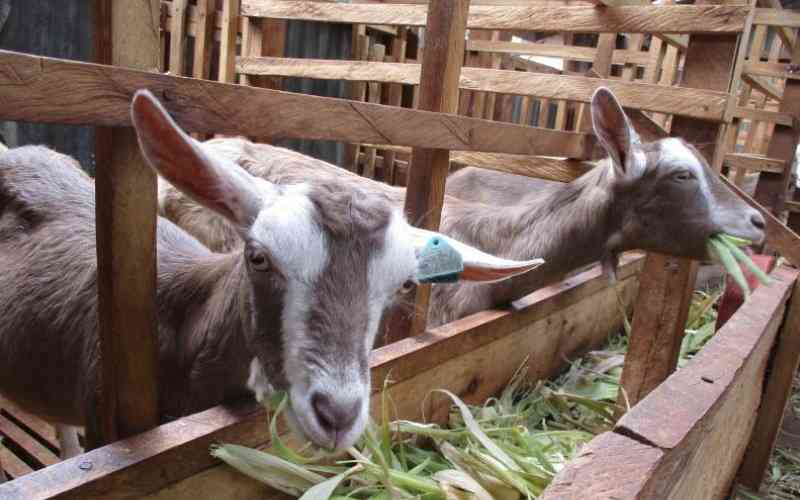
The Toggenburg dairy goat breed. [Wilberforce Okwiri, Standard]
Initially known as the poor man's cow, goat farming is gaining traction as many people join the venture. The demand for goat milk has been rising because of it is health benefits and the fact that it is great for the elderly, sick, babies, children with allergies and those with ulcers. But why keep goats? Dairy goats are relatively easy to keep, they have a short gestation period, high chances of twinning and requires less space and feed compared to dairy cows. Here is what you need to run a profitable goat venture.
Low investment
If you are interested in making money from livestock, keeping goats would be a good place to start. The venture is low investment. Let us do the math. A mature female goat goes for about Sh22,000 and a male one for about Sh17,500 while a kid goes for approximately Sh8,000. On the other hand, an in-calf heifer goes for about Sh150,000. Four female goats and a buck are sufficient to start you off.
Goat breeds
For dairy goats, one can choose from Alpine, Toggenburg, and Saanen breeds. To guarantee success, source your flock from a good breeder. The breeder should tell you the parentage of your potential stock. The stock should be sexually mature, healthy, free of pests and diseases and easy to identify using an ear tag. They should also be of good posture and gait and ready to mate or be mated.
Once mated, doe carry pregnancy for five months. Goats have capacity to give birth to more than one kid at a time (twinning), and three times in the period of two years. Therefore, they generate quicker income in short time with low investment compared to cows.
Proper housing
Goats require relatively small space to rear. A space of eight metres squared which is sufficient for one cow can accommodate four goats. The house should have a resting and feeding area.
Resting or sleeping area: This should be comfortable enough for the goats. They should be well ventilated, have a soft bedding, a wall with a door, and be well roofed.
Feeding area: It needs a water and feed trough, slatted floor, feed racks and a rain proof mineral block pack area.
That goats are browsers and not grazers, a house two feet raised off the ground is great. Put a board under the rack to catch fallen feed. This helps to reduce waste of feed.
It should be constructed near the main house for security from thieves and predators. Use locally available materials to construct their house. It should be gently sloping and easy to clean. Does, kids and bucks should be housed separately.
Feed the goat right
Proper feeding is the cornerstone of any thriving livestock business including dairy goats. When your breeds are right, correct feeding assures you a continuous supply of milk across the lactation period.
Proper feeding entails feeding your dairy goats with feeds well constituted with carbohydrates, proteins, mineral salts and vitamins as well as clean water. The quantities should be sufficient and be of good quality. This ensures that your dairy goat is healthy, can give optimal milk quantities and remains fertile for the buck.
For fodder, nappier grass, bracharia, among other green leaves can be used. The fodder should be chopped into small pieces of three cm in size. For energy, supplements like molasses, milling by-products like pollard, maize germ or bran, as well as cereals can be used.
For protein, include calliandra leaves, cotton seed cake, soya bean cake, sunflower cakeleucaena leaves, desmodium, fish-meal, dairy meal and sweet potato vines.
For mineral salts, hang nutritious salt lick constantly in their cages to lick. Invest in quality mineral salts as cheap ones are usually lacking in trace minerals which are very important for the health of dairy goats. This will avoid cases of mineral deficiencies such as rough hair coat, weak bones, low quality milk and inability to get pregnant.
On water, ensure goats gets sufficient supply of clean and fresh water. An adult goat should take at least two litres of water per day. A better practice would be to avail water so that the goats take at will, what is also known as ad libitum.
The feed that is sufficient for one cow is sufficient to feed four goats.
Keep off pests and diseases
Some of the most nagging pests are ticks, worms and coccidia. Deworming at the right time with the right dewormers and spraying with the right acaricides keeps pests at bay.
Some of the common diseases include mastitis, peste de pestes ruminants (PPR), contagious caprine pleuro-pneumonia (CCPP) foot and mouth disease (FMD) among others.
Do timely vaccination of your goats for a healthy flock. This helps to keep your goats free from highly contagious diseases like PPR, goat pneumonia, tetanus among others.
[Dr Paul Kangethe, [email protected] is a Veterinary Surgeon and the Resident Vet at Farmkenya]




