 The Standard Group Plc is a multi-media organization with investments in media
platforms spanning newspaper print
operations, television, radio broadcasting, digital and online services. The
Standard Group is recognized as a
leading multi-media house in Kenya with a key influence in matters of national and
international interest.
The Standard Group Plc is a multi-media organization with investments in media
platforms spanning newspaper print
operations, television, radio broadcasting, digital and online services. The
Standard Group is recognized as a
leading multi-media house in Kenya with a key influence in matters of national and
international interest.

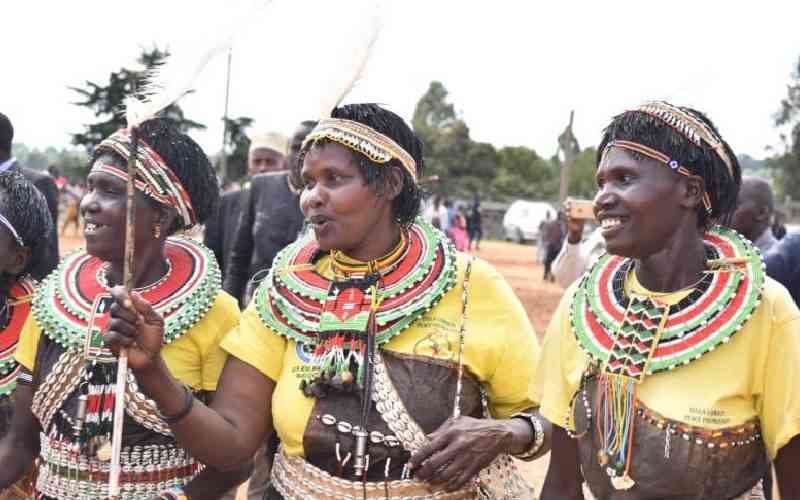
Pokot women in their beaded traditional attire. [Irissheel Shanzu]
In the heart of West Pokot County, where rugged hills stretch into the horizon and pastoralism defines daily life, tradition still holds a firm grip on the lives of women, especially when it comes to land inheritance.
Despite Kenya's progressive 2010 Constitution, which guarantees equal rights to property for both men and women, women in the Pokot community continue to be denied the right to inherit land from their fathers and husbands.
The entrenched cultural belief that only men should own and control land has left many women landless, vulnerable, and voiceless.
Centuries-old traditions continue to deprive them of inheriting land from their fathers or husbands, despite the constitution guaranteeing their rights to ownership.
In West Pokot County, a region dominated by pastoralist and agrarian lifestyles, land is a source of wealth, identity, and survival. But for many women, it is also a source of pain, humiliation and legal battles.
Emily Longura, a mother of two, is among the many Pokot women battling for their share of family land. After the death of her father, she says her brothers forcibly evicted her from her home despite a prior agreement that each of the six siblings would receive a share of land.
"I was chased from home. They said I had no right to inherit my father's land because I'm a woman," Emily said tearfully, speaking from her rented single-room house in Lelan. "They beat me. They told me to go and get married, that I didn't belong here."
Emily says the threats escalated, with her brothers hiring goons who nearly beat her to death. "I took the matter to court. I feared for my life and for my children," she said. "But even after reporting the threats, they have continued harassing me."
For Rhoda Ruto, a 51-year-old woman from Kapsait Sub-Location, the story is eerily similar. After her father passed away in 2019, her two brothers began pressuring her to leave the family homestead.
"They told me to go get married. My father gave each of us a portion of land before he died," Rhoda said. "They beat me so badly they broke my hand."
Now, unable to farm and without an income, Rhoda struggles to raise her children. "My mother is too old and powerless to stop them. I can't even farm to get food or pay school fees."
She pleads for intervention. "I ask human rights groups to help us. The Pokot culture doesn't recognize us as rightful heirs, and yet we are the ones who take care of our children."
For married women like Cherotich Kama, being married is not a guarantee of security. She was chased from her husband's 40-acre land after being branded a witch by her co-wife.
Scholar Kimerinyang, a widow and second wife, says her late husband's children beat her and served her with an eviction notice.
"They said I was a witch. I've gone to the police. The case is still in court. But I have no peace," she said. "They don't even obey court orders. I've spent so much money just attending mentions."
"He burned down my house"
Susan Lekwanyang's story stands out because she had a title deed - yet it wasn't enough. Her estranged husband began selling her 15-acre piece of land behind her back.
"I went to court and placed a caution on the land, but he ignored the court order," she said. "He burned down my house and called me a witch. The real issue? I gave birth to girls."
Susan says the emotional and financial toll of the ongoing legal battle is immense. "This land is all I had for my children. Now, we are scattered, living with relatives."
While the Constitution clearly outlines that women have equal rights to land ownership and inheritance, enforcement in remote regions like Pokot is difficult due to entrenched cultural norms.
Nicholas Odhach, Assistant County Commissioner for Pokot South Sub-County and chairperson of the local land board, says he handles such numerous cases.
"Every month, at least three women come to us saying they've been chased off their land - either by brothers or in-laws," he said. "We are trying to educate the community that the Constitution protects women, but it's a slow process."
He noted that while mediation has worked in a few cases, many others fail due to the unwillingness of men to let go of tradition.
Masitait Lokeles, the chairperson of the Pokot Council of Elders in Pokot South Sub-County, acknowledged that the Kenyan Constitution permits women to inherit land from their parents. However, he insisted that cultural considerations still play a major role in determining whether a woman receives land.
"If a woman is married to a wealthy man, she is not entitled to inherit her father's land," Lokeles said. "But if she marries a poor man, she may return to her father's home and request a portion."
He noted that under traditional Pokot customs, girls were historically not allowed to inherit anything from their parents. While the law has changed, he expressed skepticism about the effectiveness of court interventions. "Women who go to court over land are wasting time. These issues are better handled by elders through mediation," he said.




