×

The Standard e-Paper
Stay Informed, Even Offline
 The Standard Group Plc is a
multi-media organization with investments in media platforms spanning newspaper
print operations, television, radio broadcasting, digital and online services. The
Standard Group is recognized as a leading multi-media house in Kenya with a key
influence in matters of national and international interest.
The Standard Group Plc is a
multi-media organization with investments in media platforms spanning newspaper
print operations, television, radio broadcasting, digital and online services. The
Standard Group is recognized as a leading multi-media house in Kenya with a key
influence in matters of national and international interest.

Audio By Vocalize

Every weekday at noon, a long line forms quietly at St. Jerome Emiliano Ramula Preparatory School in Seme Sub-County.
Hands clutch on plates as children wait patiently, some after walking for miles under the sun. For many of them, the steaming plate they receive is the only hot meal they will eat that day.
What looks like an ordinary lunch break has become a lifeline not just for learners, but for entire households living on the edge.
The need in this part of Seme is deep and visible as many parents survive on casual farm work, while others depend on fishing that no longer guarantees daily income.
Hunger is the order of the day, children often arrive at school on empty stomachs, making learning a daily struggle.
Teenage motherhood remains widespread, forcing many young girls out of school with no skills to earn a living. Health facilities are distant and costly, leaving families to delay treatment or go without care altogether.
At the centre of these challenges is Elly Opondo, the voluntary director of St. Jerome Emiliano Ramula Preparatory School where his first step was simply to feed a few hungry children.
Five years ago, Opondo shared photos online of children he had fed with distress call attracted friends to lend hand.
Some sent food, others sent small amounts of money which slowly attracted the numbers. Today, between 240 and 280 children from the school and two neighbouring institutions receive hot lunches five days a week.
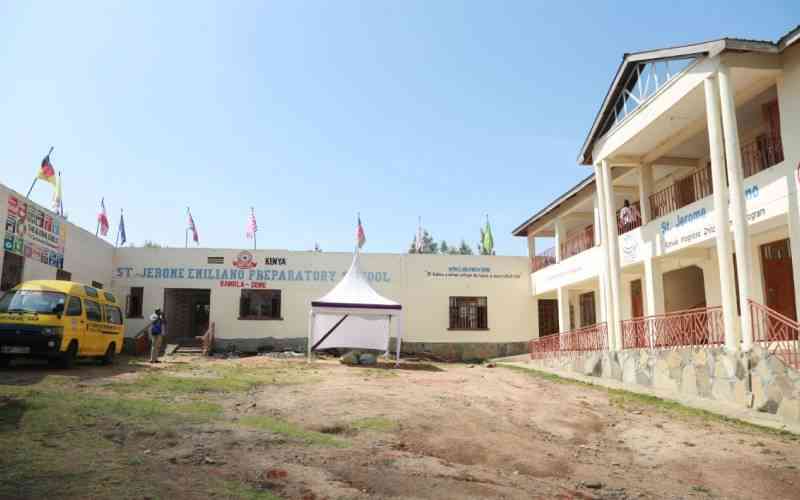
[Washington Onyango, Standard]
For many families, the impact has been immediate and profound with food assured at school, enrolment has increased and absenteeism has dropped.
Teachers say learners are more alert and engaged in class. Parents, relieved of a burden they could barely meet, say the programme has kept their children in school.
Often, the impact goes beyond the classroom. Some learners discreetly save part of their meal to take home, sharing with younger siblings who may have nothing to eat.
In these small acts, a school lunch becomes a source of hope for entire households.
“Once a child knows there is food in school, they will come. And when they come, they learn,” Opondo says.
As the needs grew, the school expanded its reach roping in teenage mothers and young women who had dropped out of school, were invited to take part in tailoring training.
Stay informed. Subscribe to our newsletter
For many, it was the first time they had learned a practical skill that could generate income.
“This training restored dignity. It gave young mothers a second chance,” Opondo notes.
Education support through donations, bright but needy learners were identified and supported to join secondary schools.
So far, 37 students have benefited, joining national schools such as Kakamega Boys, Butere Girls, Ng’iya Girls and Rang’ala Boys, schools their families once thought were far beyond reach.
Health challenges also stood out. Families were travelling long distances for basic medical care. In response, the institution began constructing a level-three health facility, expected to open in early 2026, offering affordable services to the community.
The school itself sits on family-donated land and is steadily growing. It is on course to produce its first Grade Six class in 2026 and now hosts basic ICT facilities alongside spaces for community programmes.
Sustaining the work has not been easy. Donor fatigue has forced temporary closures in the past. At one point, Opondo’s own mother sold livestock to keep the feeding programme running. Feeding one child costs about Sh40 to Sh45 a day, translating to roughly Sh2.3 million annually.
“It does not take much to change a child’s life. Even a small amount can feed a hungry child,” Opondo says.
Similar stories are unfolding across other ASAL counties, where school meals have become a powerful incentive for enrolment, retention and community stability.
In drought-prone regions, a guaranteed meal has kept children in class and reduced household pressure during lean seasons.
In Nairobi County, the scale is far larger but the principle is the same under the 'Dishi na County programme.' According to Nairobi Governor Johnson Sakaja, the school meals have transformed public education in informal settlements, enrolment in public schools has risen sharply since the programme began.
“In 2022, we had about 210,000 children in our schools. Today, we are feeding 316,000 learners daily, and the numbers keep growing,” he says.
Sakaja adds that the programme has reduced the number of children on the streets during school days and created jobs across the value chain.
“We are about to celebrate our 68 millionth meal. We have built 17 central kitchens across the city, providing thousands of jobs from food suppliers to kitchen staff,” he said.
He notes that many children carry part of the meal home for their sibling making it a household venture.
“They enjoy the food, and yes, sometimes they share it with siblings. That is the real impact.”
Last year, MPs reinstated Sh2 billion budget which the national Treasury had cut for the programme. According to chairman of National Assembly Education committee Julius Melly, this is to ensure children from vulnerable regions continue benefiting from it.
"The committee has reinstated the Sh2 billion under the NACONEK for this important programme. The committee recommends that the Budget and Appropriations Committee consider allocating an additional Sh3 billion so that the entire amount is reinstated," Melly said.

Subscribe to our newsletter and stay updated on the latest developments and special offers!







 join
join