×

The Standard e-Paper
Join Thousands Daily
 The Standard Group Plc is a
multi-media organization with investments in media platforms spanning newspaper
print operations, television, radio broadcasting, digital and online services. The
Standard Group is recognized as a leading multi-media house in Kenya with a key
influence in matters of national and international interest.
The Standard Group Plc is a
multi-media organization with investments in media platforms spanning newspaper
print operations, television, radio broadcasting, digital and online services. The
Standard Group is recognized as a leading multi-media house in Kenya with a key
influence in matters of national and international interest.

Audio By Vocalize

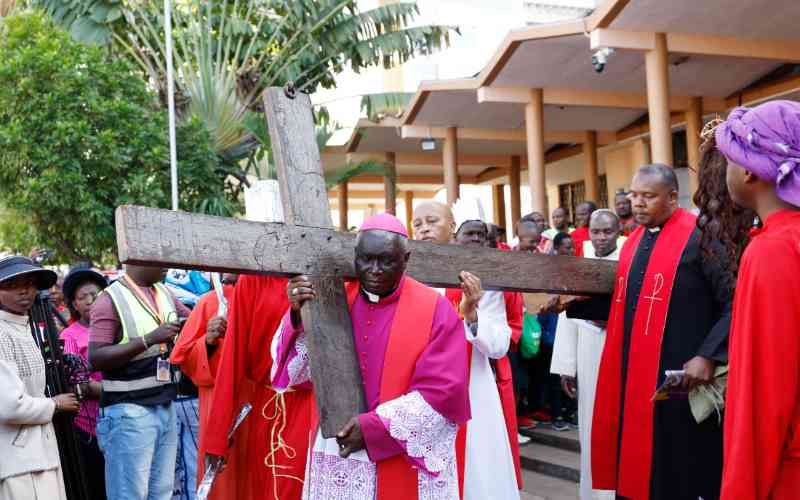
Easter is one of the most important weekends on the Christian calendar. While Christmas, observed in December, is today marked as the birth of Jesus Christ, Easter marks the resurrection of Jesus Christ three days after his death by crucifixion.Saturday, today, signifies the waiting period when the body of Christ is in the tomb and the spirit is in the underworld. It is in this liminal space, according to Christian faith, that the transformation and atonement of sins begins.
Whenever the Easter weekend comes around, I’m reminded of Mythology: The Voyage of the Hero by David Leeming, a book I chanced upon at the Margaret Thatcher Library at the main campus of Moi University many, many years ago.
The book brings together various theories on the steps to greatness taken by a hero. It looks at Jesus Christ as a hero, breaks down the steps He takes from childhood to his ascension, and draws parallels between Him and other known heroes across the world.
Leeming’s work struck me as remarkable for the way it culls the steps taken by any hero, whether in biblical stories, spy novels or any other literature. Heroes seem to follow certain steps to greatness that Leeming ably isolates and explains.
Leeming uses the concept of archetype, a universal recurring pattern or character type that exists in all walks of life. The archetype, according to Swiss psychiatrist Carl Jung, the father of analytical psychology, comes from the collective unconscious.
It is why you see patterns recurring everywhere from the Bible to your community. For instance, every community has its story of origin. According to the Bible, we all came from Adam and Eve. The Gikuyu people trace their origin to Gikuyu and Mumbi. My people of Embu trace theirs to Ndega and Nthara. The Yoruba speak of creation under the deity Oduduwa, while in ancient Greek mythology, humanity’s origins are linked to figures such as Prometheus. These archetypes are the frameworks that form all great stories.
In my view, whenever a talented writer reads stories by other great writers, these great stories become the key to the main frameworks that characterise all enduring narratives. What Leeming was explaining is not very different from the work of Edgar Allan Poe, who analysed great short stories and tried to explain what a great short story should look like in terms of structure.
Even in the area of characterisation, we used to say in the literature class that there is an Okonkwo—that well-developed character from Chinua Achebe’s Things Fall Apart—in every village. Of course, that came from the common quip that there is a madman in every market, which, in layman’s terms, is a further explanation of how archetypes frame our lives regardless of where we were born and brought up, as we all share a common collective unconscious, as explained by Jung.
Leeming’s Mythology: The Voyage of the Hero also borrows heavily from Sigmund Freud, the Austrian father of psychoanalysis, who held that human behaviour is driven by the unconscious, particularly repressed desires and childhood experiences.
Leeming examines early childhood, while Carl Jung looks at the collective and Sigmund Freud at the individual hero’s journey. Strikingly, biblical figures such as Moses, Jesus Christ and David follow a similar arc, marked for destiny from birth, as seen in both Moses and Jesus.
These parallels offer a creative blueprint. Leeming’s “voyage of the hero” can shape compelling characters—seen in series like Game of Thrones and The Blacklist, where Raymond Reddington, a most-wanted criminal, is forced to work with the Federal Bureau of Investigation to hunt down other criminals.
Back to Easter and away from Leeming’s voyage of the hero, it is noteworthy that Christians and Muslims began their fasting and prayer periods at roughly the same time this year.
This is significant because, while our faiths may differ in doctrine, we are one people who, at the most basic level, aspire to the same ideals in life. We all want to lead a life of peace, unity, love and so on.
Rise above trials
As Muslims marked Ramadan, a period of prayer and fasting, we of the Catholic faith embarked on Lent. It has been observed that human resilience is often strengthened whenever we deny ourselves indulgence so that we can come closer to that aspect of ourselves that transcends the body.
Stay informed. Subscribe to our newsletter
For even those who claim to believe in nothing acknowledge that beyond our flesh and blood lies a transcendental aspect of our being that connects to the deeper mysteries of human existence that we may never fully understand.
Stripped to their essence, Easter, Ramadan and similar journeys speak of renewal. Life is fraught with trials, echoing Percy Bysshe Shelley in Ode to the West Wind: “Oh lift me as a wave, a leaf, a cloud! / I fall upon the thorns of life! I bleed!”
Easter calls us to rise above life’s trials. Yet many Kenyans slip back into old habits. Over the holiday, some will flock to local joints and drink heavily, forgetting this is a time for reflection and renewal. But perhaps that is no surprise in a culture where even a toddler’s birthday becomes an excuse to drink late into the night.
For me, Easter is a great period in the human journey not just because it fits snugly into our journey of faith, but because, on the literary front, it gives us a chance to reflect on greatness and how we can become better people.
For those with a literary mind, it offers a chance to reflect on the path followed by all great characters in the works we create. For those we create in works of art also shape the lives of those who read such works. Happy Easter, folks!
Subscribe to our newsletter and stay updated on the latest developments and special offers!


 Prefer the Standard on Google








 join
join