×

The Standard e-Paper
Join Thousands Daily
 The Standard Group Plc is a
multi-media organization with investments in media platforms spanning newspaper
print operations, television, radio broadcasting, digital and online services. The
Standard Group is recognized as a leading multi-media house in Kenya with a key
influence in matters of national and international interest.
The Standard Group Plc is a
multi-media organization with investments in media platforms spanning newspaper
print operations, television, radio broadcasting, digital and online services. The
Standard Group is recognized as a leading multi-media house in Kenya with a key
influence in matters of national and international interest.

Audio By Vocalize
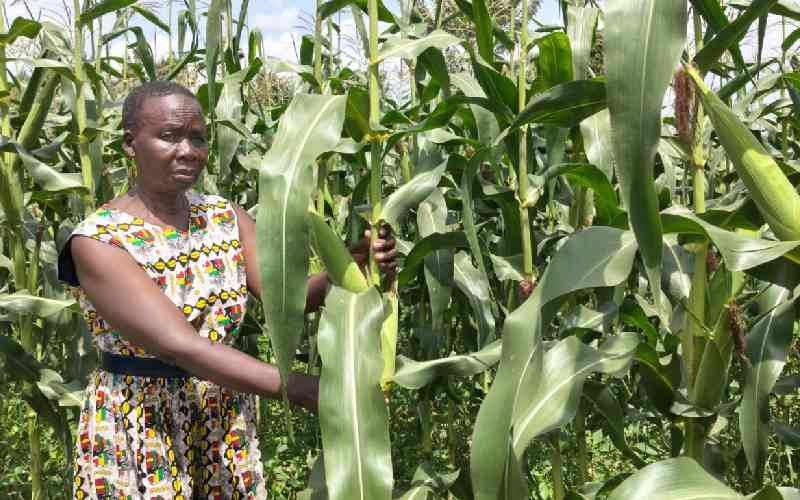
Risper Agutu on her indigenous maize farm in Got Osimbo, Ugunja Sub-county, Siaya County. [Nanjinia Wamuswa, Standard]
Farmers continue to face increasingly unpredictable weather patterns driven by climate change, rising costs of farm inputs such as fertilisers and seeds, and disruptions in global supply chains, which threaten agricultural productivity and household incomes.
However, farmers in the Got Osimbo area of Ugunja sub-county, Siaya County, are looking forward to a bumper harvest despite the prevailing harsh economic and climatic conditions.
This follows their decision to embrace indigenous and climate-resilient crops as a strategy for adapting to recurring shocks affecting modern agriculture.
Risper Agutu says indigenous crop varieties have helped her reduce production risks while improving food security and farm sustainability.
On her farm, there are healthy maize plants expected to be harvested in two weeks. Risper also grows cassava, yams, bananas, sweet potatoes and indigenous vegetables and keeps dairy cows and chickens. “I have diversified my farming, and the crops harvested not only improve household food supplies but also increase my income through surplus sales in local markets,” she says.
For many years, farmers relied heavily on hybrid seeds and chemical inputs in the hope of improving yields.
But they recall an incident that marked a turning point and led them to adopt indigenous crops.
Around three years ago, the community planted crops as usual, mainly maize and beans. However, the rains suddenly stopped, causing most of the crops to wither and dry up.
Coincidentally, one farmer who had planted indigenous maize recorded a better harvest despite the prolonged dry spell. He had opted for indigenous seeds because he could not afford hybrid seeds and fertiliser. Rickadiuse Agola says the community became curious and eager to understand why the maize had continued growing to maturity despite the harsh weather conditions.
“When we learnt that they were indigenous seeds, we decided that those are the crops we would continue planting,” he recalls. Agola grows finger millet, groundnuts, sorghum, indigenous maize and Bambara groundnuts. At the beginning of the next planting season, hundreds of locals sought indigenous seeds. Unfortunately, it wasn’t enough for everyone, but through networks, they sourced seeds from friends and relatives.
Two years ago, they established the Got Osimbo Community Seed Bank, which safeguards indigenous seeds. Here, farmers preserve, exchange and access drought-tolerant seed varieties during planting seasons.
They purchase seeds, while those who cannot afford them receive them for free and repay twice the amount after harvest.
Agola has also discovered that some indigenous crops are not eaten by monkeys. He says that in the past, monkeys destroyed large portions of his maize crops. “I have planted finger millet and bambara groundnuts several times, but monkeys do not eat them. They simply pass by looking for other crops,” he says.
Stay informed. Subscribe to our newsletter
Farmers have since benefited from training by various organisations, particularly in the preparation and use of biofertilisers, organic manure, biopesticides, and other techniques and methods that help them adapt to climate change. They say the farm inputs used on indigenous crops are locally available and easily accessible, therefore reducing the costs associated with hybrid farming, such as purchasing seeds, fertilisers, and pesticides.
“I prepare and use organic manure on my farm. I also use cow and goat urine as fertiliser and as a pesticide whenever pests attack my crops,” Mary Owino says.
They are now experiencing improved resilience and renewed hope in farming despite the challenges facing the agricultural sector.
Resilience Action Network Africa (RANA) Executive Director Aggrey Aluso commends farmers who are coming together to revive indigenous seeds, establish community seed banks and adopt organic farming practices in response to climate change.
“We’re seeing communities come together to share traditional knowledge, support one another and intentionally pass resilience skills from one generation to another. These are some of the promising initiatives we want to amplify and scale up,” he says.
Aluso explains that when societies face food insecurity, many aspects of life are disrupted. Communities are experiencing more severe health challenges due to limited food diversity and unreliable food systems, both of which are worsened by climate change.
He says governments need to create more supportive policies and legal frameworks that enable communities to adapt, rather than introducing restrictive laws that undermine local resilience efforts.
“There is a greater opportunity within governance systems, both at the county and national levels, to create an enabling environment that can help scale up these fragmented small-scale resilience initiatives. This would help communities not only take care of themselves but also move beyond subsistence farming and earn sustainable livelihoods,” Aluso says.






Subscribe to our newsletter and stay updated on the latest developments and special offers!







 join
join