×

The Standard e-Paper
Fearless, Trusted News
 The Standard Group Plc is a
multi-media organization with investments in media platforms spanning newspaper
print operations, television, radio broadcasting, digital and online services. The
Standard Group is recognized as a leading multi-media house in Kenya with a key
influence in matters of national and international interest.
The Standard Group Plc is a
multi-media organization with investments in media platforms spanning newspaper
print operations, television, radio broadcasting, digital and online services. The
Standard Group is recognized as a leading multi-media house in Kenya with a key
influence in matters of national and international interest.

Audio By Vocalize
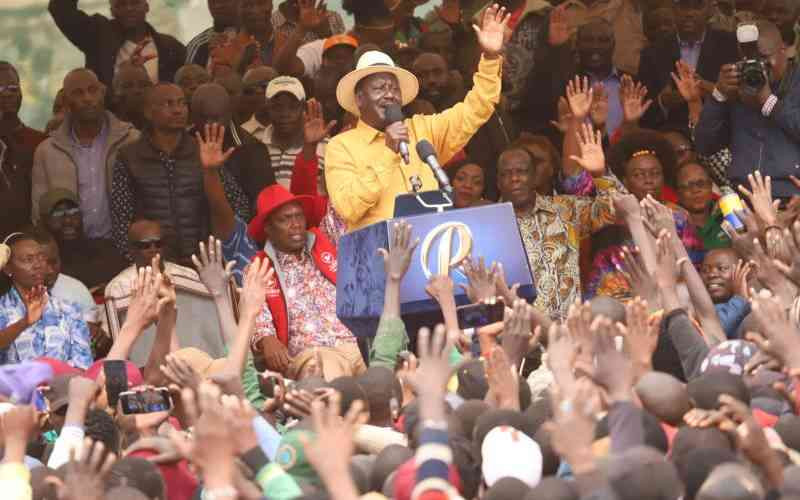
ODM leader Raila Odinga addresses Azimio consultative meeting at Kamukunji Grounds in Nairobi on June 27, 2023. [File, Standard]
Growing up, I knew Saba Saba through the name Raila Odinga. To me, it wasn't a chapter in Kenya's democratic history; it was simply "Baba's day." Whenever July 7 came around, I expected news of rallies, chants, police roadblocks, and a country divided between those who supported the demonstrations and those who didn't. I never stopped to ask where Saba Saba came from or what it originally stood for.
As I grew older, I learned that Saba Saba is much bigger than one political figure. It traces back to the struggle for multiparty democracy and the demand for greater political freedoms. That history gave the day a meaning I hadn't appreciated as a child. Still, for many Kenyans of my generation, it is difficult to separate Saba Saba from the image of Raila Odinga, whose political activism shaped how we experienced the day.
This year, however, Saba Saba felt different.
On the eve of the commemoration, the government declared that any planned demonstrations would be illegal. Whether out of fear, uncertainty, or caution, many Kenyans chose to stay indoors. The streets felt quieter than I had expected. Businesses remained cautious, movement was limited in many places, and the atmosphere lacked the energy that had defined the Saba Saba I remembered.
As I watched the day unfold, I found myself comparing it to the Saba Saba of my childhood. I cannot say with certainty what today would have looked like had Baba been leading the movement, but I believe many people in the past drew courage from his leadership. To me, today's quiet streets reflect not only concerns about security but also how Kenya's protest movements have changed over time.
Perhaps the biggest change is in me. I no longer see Saba Saba as belonging to one leader or one political movement. I now understand it as a reminder of Kenya's democratic journey and the sacrifices made by those who demanded greater freedoms. At the same time, I recognise that every generation remembers history through the people who gave it a face.
Today's silence spoke differently from the chants that once echoed through the streets. It reminded me that history is never static. It evolves with every generation, every political season, and every Kenyan who experiences it differently.
For me, Saba Saba is no longer just a political event. It is a story of memory, change, courage, and the evolving meaning of democracy in Kenya.


Subscribe to our newsletter and stay updated on the latest developments and special offers!







 join
join