×

The Standard e-Paper
Smart Minds Choose Us
 The Standard Group Plc is a
multi-media organization with investments in media platforms spanning newspaper
print operations, television, radio broadcasting, digital and online services. The
Standard Group is recognized as a leading multi-media house in Kenya with a key
influence in matters of national and international interest.
The Standard Group Plc is a
multi-media organization with investments in media platforms spanning newspaper
print operations, television, radio broadcasting, digital and online services. The
Standard Group is recognized as a leading multi-media house in Kenya with a key
influence in matters of national and international interest.

Audio By Vocalize
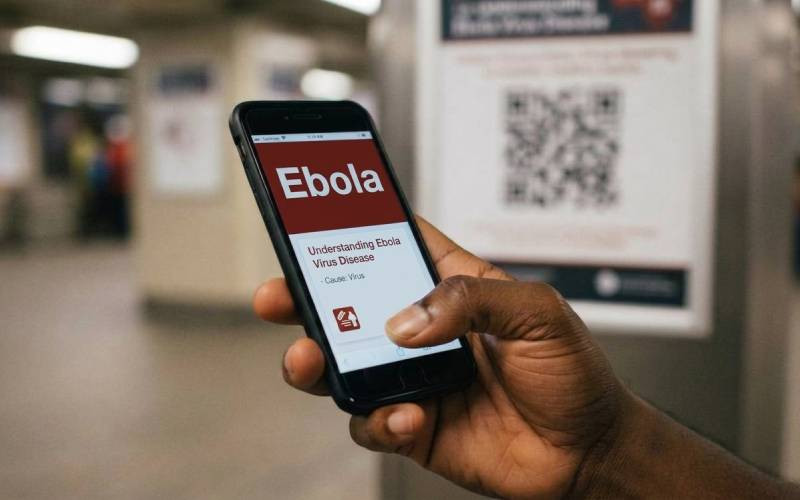
Kenya’s Ebola preparedness is facing fresh scrutiny over the use of QR-code health screening at points of entry, after a traveller arriving from the Democratic Republic of Congo said she was not required to scan a code on arrival.
The traveller, who spoke to the Standard on condition of anonymity, said she encountered stationary temperature checks but no visible QR-code screening process.
“We have the stationary thermometers but no scanning of QR code,” she said.
Her account comes as Kenya manages its first confirmed imported case of Bundibugyo Ebola involving a Kenyan citizen who had lived in the DRC for seven years.
The traveller said she encountered a different system while travelling through the DRC and Ethiopia, where QR codes formed part of the health-screening process.
“In both DRC and Ethiopia we scanned the QR codes,” she said.
She said she expected heightened vigilance when arriving from the DRC because of the ongoing Ebola outbreak.
“I’m not sure what they should be doing but for a plane load from DRC I expected some vigilance,” she said.
The traveller said she asked authorities at Jomo Kenyatta International Airport whether passengers were required to scan a QR code after arrival.
“I said, are we scanning a QR code? He said, no, no, no, no, pass, pass, pass, pass,” she said.
She described QR-code notices at other airports, including codes displayed on banners and made available to passengers during flights.
“At other airports, you go, you find stand-up banners with a QR code. Or inside the plane, you get them, you scan them, so that by the time you get there,” she said.
She said she found the Kenyan process noticeably different.
“Even in Congo, where there are no systems, you cannot cross the airport if you have not done something. Here, we have not done anything,” she said.
Stay informed. Subscribe to our newsletter
The traveller believes the change may have occurred in recent weeks.
“And this, I think, has changed in the last month or so. So, it can be relaxing. You know, the vigilance stopped,” she said.
“It stopped.”
The account does not establish that all passengers arriving in Kenya are bypassing Ebola screening, nor does it independently establish that the QR-code system was not operational at JKIA.
But it raises a specific public-health question: if the QR-code system is part of Kenya’s border health surveillance, was it being used for passengers arriving from the DRC on the day in question?
THE UHAI TEST- AI IN EBOLA WAR
The Standard also tested the digital health-screening process through Uhai, an AI-powered health assistant designed to provide information and guidance on Ebola.
Uhai introduces itself as an AI assistant that can provide information on Ebola symptoms, prevention, transmission, care guidance, nearby facilities and helpline numbers.
It also tells users that it does not replace a doctor or health worker and says it provides validated and relevant information.
The system states:
“Hello, welcome to Uhai. I am an AI assistant here to listen, support, and guide you with trusted information on Ebola – whether you are looking for answers, want to understand symptoms and prevention, or need any guidance on where to seek help in Kenya.”
It adds:
“You can type and ask me anything about Ebola symptoms, prevention, transmission, care guidance, nearby facilities, helpline numbers, or concerns you are facing in Kenya.”
The system then asks the user to continue after agreeing to its privacy policy and consent terms.
The test then moved from information provision to health screening.
As a traveller, I prompted the system:
“Generate a pass.”
Uhai responded:
“Who are you requesting for?”
I replied:
“Myself.”
Uhai then responded:
“All set! Kindly tap the button below to start your health screening.”
That interaction raises a separate question about how the digital system is designed to screen travellers.
The purpose of a digital health declaration or screening tool should be to capture relevant information, including travel history, symptoms and potential exposure, before a traveller is cleared through the relevant process.
Yet in this test, the system moved the user towards starting the health screening after only asking who the pass was for.
There was no visible preliminary question in the interaction about whether the traveller had recently been in an Ebola-affected area, whether they had been in contact with a suspected or confirmed case, or whether they had symptoms before the screening was initiated.
That does not by itself establish that Uhai cannot collect such information. It does, however, raise questions about when and how risk information is captured, and whether a traveller can obtain access to the screening process without first disclosing a relevant outbreak exposure.
Digital screening is not a substitute for clinical assessment, laboratory testing or contact tracing. Its value is as another layer of surveillance.
That layer matters because Ebola can have an incubation period of between two and 21 days. An infected traveller may therefore arrive while still asymptomatic and have no fever to trigger a temperature check.
Temperature screening can identify some symptomatic travellers, but it cannot reliably identify every infected person.
A digital health declaration can potentially capture information that a thermometer cannot, including recent travel, possible exposure and symptoms and can help direct a traveller for further assessment when a risk is identified.
Kenya’s first imported case illustrates why those layers matter.
According to Health Cabinet Secretary Aden Duale, the patient travelled from the DRC to Kampala by road before boarding Jambojet flight 8523 to Nairobi on October 3, arriving at 1.10 pm.
Duale said the patient underwent the normal public health screening at Jomo Kenyatta International Airport before being transported by a relative and a friend to Nairobi Hospital, where he was isolated.
The patient was later confirmed to have Bundibugyo Ebola and died.
The case means Kenya’s border surveillance is no longer a theoretical preparedness exercise. An infected traveller has already entered the country.
The issue is therefore not whether a QR code alone can stop Ebola from entering Kenya. It cannot.
The question is whether every layer of surveillance is functioning as intended, particularly for passengers arriving from an active Ebola outbreak zone.
Health authorities now need to clarify whether QR-code screening is mandatory for passengers arriving from the DRC, what information the system captures, when that information is reviewed, who receives alerts generated by the system and whether the system was fully operational when the traveller arrived on Saturday.
They also need to clarify the role of Uhai in the broader border-health system, whether it is an information tool, a formal health-screening platform or both, and what safeguards are in place to ensure that a traveller from an Ebola-affected area cannot simply proceed without completing the relevant health assessment.






Subscribe to our newsletter and stay updated on the latest developments and special offers!







 join
join