×

The Standard e-Paper
Stay Informed, Even Offline
 The Standard Group Plc is a
multi-media organization with investments in media platforms spanning newspaper
print operations, television, radio broadcasting, digital and online services. The
Standard Group is recognized as a leading multi-media house in Kenya with a key
influence in matters of national and international interest.
The Standard Group Plc is a
multi-media organization with investments in media platforms spanning newspaper
print operations, television, radio broadcasting, digital and online services. The
Standard Group is recognized as a leading multi-media house in Kenya with a key
influence in matters of national and international interest.

Audio By Vocalize
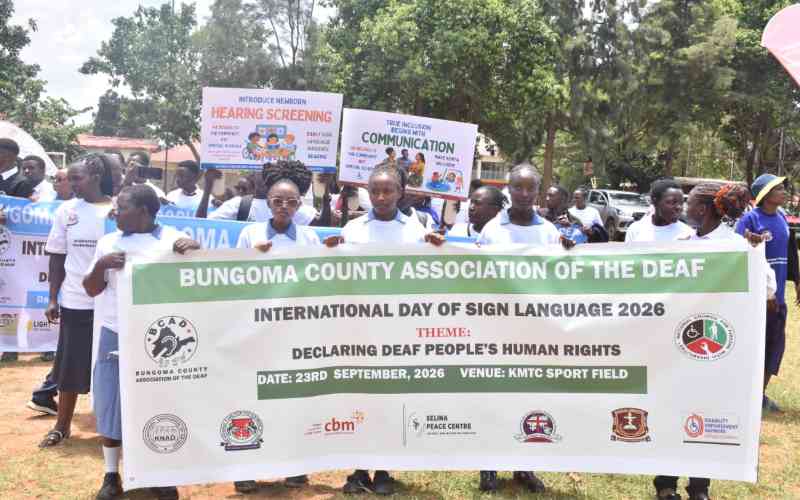
People with hearing disability have called on the government to ensure public institutions provide adequate Kenyan Sign Language services, saying communication gaps continue to deny them access to healthcare, education, justice and other essential services.
Kakamega Association of the Deaf chairman Abel Ouma said public officers should be trained in Kenyan Sign Language and institutions required to provide accessible communication should comply with the law.
Ouma spoke at Kenya Medical Training College (KMTC) grounds in Bungoma during the 2026 International Deaf Awareness Week, whose theme was “Declaring deaf people’s human rights”.
He said the absence of sign language interpreters in public institutions forces deaf people to rely on relatives or other third parties when seeking services, limiting their ability to communicate independently.
“Accessible communication is a basic right. Deaf people should be able to access information and services through Kenyan Sign Language without discrimination,” Ouma said.
He called for doctors, nurses, police officers, teachers, judicial officers and other frontline government workers to receive sign language training to enable them to serve deaf people directly.
The call comes against a backdrop of low compliance with disability inclusion measures in public institutions. Data from the National Council for Persons with Disabilities shows that only four per cent of public institutions had met the mandated five per cent employment reservation for persons with disabilities.
The council also found that only 35 per cent of institutions had employed any persons with disabilities by July 2022, with persons with disabilities accounting for 1.32 per cent of the total workforce.
Ouma said the figures pointed to the need for stronger implementation of laws and policies on disability inclusion.
“The rights, voices and aspirations of deaf people matter and we must remain committed to breaking down communication barriers,” he said.
He urged county governments to include persons with disabilities in planning and budgeting, saying failure to factor in their needs at the local level limits access to government programmes and services.
The leaders are also pushing for implementation of the Persons with Disabilities Act, 2025, which strengthens provisions on accessibility, communication and inclusion.
Ouma said communication barriers were particularly serious in healthcare, policing and the justice system, where failure to communicate effectively can affect a person's ability to receive treatment, report a crime or participate in legal proceedings.
He urged parents to learn Kenyan Sign Language and support deaf children to acquire communication skills early.
Ouma also called on development partners, civil society organisations and the private sector to support sign language training, accessible information and economic empowerment programmes.
Stay informed. Subscribe to our newsletter
He said deaf people should be involved in decisions affecting them rather than being treated only as beneficiaries of government and development programmes.
The awareness week activities included a street procession through Bungoma town by deaf people and other stakeholders to raise awareness of their rights and the challenges they face.







Subscribe to our newsletter and stay updated on the latest developments and special offers!







 join
join