×

The Standard e-Paper
Stay Informed, Even Offline
 The Standard Group Plc is a
multi-media organization with investments in media platforms spanning newspaper
print operations, television, radio broadcasting, digital and online services. The
Standard Group is recognized as a leading multi-media house in Kenya with a key
influence in matters of national and international interest.
The Standard Group Plc is a
multi-media organization with investments in media platforms spanning newspaper
print operations, television, radio broadcasting, digital and online services. The
Standard Group is recognized as a leading multi-media house in Kenya with a key
influence in matters of national and international interest.

Audio By Vocalize
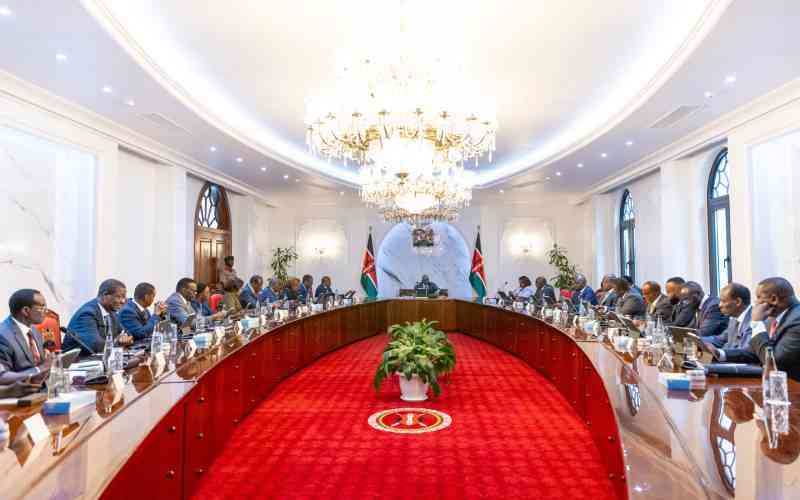
National Assembly Speaker Moses Wetangula has moved to the Court of Appeal to challenge the recent High Court landmark decision declaring President William Ruto's Cabinet unconstitutional for failing to comply with the constitutional two-thirds gender rule.
In a Notice of Appeal lodged on July 8, Wetang'ula and the National Assembly say they are dissatisfied with part of the judgment delivered on June 30 by a three-judge bench comprising Justices Eric Ogola, Stephen Githinji and Jairus Ngaah and intend to challenge the findings before the Court of Appeal.
The appeal specifically contests the declaration that President Ruto's current Cabinet violates Article 27(8) of the Constitution because more than two-thirds of its members are of the same gender.
The High Court also held that the constitutional gender principle is immediate, mandatory and fully enforceable in relation to appointive bodies, including the Cabinet established under Article 152 of the Constitution.
Further, the court directed the appointing authority to make Cabinet appointments that comply with the two-thirds gender principle within 120 days from the date of the judgment.
The ruling arose from consolidated petitions filed by a coalition of civil society organisations and public interest litigants led by Saitabao Ole Kanchory, Katiba Institute, Centre for Rights Education and Awareness, Institute for Social Accountability, Kenya Human Rights Commission and Okiya Omtatah Okoiti, who challenged the constitutionality of the Cabinet following its reconstitution after the July 2024 Gen Z protests.
In the majority judgment, Justices Ogola and Githinji found that the Cabinet's composition falls short of the constitutional threshold requiring that no more than two-thirds of members be of the same gender.
The judges noted that the Secretary to the Cabinet cannot be included in computing compliance because Article 152 of the Constitution defines the Cabinet as consisting only of the President, Deputy President, Attorney-General and Cabinet Secretaries.
The current Cabinet comprises eight women: Lands Cabinet Secretary Alice Wahome, Tourism Cabinet Secretary Rebecca Miano, Defence Cabinet Secretary Soipan Tuya, Environment Cabinet Secretary Dr Deborah Barasa, East African Community Cabinet Secretary Beatrice Askul Moe, Gender Cabinet Secretary Hanna Cheptumo, Attorney-General Dorcas Oduor and Secretary to the Cabinet Mercy Wanjau.
The male members are Prime Cabinet Secretary Musalia Mudavadi, Interior Cabinet Secretary Kipchumba Murkomen, Health Cabinet Secretary Aden Duale, Energy Cabinet Secretary Opiyo Wandayi, Treasury Cabinet Secretary John Mbadi, Mining Cabinet Secretary Hassan Joho, Cooperatives Cabinet Secretary Wycliffe Oparanya and Public Service Cabinet Secretary Geoffrey Ruku,
Others are ICT Cabinet Secretary William Kabogo, Education Cabinet Secretary Julius Ogamba, Labour Cabinet Secretary Alfred Mutua, Water Cabinet Secretary Eric Mugaa, Youth Affairs Cabinet Secretary Salim Mvurya, Agriculture Cabinet Secretary Mutahi Kagwe and Transport Cabinet Secretary Davis Chirchir.
While the majority upheld the President's powers to reappoint Cabinet Secretaries and dismissed challenges to the appointment of ODM leaders into government, Justice Jairus Ngaah issued a strongly worded dissent.
Justice Ngaah questioned why President Ruto reappointed Cabinet Secretaries he had previously dismissed as ineffective following the nationwide protests.
"Why would the President renominate people that he found to be ineffective and dismissed them to the same positions?" he posed, arguing that a dismissed State officer can only be reappointed if they remain qualified under the Constitution.
Stay informed. Subscribe to our newsletter
He also faulted the inclusion of opposition politicians in Cabinet without a formal coalition agreement, holding that the Political Parties Act only permits such appointments through a legally recognised coalition framework.
Unless the Court of Appeal grants a stay, the High Court's order requiring the Cabinet to be reconstituted within 120 days remains in force pending the hearing and determination of the appeal.



Subscribe to our newsletter and stay updated on the latest developments and special offers!







 join
join