×

The Standard e-Paper
Kenya’s Boldest Voice
 The Standard Group Plc is a
multi-media organization with investments in media platforms spanning newspaper
print operations, television, radio broadcasting, digital and online services. The
Standard Group is recognized as a leading multi-media house in Kenya with a key
influence in matters of national and international interest.
The Standard Group Plc is a
multi-media organization with investments in media platforms spanning newspaper
print operations, television, radio broadcasting, digital and online services. The
Standard Group is recognized as a leading multi-media house in Kenya with a key
influence in matters of national and international interest.
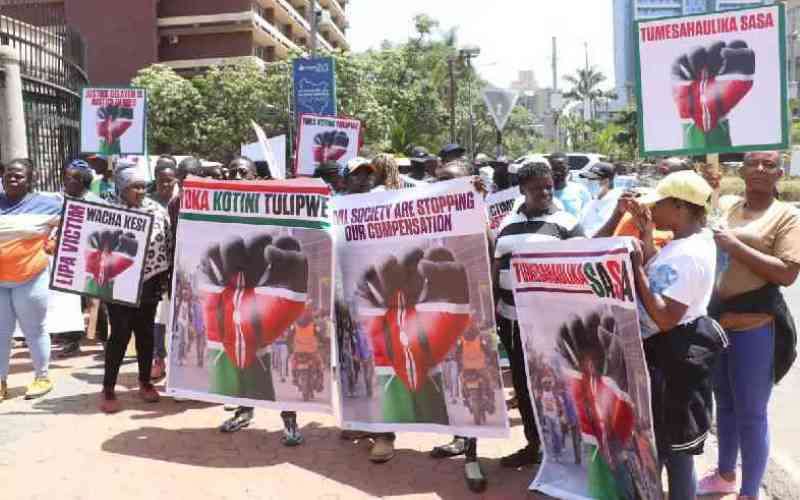
Human rights groups and constitutional lawyers have dismissed the government’s plan to compensate victims of protest-related abuses as a political ploy meant to hoodwink Kenyans rather than deliver justice.
The promise to compensate victims formed part of the recommendations in the 10-Point Agenda that emerged from talks between President William Ruto and the late leader Raila Odinga following months of political tension and protests.
The 10-point agenda was signed in March 2025 and aimed at fostering national unity and addressing long-standing governance challenges.
The pact came after the widespread protest by Kenya’s youth in 2024, who expressed frustration with unemployment, underemployment and marginalisation, high cost of living, poor governance, misappropriation of public finances, among other issues.
But as the deadline for compensation approaches, human rights groups say the process has largely stalled and appears to have been poorly designed from the start.
Kamau Ngugi, Executive Director of the Defenders Coalition, stated that the commitment was presented to Kenyans as an effort to address grievances arising from police brutality during protests.
“The approach between the president and the leader of the then leader of opposition was meant to convince the country that they were aware of the grievances Kenyans had faced, especially regarding human rights violations,” Ngugi said.
One of the key issues, he said, was the heavy-handed response by police officers to protests.
He noted that demonstrations themselves were legitimate expressions of public grievances, protected under the Constitution, but were met with excessive police force.
“ The extreme brutality that the police used to quell what was a legitimate expression of grievance through the memorandum and protest was one of the major concerns,” he said.
According to Ngugi, many Kenyans had taken to the streets to express dissatisfaction with governance issues and to demand accountability, only to face violent crackdowns.
“The people who were killed were killed because of expressing themselves and raising real grievances,” he said.
However, Ngugi argues that the promise to compensate victims quickly became politicised.
“A very important issue that touches the heart of survivors and families of victims was politicised. Instead of addressing the real challenges, it became a political promise that ended up hoodwinking Kenyans,” he said.
According to Ngugi, the failure to implement the compensation plan has led to frustration among victims and their families.
“At the expiry of the timelines that were provided, nothing has been done. Not a single victim,” he said.
He also criticized the framework used to establish a compensation panel, arguing it lacked legal grounding and was destined to fail.
“The compensation panel that was established by the executive was built on shaky grounds. They were aware that it was unlawful and unconstitutional, but they went ahead with it,” Ngugi said.
“If they were serious about it, they could have developed it under a legal framework that is already established by the constitution, which is the Kenyan National Commission on Human Rights,” he added, stating that the commission is the institution constitutionally mandated to handle such matters.
President Ruto had constituted a victims' compensation panel, headed by constitutional scholar Professor Makau Mutua, to review cases of individuals affected during protest and recommend compensation.
However, the panel quickly ran into controversy after a court question it’s legality, arguing that its mandate appeared to overlap with that of constitutional institutions tasked with addressing Human Rights violations.
The legal challenge and criticism from other right and legal players led to resignation from the panel, including former president of the Law Society of Kenya, Faith Odhiambo and outgoing Executive Director of Amnesty International-Kenya, Houghton Irungu, raising further doubts about the viability of the process.
Critics argue that instead of creating an ad hoc panel drew the executive, the government should have relied on existing constitutional bodies.
Ngugi further noted that beyond compensation, victims are still waiting for accountability for deaths, injuries, and disappearances linked to protest crackdowns.
“Even for those who suffered disappearances, killings and injuries, none of them have ever gotten justice through the legal process,” he said.
“Accountability is also a key process of healing, but not a single person has been.”
Similar concerns were raised by Eric Mukoya, Executive Director of the Undugu Society of Kenya and a constitutional lawyer, who said the compensation framework did not fit within the constitutional structure of government institutions.
Mukoya described that the agreement between the two parties itself is largely political.
“The 10-point Agenda was essentially a political agreement between critical political players in the country. Whether it has served the country or not is something Kenyans themselves must judge
But he said the composition panel faced serious legal questions from the outset, including a court ruling challenging its structure.
“That process was called out by the court. The court provided grounds as to why the panel that the president had put together needed to be reconsidered. That court order that actually made some members of that panel resign,” he added.
He noted that the panel appeared to duplicate the role of constitutional institutions retaliating that it was wrong for the panel to start doing the work of the Kenya National Commission on Human Rights.
Mukoya added that the government already had institutions capable of managing compensation for victims, including the Victims Protection Agency under the Attorney General’s office.
“What was so difficult for that particular agency to work with the KeNHA National Commission on Human Rights and get these things right, because we needed to know who was a victim, who was affected, but what was the threshold that the government was using to know whether you were a victim or not,” Mukoya posed.
He also criticized the scope of the initiative, arguing it risks excluding other victims of state violence, stating that the limited compensation only applies to victims of one period, while Kenya has experienced violations over time.
“The initiative was to target Kenyans who've been hurt during riots or riots, but we have other violations which were also riot-oriented and therefore you cannot limit that to 2017 or 2022 or 2024. We have people of 2002, people of 2007 and many others who have not been compensated, “ Mukoya argued.
“So in itself, the structure is discriminatory and so because of that, I don't think from where I sit it represents the ideals of Kenyans,” he added.
In his view, the initiative may have been used as a political tool rather than a genuine attempt at justice
“I think the government then decided, or the president decided, this was going to be a tool they would use to tell Kenyans, 'I tried to compensate you, but civil society and other players did not want me to assist you.’. For me, it's a tool for campaigns and elections,” he added.
Mukoya insisted that compensation alone cannot resolve human rights violations without accountability.
“ There cannot be compensation without accountability. We need the command responsibility to be followed through to ensure the police officers who gave that command are followed through so that they can face the law,” he said.
“The police officers who shot and maimed people must take individual responsibility so that their role in that can be played out before a law of correct jurisdiction,” he added.
Beyond financial payment, Mukoya said victims need answers and enclosure.
“Compensation is not about money. It is about healing and people getting explanation and closure. Those who lost their children to know what happened, mourn and heal, “ he added, stating that for many families who lost their relatives during protestcrackdowns, that process of healing is yet to begin.





Subscribe to our newsletter and stay updated on the latest developments and special offers!






 join
join