×

The Standard e-Paper
Fearless, Trusted News
 The Standard Group Plc is a
multi-media organization with investments in media platforms spanning newspaper
print operations, television, radio broadcasting, digital and online services. The
Standard Group is recognized as a leading multi-media house in Kenya with a key
influence in matters of national and international interest.
The Standard Group Plc is a
multi-media organization with investments in media platforms spanning newspaper
print operations, television, radio broadcasting, digital and online services. The
Standard Group is recognized as a leading multi-media house in Kenya with a key
influence in matters of national and international interest.

Audio By Vocalize
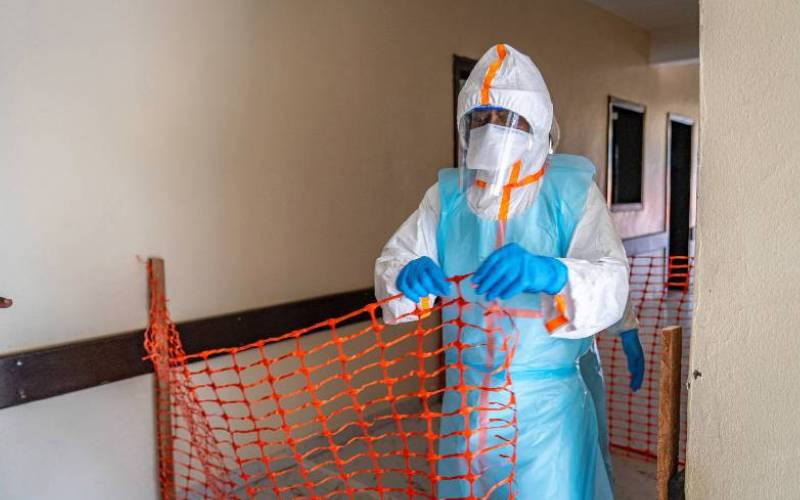
On July 10, a 23-year-old man left South Kivu in eastern Democratic Republic of Congo.
What followed was a journey across national borders, several provinces and one of Africa’s great rivers.
By the time it ended, the man was dead and health authorities were tracing 38 people who had come into contact with him.
His name has not been publicly released.
What is known is that he carried Bundibugyo Ebola into Sud-Ubangi, a north-western DRC province that had not previously reported a case during the current outbreak.
His journey began in South Kivu, one of the provinces already affected by Ebola. He crossed into Rwanda before travelling to Uganda, a country that had only recently declared its own Ebola outbreak over.
Uganda recorded 20 confirmed cases and two deaths during its Bundibugyo outbreak.
On July 28, Uganda's Ministry of Health declared the outbreak over after completing 42 consecutive days without a new confirmed case. The World Health Organisation and Africa Centres for Disease Control and Prevention welcomed the declaration in a statement issued on August 27.
The 42-day period began after Uganda's last patient, an imported case, was discharged on July 16. It represents twice the upper limit of Ebola's incubation period and is used to provide additional assurance that no transmission chains have been missed.
WHO Director-General Tedros Adhanom Ghebreyesus said Uganda had demonstrated that decisive action could bring Ebola outbreaks under control.
“With a focus on preparedness, increased surveillance to find potential cases in health facilities and communities, and careful management of points of entry, countries can keep people and goods moving while ensuring that people stay safe, or receive care if they are sick,” Tedros said.
But the movement of the DRC patient offered a reminder of how difficult that task becomes when people continue travelling between countries and regions where transmission is occurring.
After leaving Uganda, the man returned to DRC and continued through Ituri, the epicentre of the outbreak. He then travelled to Tshopo, where he developed symptoms, before moving westwards into Mongala.
His journey continued by boat along the Congo River. He spent two days at a health facility in Mongala before eventually reaching Sud-Ubangi.
Stay informed. Subscribe to our newsletter
By then, his condition had deteriorated.
He was admitted to a health facility in Gwaka, where a sample was taken and sent for testing. The result was positive for Bundibugyo Ebola.
He died on September 8.
But his death did not end the journey of the virus.
Authorities identified 38 people who had been in contact with him. They are contacts under surveillance, not confirmed Ebola patients.
Their movements and health status are now being monitored to establish whether the transmission chain ended with the man's death or whether the virus was passed to someone else.
The latest figures show 7,043 confirmed cases in DRC, 3,400 deaths and 1,690 recoveries. The daily update recorded 80 new cases, 49 additional deaths and 24 recoveries. The outbreak has now spread to seven provinces.
Sud-Ubangi is the first province in western DRC to report an Ebola case during the current outbreak. The north-western province borders both the Central African Republic and the Republic of Congo, raising concern about the potential for further cross-border transmission and placing greater emphasis on surveillance and contact tracing.
For Kenya, the significance goes beyond the numbers.
“The current Ebola outbreak is already a serious regional concern, although most transmission remains within the DRC,” says infectious disease specialist Dr Ahmed Kalebi.
He says the size of an outbreak alone does not determine when it becomes a regional emergency.
“The tipping point is not a particular case number, but sustained spread across several areas, unidentified transmission chains, community deaths and export of cases across borders.”
That distinction matters because the current outbreak has already demonstrated how quickly the virus can move with people.
The man crossed into Rwanda, entered Uganda, returned to DRC and then travelled through Ituri, Tshopo and Mongala before reaching Sud-Ubangi.
His route illustrates a problem that has confronted public health for centuries: infectious diseases do not recognise the boundaries drawn on maps.
The Black Death offers one of history's starkest examples. The plague devastated Europe and parts of Asia and North Africa in the 14th century, killing tens of millions of people. Some historical estimates put the global death toll as high as 75 million to 200 million.
The disease spread along established networks of human movement and trade, including maritime routes. There were no modern diagnostic tests, surveillance systems or border-health networks capable of identifying infected travellers.
Centuries later, COVID-19 demonstrated the same vulnerability on a much faster scale.
More than 779 million confirmed infections and more than 7.1 million reported deaths have been recorded globally, according to the World Health Organisation, although the true toll is likely higher because confirmed figures do not capture every infection or death.
The virus was first identified in China in late 2019. Within weeks, cases had been detected in other countries, and international travel became a major public-health concern as infected people crossed borders before they were identified.
Kenya experienced that reality early in the pandemic.
On March 13, 2020, the country confirmed its first COVID-19 case involving a Kenyan woman who had recently travelled from the United States through London. She was admitted and isolated at Kenyatta National Hospital.
Within days, two passengers who had travelled on the same flight were also confirmed to have COVID-19.
An analysis of Kenya's early cases found that 31.8 per cent of cases with an identified likely source of exposure were linked to international travel.
The lesson is not that borders are irrelevant.
It is that surveillance must move as quickly as the people crossing them.
An infected traveller does not necessarily need to move directly from DRC to Nairobi for Ebola to become a Kenyan concern.
Kenya does not share a border with DRC, but it is connected to the region through Uganda, South Sudan and other established travel and trade routes.
“The regional threat becomes much greater if neighbouring countries fail to rapidly contain secondary transmission,” Kalebi says.
For now, he says there is some reassurance.
“Fortunately, we have not yet seen sustained transmission outside the DRC,” he says.
Uganda has contained its outbreak, while Rwanda, Burundi, Tanzania and South Sudan have so far avoided sustained transmission.
But Kalebi says vigilance remains necessary because DRC is vast and movement across the region is constant.
“The DRC itself is a vast country and the outbreak is already spread across several provinces.”
For Kenya, the risk remains low.
“The risk to Kenya today remains very low, but it is not zero,” Kalebi says.
He says the most likely scenario would involve an infected traveller arriving by road or air after leaving an affected area during the incubation period and developing symptoms after reaching Kenya.
“That risk would rise if transmission were re-established in Uganda or spread into South Sudan, given our proximity and much greater movement of people between Kenya and those countries, or if repeated international exportation began occurring through major regional travel corridors,” he says.
The Sud-Ubangi case shows why that possibility cannot simply be dismissed.
The patient travelled while moving through communities, transport networks and health facilities. He travelled by boat and interacted with people along the way.
Each stop created another opportunity for exposure.
That is why contact tracing remains one of the most important tools in an Ebola response.
It is also why hospitals are critical.
A patient arriving at a Kenyan facility with fever, vomiting or other symptoms may initially appear to have an ordinary illness. But a recent travel history can change the entire response.
“First, we must strengthen surveillance at points of entry and in hospitals so recent travel history is picked up early,” Kalebi says.
“Second, ensure isolation, PPE, specimen testing and notification pathways are clearly established and rehearsed.”
“Third, protect and regularly train healthcare workers, because one missed first case in a busy facility can expose many people very quickly.”
The warning is particularly relevant in DRC, where health workers have themselves been infected during the outbreak.
“It tells us containment is still incomplete,” Kalebi says.
“Infection of healthcare workers is a warning that some cases are still being recognised late, or that there are gaps in triage, PPE use and infection prevention.”
The challenges extend beyond hospitals.
Some affected areas of DRC are dealing with insecurity, displacement, poor infrastructure and limited administrative capacity.
“Large parts of the affected areas of the DRC are also dealing with conflict, unrest, poor infrastructure and limited administrative capacity, making containment much more difficult than in Uganda, where there is a stronger centrally coordinated response,” Kalebi says.
The vaccine question adds another layer of uncertainty.
The current outbreak is caused by Bundibugyo Ebola, while the Ervebo vaccine was developed against Zaire Ebola.
WHO says it is not known whether Ervebo protects humans against Bundibugyo.
The vaccine has a proven safety and effectiveness record against Zaire Ebola, but there is not yet sufficient evidence to establish whether it offers meaningful protection against the virus driving the current outbreak.
That question is now being investigated in a Phase 3 trial.
Of the 70,000 Ervebo doses allocated to DRC, 20,000 are being used for the clinical trial.
For Kalebi, the distinction is critical.
“Ervebo is a proven vaccine against Zaire Ebola, but we do not yet know how well it protects humans against Bundibugyo.”
“The two viruses share certain immunological properties, and animal and laboratory studies suggest there may be some cross-protection, which is why this is now being formally tested in a Phase 3 trial.”
He says Kenyans should not mistake the availability of a vaccine for certainty of protection.
“The concern is not that the vaccine is unsafe; its safety profile is already well established.”
“The uncertainty is whether it provides meaningful protection against Bundibugyo, so people should not assume they are fully protected while that question remains unanswered.”
For Kenya, preparedness therefore cannot depend on vaccination alone.
“Ebola control does not depend on vaccination alone,” Kalebi says.
“Early recognition, isolation, laboratory diagnosis, contact tracing, infection prevention and safe burials remain the main tools.
Africa CDC has also urged countries across the region to strengthen preparedness, particularly surveillance at borders, laboratory capacity, infection prevention and control, isolation facilities and coordination between neighbouring countries.
The objective is simple: detect an imported case before it becomes an outbreak.
For Kenya, the first line of defence is therefore not only at airports and borders. It is also in hospitals, laboratories and communities.
It is in the ability of a clinician to ask where a patient has travelled, the availability of protective equipment and the speed with which health officials can identify everyone who may have been exposed.
The 38 contacts in Sud-Ubangi illustrate why speed matters.
They are not merely a statistic. Each represents another person whose movements, health status and possible exposure must be established.
If none becomes infected, the chain ends.
If one develops Ebola, the work begins again.
That is the nature of an outbreak.
For ordinary Kenyans, however, Kalebi's message is not one of alarm.
“Be alert and informed, but do not panic.”
“There is no Ebola outbreak in Kenya at present and the risk to Kenya remains very low.”
Anyone who has travelled to an affected area and develops symptoms such as fever, severe weakness, vomiting, diarrhoea or unexplained bleeding should seek medical attention immediately and disclose their travel and exposure history.
Travellers whose exposure history puts them at risk should be monitored during the 21-day incubation period.
The reason is simple: early diagnosis can mean the difference between one patient and a chain of infections.
Kenya's preparedness therefore has to assume that the first suspected case may arrive quietly.
It may be a traveller returning from the region. It may be someone who has crossed several borders. It may be someone who does not initially know they have been exposed.
And it may look, at first, like an ordinary illness.
“We have to prepare on the assumption that there is currently no proven Bundibugyo-specific vaccine available to us,” Kalebi says.
“Kenya is better prepared than in previous years, but that preparedness must be continually tested in our hospitals and at points of entry so that the first suspected case, should one occur, is recognised and managed immediately.”
The journey of the 23-year-old man is now part of the epidemiological map of the outbreak.
He left South Kivu on July 10.
He crossed into Rwanda and Uganda before returning to DRC.
He passed through Ituri, Tshopo and Mongala, travelled along the Congo River and spent time at a health facility before reaching Sud-Ubangi.
He died on September 8.
After his death, 38 contacts were identified.
His name remains unknown to the public.
But his journey has become a warning about how quickly an outbreak can move through the ordinary business of life — travelling, trading, seeking treatment, crossing borders and going home.





Subscribe to our newsletter and stay updated on the latest developments and special offers!








 join
join