×

The Standard e-Paper
Stay Informed, Even Offline
 The Standard Group Plc is a
multi-media organization with investments in media platforms spanning newspaper
print operations, television, radio broadcasting, digital and online services. The
Standard Group is recognized as a leading multi-media house in Kenya with a key
influence in matters of national and international interest.
The Standard Group Plc is a
multi-media organization with investments in media platforms spanning newspaper
print operations, television, radio broadcasting, digital and online services. The
Standard Group is recognized as a leading multi-media house in Kenya with a key
influence in matters of national and international interest.

Audio By Vocalize
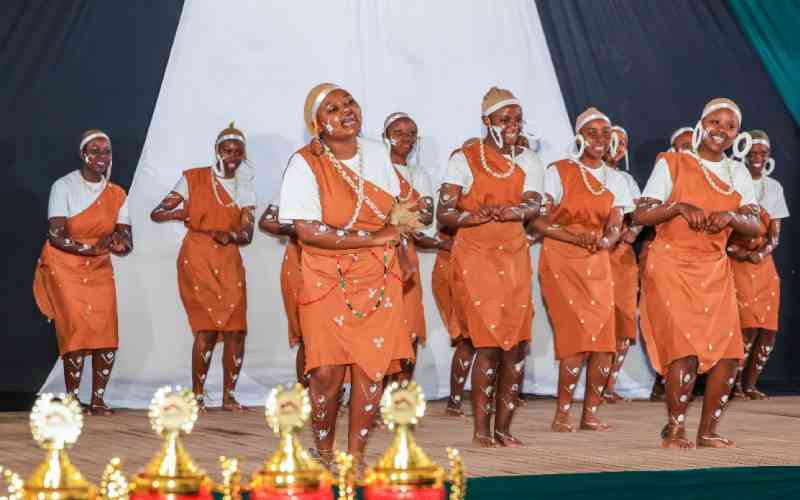
Students perform a Kikuyu folk dance during Kenya Music Festivals, Nairobi regional at Buru Buru Girls on July 1,2026. [Benard Orwongo, Standard]
Girls' schools once again stamped their authority at this year's Nairobi Region Kenya Music Festival.
Girls swept top honours in most competitive classes and reinforcing a trend that has seen female learners increasingly dominate one of the country's largest co-curricular programmes.
From contemporary gospel and indigenous folk music to patriotic compositions, theatre and cultural dances, girls' schools emerged as the biggest winners, even as education stakeholders expressed concern that boys are steadily withdrawing from the festival.
Karen C Girls was among the standout performers, winning every class it entered. The school clinched top honours in Pop Gospel, the Teachers Service Commission-sponsored class, the Central Bank set piece, patriotic song composition, arrangement of Zinazovuma, the girls' set piece and the mixed set piece performed jointly with Lenana School.
Apostolic Carmel Girls also impressed adjudicators after emerging winners in the Marakwet Dance and the Rest of Africa dance category, while Kariobangi North Girls Secondary School dominated cultural performances by winning the Pokot dance, Karaoke by Adwina, Pop Talent, Pokot folk song, Samburu folk song and Samburu dance, all earning qualification to the national festival.
State House Girls continued their rich tradition in cultural music by triumphing in the Kisii folk song, Keiyo folk dance and Maasai folk song categories.
Moi Girls Nairobi also enjoyed an exceptional outing, taking first position in the Zilizovuma class with a creative arrangement of Jana Usiku by Elani. The school finished second in the Pop Gospel category with its arrangement of Mbela by Rose Muhando and also excelled in the Karaoke class with Woman Is, a powerful piece from the musical Lempicka celebrating women's resilience and determination.
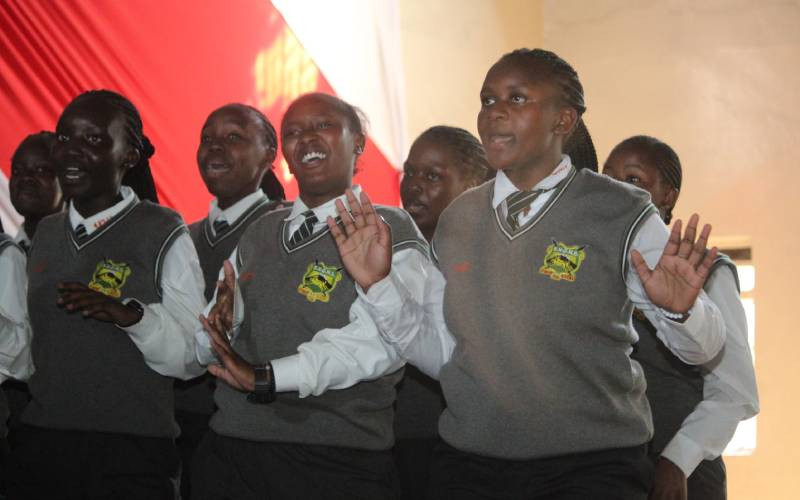
Other girls' schools that recorded strong performances included County Girls, Starehe Girls Centre, Pangani Girls and Our Lady of Mercy South B, which won both the Luhya-Bukusu folk song and Luhya folk dance categories. Ushirika Secondary School also qualified for the national festival after impressing judges with its Luhya sacred folk performance, Risuvira-Faith.
In theatre, Precious Blood Riruta defeated Ofafa Jericho High School to win the Kenya National Theatre class.
Among boys' schools, only a handful managed to break the dominance. Pumwani Boys High School emerged victorious in the Zilizopendwa category with live accompaniment ahead of Lenana School. The school also excelled in Recorder Ensemble, Woodwind Solo, Piano Solo and Piano Duet.
The impressive performances by girls mirror a growing national trend that has now attracted the attention of education policymakers.
Speaking during the Kenya Music Festival last year, Chairman Prof. Fredrick Ngala said participation statistics reveal a significant gender imbalance that requires urgent intervention to ensure boys are not left behind.
According to Prof. Ngala, more than 140,000 learners participated in last year's national festival, but only slightly over 45,000 were boys compared to more than 95,000 girls.
"The female students participating in this festival are slightly over 95,000. The male students participating in the festival have slightly over 45,000. Meaning, we have to take affirmative action to enable the boy child to participate in the festival," said Prof. Ngala.
Stay informed. Subscribe to our newsletter
He noted that girls now dominate the majority of the more than 600 competitive classes, prompting education stakeholders to explore strategies for increasing boys' participation through mentorship and talent development programmes.
The concern comes as the Kenya Music Festival continues to evolve into a key pillar of the Competency-Based Education (CBE), where co-curricular activities are regarded as essential in nurturing learners' talents alongside academic achievement.
Unlike in previous decades when the festival largely revolved around singing and traditional dance, learners now compete in innovation, entrepreneurship, environmental conservation, climate change, financial literacy, digital creativity, public speaking and cultural preservation.
Through music, dance, choral verse, narratives and elocution, learners are increasingly challenged to propose practical solutions to contemporary social and economic problems while developing communication, leadership, teamwork and critical-thinking skills.




Subscribe to our newsletter and stay updated on the latest developments and special offers!







 join
join