The Standard Group Plc is a
multi-media organization with investments in media platforms spanning newspaper
print operations, television, radio broadcasting, digital and online services. The
Standard Group is recognized as a leading multi-media house in Kenya with a key
influence in matters of national and international interest.
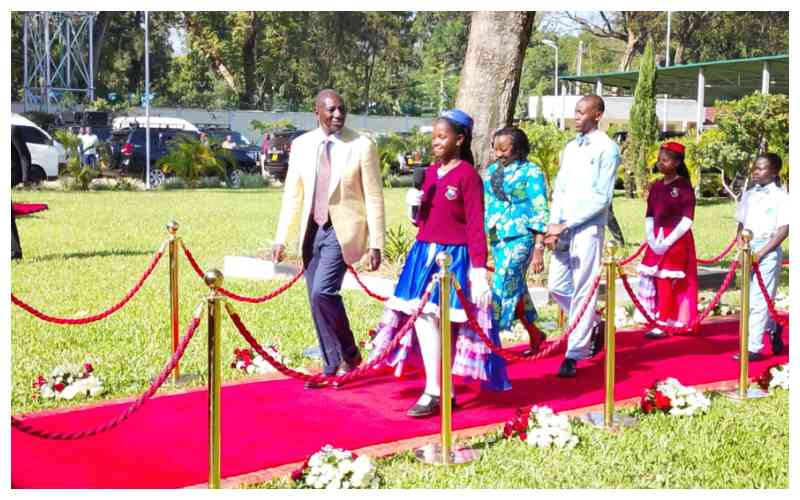
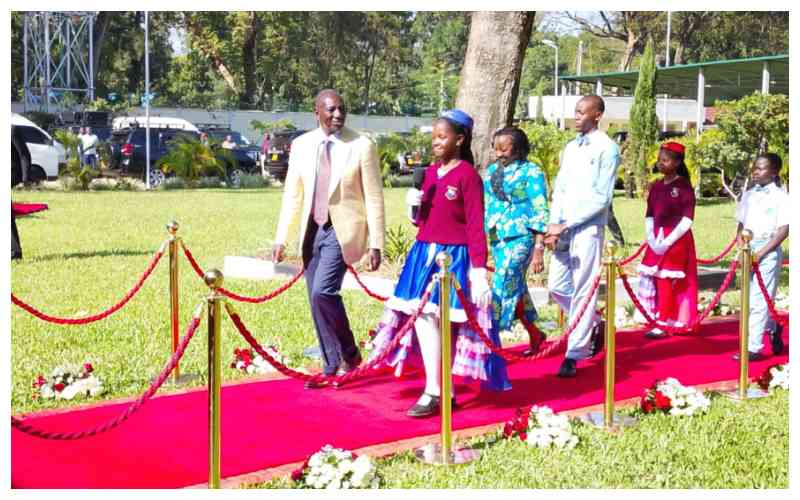
President William Ruto at Bungoma State Lounge [Standard Jacklie Inyanji, Bernard Lusigi]
The Bungoma State Lounge on Friday came alive with the thunder of drums, the gentle strumming of traditional instruments, rhythmic dances and a dazzling display of colourful traditional attire as learners from across Kenya took to the stage to tell the country’s story through music, dance, poetry and drama.
For a moment, the venue was transformed into a cultural crossroads.
From the shores of Lake Victoria to the hills of Central Kenya, from the coastal rhythms of the Digo community to the graceful movements of Indian classical dance, the young performers carried the audience on a journey across cultures, communities and generations.
President William Ruto, who interacted with some of the learners dressed in colourful traditional attire as he made his way to the Bungoma State Lounge, listened as they spoke passionately about the place of music, drama and other creative activities in their lives.
The learners said the activities bring people together and provide a platform for young people to discover, nurture and showcase their talents.
Their message appeared to strike a chord with the President, who said the Competency-Based Curriculum had given creative arts a new place in Kenya’s education system.
“With CBC, music is no longer an extracurricular activity but a national priority. Music festivals should be budgeted for,” Ruto said.
The President said Kenya must embrace the creative economy, describing it as an important space for the country’s future.
“Creative space is the future and no longer a luxury. I have a specific ministry to deal with talent and the future is very bright,” he said.
First Lady Rachel Ruto, herself watching the colourful celebration of talent and culture, reflected on the role of nurturing in raising the next generation.
“As a mother, one nurtures, and I see that in the work that I do. I am looking forward to zilizopendwa,” she said.
Oneno Comprehensive School opened the stage with a folk song, its performers setting the mood for what would become a spectacular celebration of Kenya’s diversity.
One performance after another painted a different cultural picture.
Kianda School brought a taste of Europe to Bungoma with a traditional French dance. With every synchronised step and carefully timed movement, the learners demonstrated remarkable accuracy and discipline, earning admiration from the audience as Western and Anglo-Saxon traditions found a place on the Kenyan stage.
Holy Innocent Tassia School followed with a Western-style singing game where voices, movement and play blended seamlessly. Beyond the entertainment, the performance carried a message of friendship, cooperation and teamwork.
But it was the modern world that took centre stage when Daksh Dabasiya of SCLP Samaj School presented “Omutandao.”
The thrilling performance spoke directly to the digital generation, warning learners and the wider community about the dangers of misusing the internet.
Through the performance, the young artists called for responsible and ethical use of technology while highlighting the consequences of reckless online behaviour.
From the digital world, the audience was transported to the Kenyan coast.
Mtwapa Elite Academy from Kilifi brought colour, rhythm and energy to the stage with African-style singing games traditionally performed by Digo children in the evening as they await their meals.
The performance was more than a game. It was a glimpse into a cultural practice where children sing, play and move together, strengthening social bonds while passing traditions from one generation to the next.
Marimanti Primary School then carried the audience to the slopes of Mount Kenya with a Kikuyu folk song, while Chepsigot Special School from Nandi stirred emotions with the poem “Tuwe Pamoja.”
Its message was simple but powerful: unity is strength.
Through the poem, the performers reminded the audience that togetherness and cooperation remain essential in overcoming challenges and building a successful nation.
Elwak School added the rich sounds of a Somali song to the cultural feast, while Makuyu Boys School presented another Kikuyu folk song.
Indian culture also had its moment under the bright lights.
Roohi Agarwal of Oshwal Academy Nairobi Primary delivered a graceful Bharatnatyam performance, “Aigiri Nandini,” with each carefully choreographed movement adding another shade to the already colourful cultural canvas.
Sigalagala National Polytechnic turned attention to the country’s economic journey through “Hongera Benki Kuu ya Kenya,” a performance celebrating the Central Bank of Kenya’s 60 years of existence and its role in stabilising the economy.
The celebration stretched beyond Kenya’s borders as Ugandan culture was represented through the use of various African musical instruments, reminding the audience of the shared rhythms and traditions that connect communities across the region.
Sabatia Teachers Kwaya performed “Nakubaliana na Neno Lako,” while St Charles Lwanga School showcased the beauty of the Gusii community through a folk song.
The University of Nairobi took to the stage with “Tujenge Kenya Yetu,” emphasising the role of the Public Service Commission in national development.
Sigot Senior School from Nandi also presented a folk song, while Elegance Spar School added the power of spoken word through poetry.
As the performances continued, the audience was taken to the shores of Lake Victoria through Christine Akoth of Ulalwe Apate Junior Secondary School in Siaya.
Her performance of a traditional Luo song featuring the nyatiti, an eight-stringed instrument played by plucking its strings, brought alive the sound of a musical tradition often heard during weddings and other community ceremonies.
The young performers were dancing to the rhythms of their ancestors while also speaking about the future a future where technology, creativity and culture can exist side by side.
And as President Ruto spoke of a future in which creative talent is treated as a national priority, the songs, dances and poems from the stage appeared to offer a vivid reminder that Kenya’s greatest cultural story may still be unfolding in the hands, voices and footsteps of its young people.
Premium Article
Get Full Access for Ksh299/Week.
Bold Reporting Takes Time, Courage and Investment. Stand With Us.
🔥 Flash Sale !
Subscribe now and enjoy 50% off annual plans. Offer ends in…

 The Standard Group Plc is a
multi-media organization with investments in media platforms spanning newspaper
print operations, television, radio broadcasting, digital and online services. The
Standard Group is recognized as a leading multi-media house in Kenya with a key
influence in matters of national and international interest.
The Standard Group Plc is a
multi-media organization with investments in media platforms spanning newspaper
print operations, television, radio broadcasting, digital and online services. The
Standard Group is recognized as a leading multi-media house in Kenya with a key
influence in matters of national and international interest.


 Prefer the Standard on Google






 join
join