×

The Standard e-Paper
Fearless, Trusted News
 The Standard Group Plc is a
multi-media organization with investments in media platforms spanning newspaper
print operations, television, radio broadcasting, digital and online services. The
Standard Group is recognized as a leading multi-media house in Kenya with a key
influence in matters of national and international interest.

Audio By Vocalize
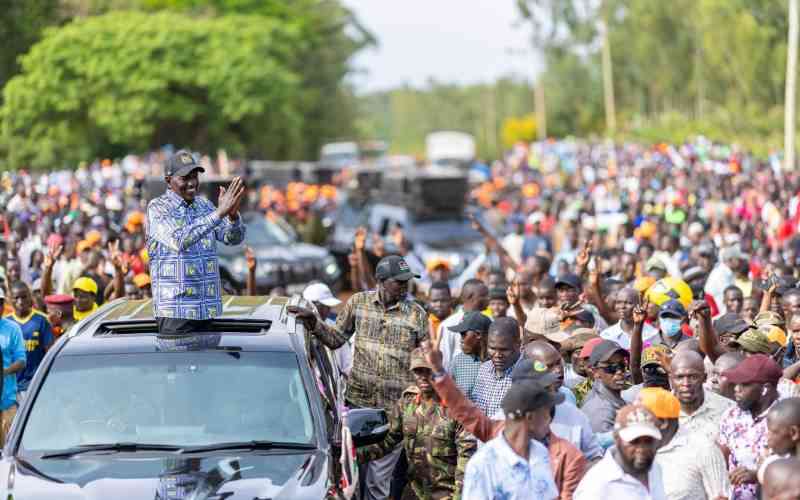
President William Ruto addresses residents after commissioning the Matungu-River Sio-Nasianda road in Matungu Constituency, Kakamega County. [PCS]
In the theatre of Kenya’s tragicomedy politics, President William Ruto is currently starring in a tragedy of his own casting, surrounded not by a loyal cabinet of counsel, but by a veritable court of leeches.
His gravest threats do not, of necessity, lurk across the aisle in the opposition benches; they ride comfortably in his own presidential motorcade, always in attendance at state banquets. Their stock-in-trade is a toxic cocktail of reckless rhetoric, blinding hubris, and wilful denial of prevailing reality. They are political opportunists in the purest sense—creatures who know, as surely as the sun rises in the East and sets in the West, that without Ruto’s coattails to cling to, their careers would wither on the vine.
To this entourage, the President is merely a means to a lucrative end. Should he triumph, they feast; should he stumble, they will have already surfed the crest of his wave to safety. With the campaign season looming and the presidential purse strings loosening, their true motives are laid bare. We have heard them mock Senator Edwin Sifuna for lacking deep pockets. Indeed, they possess money to burn—literally, if one judges by the rate at which campaign funds evaporate into their own pockets.
Their preoccupation is not with the ballot box per se, but with the bank vault. Every shilling disbursed for mobilisation seems to encounter a strange magnetic attraction to their sticky fingers. Even if the promised plum appointments never materialise, they will have siphoned enough from the campaign war chest to hibernate comfortably for five years, until another fleece-able host appears for them to latch onto.
Amidst this sea of sycophants stands perhaps a solitary exception: Farouk Kibet. Whatever one’s political persuasion, Kibet’s devotion appears unalloyed by the lust for public office. Forged over decades, his loyalty is neither transactional nor transient. While Ruto’s chief lieutenants seem eager, as Sifuna aptly observed, to sleep longer rather than preach the gospel longer, Kibet has been crisscrossing the republic, hawking the UDA brand with an evangelist’s zeal that puts career politicians to shame.
Contrast that grit with the hideous display by the Central Organisation of Trade Unions Secretary-General Francis Atwoli’s recent foray into amateur economics. Attempting to whitewash the punitive cost of fuel in Kenya, Atwoli spun a tall tale of biblical proportions, swearing before the President that petrol in Egypt retails at an astronomical Ksh 1,018 per litre.
A five-second consult with Google would have spared him the embarrassment, revealing that Egyptian motorists actually pay between Ksh 50 and Ksh 58—a fraction of what Kenyans endure. One must ask; does Atwoli take the citizenry for absolute fools? Rather than soothing public anger, such barefaced fabrication only widens the chasm of distrust between the governed and those who govern. In an era where ordinary citizens dissect every policy with surgical precision, insulting their intelligence is political arson.
The tragedy is that those closest to the throne refuse to speak truth to power, opting instead for flattery that leaves the President strategically blind. As it were, the man walking behind you is best placed to warn you that the seat of your trousers is soiled. If he chooses to pretend otherwise and stay silent, you will stride into a crowded room brimming with confidence, only to become the laughingstock of the assembly.
History is littered with rulers undone by minders obsessed with what proximity to power accorded them. Consider France’s Louis XVI, insulated at the Versailles palace by fawning courtiers who mistook gilded luxury for genuine loyalty until the guillotine fell; or Rome’s emperors, undone by Praetorian guards who praised them in public while auctioning the empire behind their backs. Even closer to home, the fall of Mobutu Sese Seko serves as a sobering cautionary tale of a leader blinded by praise-singers until his regime collapsed from within.
Ultimately, leadership requires mirrors, not magnifying glasses for one’s ego. Until President Ruto swaps his choir of dishonest praise-singers for candid truth-tellers, he risks marching boldly into political peril, blissfully unaware of the stain behind him—while his entourage quietly counts the silver.
Subscribe to our newsletter and stay updated on the latest developments and special offers!


 Prefer the Standard on Google