×

The Standard e-Paper
Smart Minds Choose Us
 The Standard Group Plc is a
multi-media organization with investments in media platforms spanning newspaper
print operations, television, radio broadcasting, digital and online services. The
Standard Group is recognized as a leading multi-media house in Kenya with a key
influence in matters of national and international interest.
The Standard Group Plc is a
multi-media organization with investments in media platforms spanning newspaper
print operations, television, radio broadcasting, digital and online services. The
Standard Group is recognized as a leading multi-media house in Kenya with a key
influence in matters of national and international interest.

Audio By Vocalize
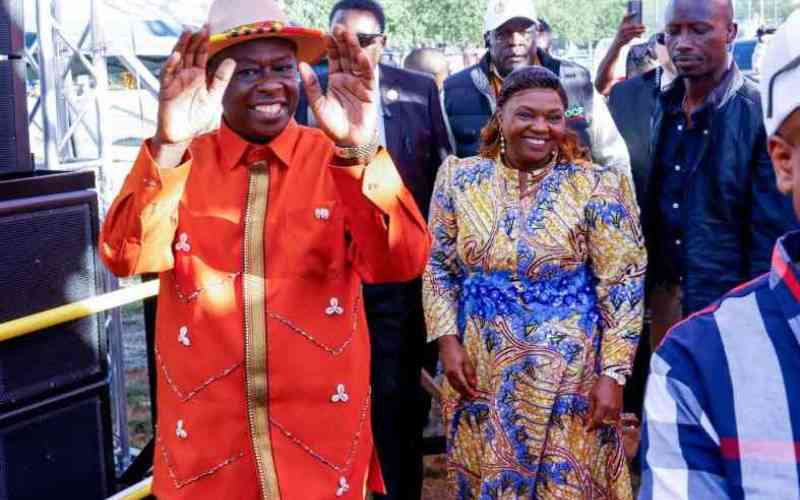
My attention has been drawn to Rigathi Gachagua the man, the political idea, and the political force he is becoming. I have been watching his activities in America, and I cannot help but see a deliberate political calculation in his extended stay there. In my view, Gachagua has managed to shift the centre of political attention from Kenya to America. That is significant. A politician who can remain thousands of kilometres away and still dominate political discussion at home is a politician whose movements cannot be ignored.
My first observation is image. Gachagua is polishing his political image and internationalising his profile. He is presenting himself as a politician capable of engaging influential people beyond Kenya and operating in circles that matter to international policy and diplomacy. Whether those engagements eventually translate into electoral advantage is a different question, but the image he is building is unmistakable. He wants to appear presidential, internationally acceptable and capable of engaging people who influence policy and political thinking in the United States.
The second issue is capacity. Gachagua appears to be projecting himself as a politician with the networks, resources and organisational ability required to mount a presidential campaign. Politics is not only about what a politician says; it is also about the perception of what that politician can do. In my assessment, Gachagua is creating a perception that he is ahead of some of his competitors in political organisation, resources, networks and public image.
We have seen this kind of positioning before. Raila Odinga was, at different stages of Kenya’s political history, the first among equals in opposition politics. Mwai Kibaki occupied a similar position in 2002. When Raila said “Kibaki Tosha”, he was effectively placing Kibaki above the other contenders in the emerging opposition equation. I see Gachagua attempting to create a similar political distance between himself and some of the other players.
Whenever Gachagua is away, I observe what appears to be a reduction in the intensity of the Opposition conversation. That raises a fundamental question: What happens to the Opposition when Gachagua is not in Kenya? To me, his continued ability to command attention from abroad strengthens the argument that he has become one of the central figures in the Opposition.
The Opposition field remains fluid, but I see a political equation emerging around Ediwn Sifuna and Gachagua. If these two eventually become the dominant players, each will have to calculate how to strengthen his position while preventing the other from gaining the upper hand. That is not unusual in politics. It is the natural consequence of a field becoming narrower.
I am reminded of the story in ‘The world in my pocket’, where members of a group initially plan to share their spoils. Then one of them starts calculating how much more everyone would get if some of the others were removed. Eventually, only two remain, and the calculation becomes even more direct: If one eliminates the other, everything belongs to the survivor.
That is how political competition can evolve. When the field narrows, the calculations become sharper. And those who appear to have been eliminated do not necessarily disappear. They can return as allies, negotiators or opponents of those who pushed them aside.
That is why I am watching the Gachagua-Sifuna equation carefully. If they become the two dominant poles of the Opposition, politicians such as Kalonzo Musyoka and Fred Matiang’i will have to decide how to respond to that emerging reality. They may negotiate, reposition themselves, or seek new alliances. In politics, nothing remains permanent.
Gachagua has argued that the Opposition should delay the selection of its presidential flag-bearer until next year. Some of us have questioned that strategy. My concern is that the longer the decision is delayed, the greater the influence Gachagua can potentially exercise over the eventual choice.
Once other politicians understand the calculation, they will not simply sit and wait. They will develop counter-strategies. Those who believe they are being disadvantaged by the delay will begin looking for ways to disrupt the strategy. That, in my assessment, is when the real 2027 game begins.
Ruto remains the incumbent President and an experienced political operator. My argument is not that he is invincible. It is that political dissatisfaction does not automatically translate into an electoral victory. History teaches us that even vulnerable incumbents can survive when challengers fail to organise effectively.
Look at Kenya in 2002. The Opposition wave was enormous, but Kibaki did not secure the overwhelming percentage some people had expected. The lesson is simple: Public sentiment must be converted into organisation, resources, messaging and a candidate with sufficient time to build a national campaign.
You cannot wait until April or May of an election year, unveil a candidate and expect that candidate to defeat an incumbent who has spent years building political structures. Presidential elections are won through preparation, organisation and sustained campaigning.
I also caution politicians against trusting promises without evidence. I have interacted with politicians and shared ideas with some of them privately. Kalonzo, for example, will remember some of the things I told him over breakfast. I will not repeat those conversations here. But the principle is simple: In politics, a promise remains a promise until it is converted into action. That is the environment in which Gachagua, Sifuna, Kalonzo, Matiang’i, and the other players are preparing for 2027.
Stay informed. Subscribe to our newsletter
Subscribe to our newsletter and stay updated on the latest developments and special offers!


 Prefer the Standard on Google





 join
join