×

The Standard e-Paper
Stay Informed, Even Offline
 The Standard Group Plc is a
multi-media organization with investments in media platforms spanning newspaper
print operations, television, radio broadcasting, digital and online services. The
Standard Group is recognized as a leading multi-media house in Kenya with a key
influence in matters of national and international interest.
The Standard Group Plc is a
multi-media organization with investments in media platforms spanning newspaper
print operations, television, radio broadcasting, digital and online services. The
Standard Group is recognized as a leading multi-media house in Kenya with a key
influence in matters of national and international interest.

Audio By Vocalize
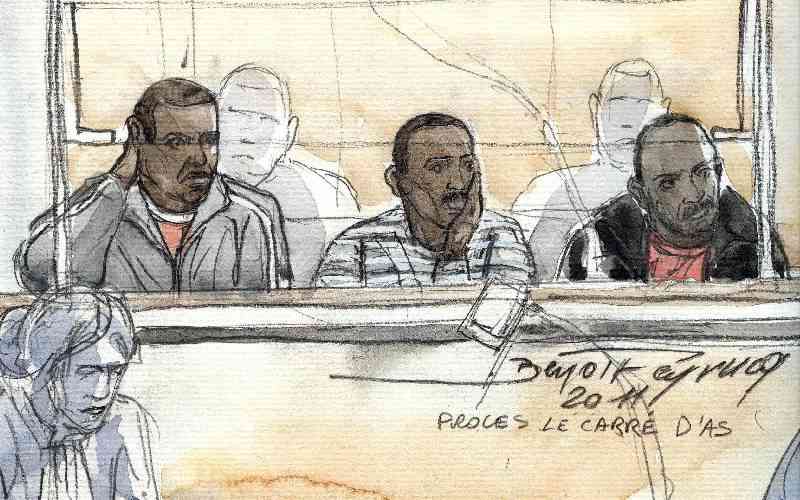
A court sketch made on November 16, 2011 at Paris courthouse during their trial, shows three of six alleged Somali pirates accused of taking a French couple hostage on their yacht off the coast of Somalia in 2008. [AFP]
Somali pirates used a previously hijacked ship to seize their latest target, security officials said, while their families told AFP they were partly driven by the impact of illegal fishing trawlers.
A new group of pirates from the semi-autonomous Puntland region have led a resurgence of attacks on shipping since April after more than a decade in which the issue was contained by heightened international security measures.
On Monday, the Cameroon-flagged cargo ship, Lutuf, was hijacked by eight gunmen, who launched the attack from a ship they seized in April, the MV Sward, Puntland security officials told AFP.
There were already four merchant vessels held hostage in Somali waters and the pirates used the Sward to hijack two Iranian fishing boats last month that were released after ransoms were paid.
It's a tactic that was used often during the height of Somali piracy in the late 2000s and early 2010s.
The security officials expressed surprise that the Lutuf had travelled within three nautical miles of the Somali coast given the spate of attacks.
They also said the pirates were able to board before its armed guards could shoot.
"No one fired back," one said.
The hostages include six Indians, a Georgian and a Turk, and the ship was heading for Dar es Salaam in Tanzania when it was captured.
Turkish military helicopters circled the hijacked ship later on Monday but did not attempt to board.
Turkey is a key military backer to Somalia and has naval assets in the region, though its presence has often been criticised by Puntland, whose government is at odds with the federal authorities in Mogadishu.
'Difficult circumstances'
The hijackers hail from the Mudug region of Somalia, in particular the port town of Garacad, and are well-known among the local community, according to the Puntland security officials.
Many are angry over illegal foreign trawlers that they say have decimated the fishing industry on which many depend.
Stay informed. Subscribe to our newsletter
A clan elder, and uncle of one of the hijackers, told AFP by phone that the issue was driving the pirate attacks.
"I'm not in favour of what my nephew is doing... it is wrong," he said.
"I can't bring myself to support such actions, but then again his way of life (as a fisherman) no longer exists, so it's these difficult circumstances that force him to do attacks at sea."
The cousin of another hijacker told AFP he did not support violence but said they were responding to the collapse in the fishing industry.
"When someone has their only form of livelihood threatened, some will do things that might be criminal.
"We have known each other since we were young boys... I don't support his actions but I know nobody wakes up one day and says they're going to get a gun and risk their lives at sea," he said.
Subscribe to our newsletter and stay updated on the latest developments and special offers!


 Prefer the Standard on Google