×
App Icon
The Standard e-Paper
Home To Bold Columnists
★★★★ - on Play Store
Download Now

Agronomist's push to grow herb exports to the EU

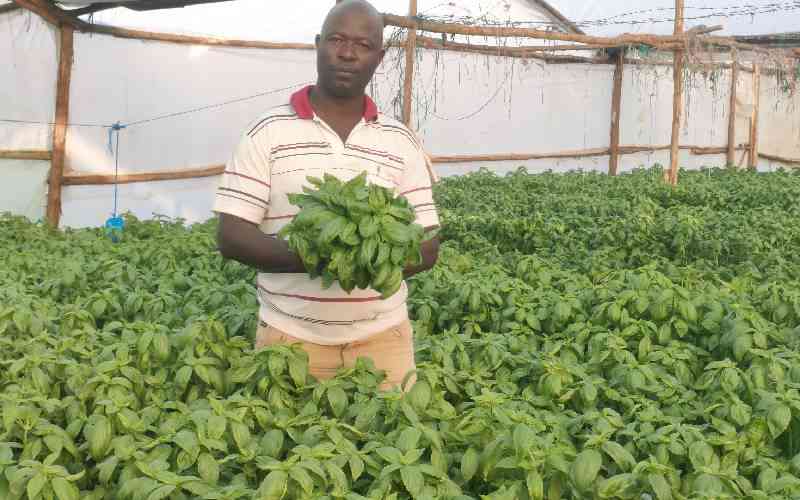
Bramwel Mulama in his basil farm located Mutalia area in Machakos County. [Nanjinia Wamuswa, Standard]

In 2018, Bramwel Mulama left his position as an associate researcher at the International Centre of Insect Physiology and Ecology (Icipe) to focus fully on his own farming ventures and offer agronomy services to other farmers.

During his five-year tenure at Icipe, Mulama managed his farms remotely while also supporting fellow farmers. The networks he built during this period later proved invaluable when he went into private farming.

“While at Icipe, I travelled across the world, working in agriculture, setting up greenhouses, conducting research and analysing data. This exposure broadened my network and ultimately became the backbone of my agronomy consultancy,” he says.


Today, Mulama manages tens of farmers. He exports herbs and oversees greenhouse operations across the country, including in Machakos, Kajiado, Taita Taveta and Nyeri.

He says that what began as a simple interest in sustainable farming has grown into a multinational network, a thriving consultancy and a rapidly expanding herb-export business to European markets.

Mulama’s journey began in 2008, when he enrolled for a diploma in agriculture at the Kenya Institute of Organic Agriculture, before later pursuing Environmental Sciences at the then Kenya Polytechnic, now the Technical University of Kenya (TUK).

He reflects: “I never imagined I would grow to where I am today, although I always had big dreams in agriculture.”

Mulama’s career officially began in 2011 when he joined a project on African Indigenous Vegetables sponsored by the National Council of Science and Technology.

He worked under Prof Mary Abukutsa across the former Western Province, where he sharpened his technical and research skills before moving to Dominion Farms in Siaya as an agronomist.

In his own farming initiative, Mulama began with French beans before diversifying into chillies and sweetcorn.

At one point, he contracted more than 100 farmers in Machakos, Mwea, Murang’a and Kajiado to grow chillies. To ensure high-quality produce, he travelled extensively, guiding farmers through nursery establishment, transplanting, crop management, harvesting and post-harvest handling, before aggregating and exporting their produce.

He also managed his own 20-acre chilli farm in Emali.

In 2022, Mulama shifted his focus to herbs, starting with basil in Ngoliba. However, transport quickly became a major challenge, as exporting required refrigerated trucks, and the three-hour distance to the airport significantly increased his costs.

To minimise costs that were eating into his profits, he relocated his operations to farms closer to the airport. That is how he began producing basil in the Mutalia area along Kangundo Road in Machakos County, where he now grows the crop in 16 greenhouses as well as in the open field.

He also co-owns 34 greenhouses with a business partner in Isinya, Kajiado County.

“From Mutalia, a truck takes less than 30 minutes to reach the airport. That efficiency in transport means everything in export farming,” he says.

A visit to his Mutalia farms, where he currently harvests about 2.5 tonnes of basil per week, we found him readying for harvesting.

Since it was a Saturday evening, Mulama explained that he was expecting a team of about 20 casual women workers to begin harvesting basil at around 7pm, working throughout the night.

Harvesting is done at night. “Basil harvesting requires precision. We pick at night when temperatures are low to prevent wilting.

The herbs are so delicate that even slight wilting leads to rejection in the export market,” he explained.

As they harvest, another team immediately begins grading, packaging and strapping before loading basil onto a refrigerated truck waiting on-site for precooling. This ensures the herbs remain fresh.

He says quality seedlings are the foundation of quality produce. He propagates his own seedlings, a process that takes about 21 days, and once transplanted, basil requires at least another 20 days to reach the first harvest.

With proper agronomic care, Mulama says a farm can achieve up to 20 harvests, with harvesting done once every week.

He advises that, to give basil a strong start, the soil should be mixed with plenty of organic matter before transplanting the seedlings.

As he continues expanding his herb enterprise, Mulama’s immediate plan is to build a cold room where basil and other herbs can be stored for several days without losing freshness as they await market distribution.

His greatest asset in farming is his agronomy expertise. Years of hands-on work, research and networking, combined with visits to global agricultural expos such as those in the Netherlands, have made him well attuned to the European market cycle.

Demand for herbs soars from September to May, during Europe’s winter and spring, then dips during the summer months when European farmers resume production. Kenya, with its tropical climate, remains a key supplier.

 “During low seasons, my export orders drop from six tonnes to two tonnes. At such times, I shift production to high-demand local crops such as cucumbers and sweet corn,” he says, adding, “You must always adjust. In this industry, you learn what performs well at what time, and you keep changing.”

He says the export markets prefer the Sweet Aroma 2 variety.

Mulama advises that proper plant population, ventilation and pest control, especially for spider mites, are essential. Strict hygiene and irrigation systems also determine success.

Over the years, he has relied on agents to export his produce, with basil prices ranging between Sh300 and Sh450 per kilo.

Since leaving formal employment, Mulama says farming has been his full-time job. “I earn enough. I don’t think I need a job elsewhere. No one can afford me now,” he says.

He reveals plans to begin exporting independently.

But, before that, he plans to expand and start producing at least six tonnes of basil weekly, plus other herbs such as rosemary, winter thyme, oregano, chives, sage and lemongrass that will enable him to meet direct export volumes without relying on intermediaries. Mulama has been careful to observe strict pesticide residue standards to minimise losses.

With his planned expansion and focus on self-managed logistics, he boasts of being on the way to becoming one of Kenya’s leading herb producers and exporters.