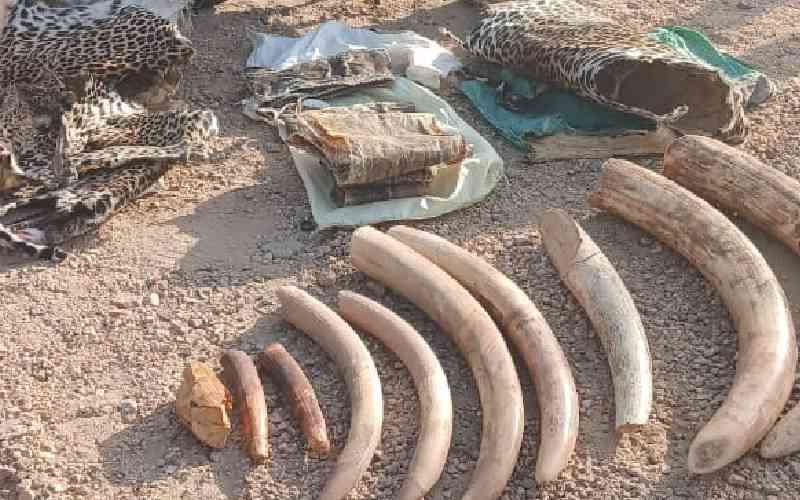
KWS officers seize 10 pieces of elephant tusks, three leopard skins, and three python skins during an operation on wildlife trafficking in Lokichar, Turkana County, on January 28, 2026. [Bakari Ang'ela, Standard]
Kenya Wildlife Service (KWS) officers have arrested three suspects and seized ten elephant tusks, three leopard skins, and three python skins during an operation in Lokichar targeting regional trafficking networks.
KWS Turkana County Warden Elijah Chege said the suspects were transporting the wildlife products on a motorbike with no registration plates when they were nabbed by the officers.
“Today, 28/01/2026, our team successfully arrested three suspects in possession of ten pieces of elephant tusks, three leopard skins, and three python skins during an operation at Lokichar,” Chege said.
He said the suspects are in custody as investigations continue to trace the wider criminal network.
Wildlife trafficking remains a major threat to endangered species such as elephants and leopards, whose populations are under severe pressure from poaching driven by high local and international demand for ivory, animal skins, and other wildlife products.
“Wildlife trafficking not only threatens the survival of elephants, leopards, and pythons but also undermines community security and conservation efforts,” Chege said.
“These crimes are often linked to organised criminal networks that exploit remote areas and vulnerable communities to move illegal wildlife products across borders,” he added.
Preliminary investigations indicate that the suspects may be part of a regional network operating in northern Kenya and neighboring countries.
Turkana’s vast terrain and proximity to international borders make it a strategic corridor for illegal wildlife trade, connecting poaching zones to export routes targeting East African and global markets.
Authorities explained that elephant tusks fetch high prices on the black market, leopard skins are trafficked for cultural regalia or illegal export, and python skins are used in the fashion industry for bags, shoes, and accessories. The lucrative trade has fueled organised poaching syndicates in remote counties, including Turkana.
“The suspects are currently in custody and will be processed according to the law as investigations continue to trace the wider network behind the illegal trade,” Chege said.
“We are determined to dismantle these networks and ensure that those involved are held accountable,” he added.
Under the Wildlife Conservation and Management Act, offenders face life imprisonment, fines of up to Sh20 million, or both. KWS said that the penalties serve as a deterrent to would-be traffickers and poachers.
Stay informed. Subscribe to our newsletter
The Lokichar operation is part of a broader crackdown in Turkana, which has seen increased intelligence-led surveillance, patrols, and community engagement.
Authorities said that close collaboration with local communities has been key to preventing poaching and intercepting trafficked wildlife.
“This operation was made possible through collaboration with local communities and other security agencies,” Chege said.
“Public vigilance plays a critical role in protecting wildlife, and we urge residents to report suspicious activities immediately,” he added.
Conservation experts warn that unchecked poaching disrupts ecosystems, reduces tourism revenue, and undermines community development, particularly in counties like Turkana where tourism can boost local economies.
KWS has stepped up enforcement along known trafficking routes, deploying officers to patrol remote areas, and coordinating with other agencies to monitor cross-border activity.
Community leaders praised the arrest of the suspects.
James Lokai, a Turkana elder, said: “This arrest is a step in the right direction. But if poaching continues, in the days ahead we will not have the Big Five, and our children will only read about them in books, like dinosaurs that no longer exist.”
“If we don’t act now, the wildlife that surrounds us will vanish. Our generation will be left reading history while elephants and leopards disappear from our land,” said Mary Kerio, a local teacher.
KWS warned that the operations in Turkana will continue, focusing on intelligence-led interventions, inter-agency collaboration, and public awareness campaigns.
“Protecting our wildlife heritage is a shared responsibility,” Chege said.
“Together with communities, law enforcement, and partner agencies, we can ensure future generations inherit a safe and thriving environment, free from poaching and trafficking,” he added.
The seized tusks, leopard skins, and python skins have been secured as evidence and will be presented in court after forensic analysis.
Authorities noted that wildlife trafficking often intersects with other criminal activities, including arms smuggling, human trafficking, and cross-border organized crime.
By targeting these networks, KWS aims to protect wildlife while strengthening security and rule of law in vulnerable counties.
The Lokichar operation underscores the importance of coordinated, sustained efforts to protect endangered species.
With strict legal penalties, enhanced enforcement, and public cooperation, authorities say Kenya’s wildlife can be safeguarded for generations.